| What This Guide Covers
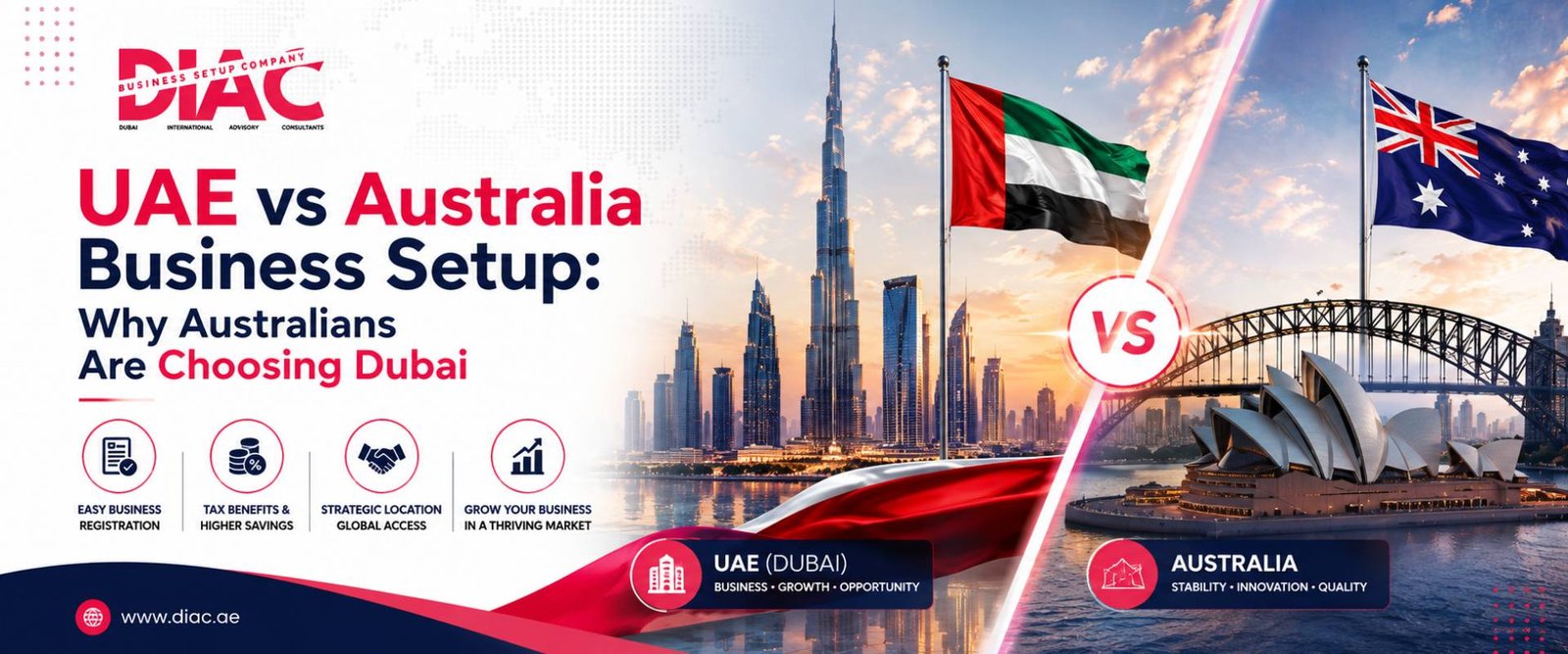
Australian entrepreneurs are moving to Dubai at a growing rate, drawn by 0% personal income tax versus Australia’s 45% top rate, faster company formation, and access to GCC and Asian markets. This guide compares both countries across every factor that matters for business founders: tax, company structure, banking, cost of living, visa options, and the dual structure many Australians use to keep both bases. |
Australia is one of the world’s most liveable countries and one of its most expensive places to run a high-income business. Its tax system extracts up to 45 cents in every dollar of personal income, its company tax rate sits at 25 to 30 percent depending on turnover, and its capital gains tax is a significant consideration for founders planning an exit. For Australian entrepreneurs whose business operates internationally or digitally, the question is no longer unusual: is there a better place to base this?
Dubai has become a serious answer to that question for a growing cohort of Australian founders. The combination of 0% personal income tax, 9% corporate tax with significant free zone exemptions, fast company formation, and a genuinely high standard of living has moved the UAE from a curiosity to a practical business decision for many Australians. This guide compares both jurisdictions honestly, covers the specific considerations relevant to Australian founders, and explains the structures that work best for businesses with Australian operations or clients.
Full overview of UAE company formation options at our UAE business setup. For the India vs Dubai comparison that follows a similar structure, see our Dubai vs India business setup guide.
Tax: The Core Reason Australian Founders Look at Dubai
Tax is almost always the first topic when an Australian founder starts researching Dubai, and the numbers are stark enough to explain why the conversation happens at all.
Australian Tax Rates
Australia operates a progressive personal income tax system with a top marginal rate of 45% on income above AUD 180,001, plus the 2% Medicare levy, taking the effective top rate to 47%. Company tax is 25% for businesses with turnover below AUD 50 million (the base rate for small and medium businesses) and 30% for larger companies. Capital gains tax applies at the personal marginal rate with a 50% discount for assets held over 12 months, meaning an Australian founder who sells a business may pay up to 23.5% CGT. Dividend imputation (franking credits) partially offsets double taxation at the company level, but remains a complex compliance area.
Australia also levies:
- Goods and Services Tax (GST) at 10% on most supplies
- Payroll tax at the state level, ranging from 4.75% to 6.85% on wages above a threshold
- Land tax and stamp duty on property transactions
- Fringe benefits tax (FBT) at 47% on certain non-cash employee benefits
UAE Tax Rates
The UAE introduced federal corporate tax of 9% effective June 2023, applying to profits above AED 375,000 (approximately AUD 155,000). Below this threshold, the rate is 0%. Free zone entities meeting the Qualifying Free Zone Person (QFZP) criteria pay 0% on qualifying income. There is no personal income tax in the UAE, no capital gains tax on most asset classes, no withholding tax on dividends, and no inheritance tax. VAT applies at a flat 5% on most goods and services. Our UAE corporate tax guide covers the QFZP exemptions and filing requirements in full.
| Tax Category | Australia | UAE | Practical Difference |
| Personal income tax | Up to 47% (incl. Medicare) | 0% | The most significant single factor for high-income founders |
| Corporate tax | 25% to 30% | 9% (above AED 375k); 0% for QFZP free zones | UAE CT lower; free zone exemption available |
| Capital gains tax | Up to 23.5% (after 50% discount) | 0% on most asset classes | Exit planning: significant advantage for UAE |
| Dividend tax | Up to 47% on unfranked dividends | 0% | UAE distributions are tax-free to shareholders |
| GST / VAT | 10% | 5% | UAE VAT is half the Australian GST rate |
| Payroll tax | 4.75% to 6.85% (state level) | None | UAE has no payroll tax |
| Inheritance tax | None (but CGT on death in some states) | None | Both similar |
| The tax residency question: Relocating to Dubai and establishing a UAE tax residency requires spending at least 183 days per year outside Australia in most cases. The Australia-UAE Double Tax Agreement is limited: Australia does not currently have a comprehensive DTA with the UAE, which means Australian-sourced income may still attract Australian tax even for UAE residents. This is a nuanced area that requires advice from an Australian tax specialist familiar with UAE structures before any residency change is made. |
Company Formation: Australia Pty Ltd vs UAE Free Zone vs Mainland
The mechanics of setting up a company differ significantly between Australia and the UAE, and for Australian founders the comparison reveals some clear structural advantages in the UAE for internationally oriented businesses.
Australian Proprietary Limited Company (Pty Ltd)
Setting up an Australian Pty Ltd through ASIC (Australian Securities and Investments Commission) is straightforward: the process is primarily online and can be completed in one to two days for a standard company with no unusual features. Annual ASIC fees are modest (currently AUD 310 per year for a standard proprietary company). However, the regulatory and tax compliance burden once the company is operating is substantial: annual financial statements, ATO (Australian Tax Office) lodgements, BAS (Business Activity Statements) quarterly, PAYG withholding, and superannuation obligations for any employees.
UAE Free Zone Company
UAE free zone formation for an Australian founder typically takes one to five working days for most major free zones. Cost from the equivalent of AUD 5,000 to AUD 25,000 per year depending on the zone and office type. Key advantages for Australians: 100% foreign ownership (an Australian founder needs no UAE partner), zero personal income tax on distributions, no superannuation obligations on UAE-employed staff, and the ability to invoice global clients in USD, EUR, or AED without Australian RBA restrictions. Full free zone comparison at our business setup in Dubai free zone guide.
| Factor | Australian Pty Ltd | UAE Free Zone | UAE Mainland |
| Formation time | 1 to 2 days (ASIC online) | 1 to 5 working days | 5 to 15 working days |
| Annual compliance cost | AUD 310 ASIC fee + substantial tax compliance | AED 12,000 to 50,000+ license | AED 10,000 to 25,000+ license |
| Foreign ownership | 100% always | 100% always | 100% most activities (post-2021) |
| Tax on company profit | 25% to 30% | 0% to 9% (QFZP eligible) | 9% above AED 375,000 |
| Capital controls | None (AUD is freely convertible) | None (full capital account freedom) | None |
| Superannuation obligation | 11% of employee salary (mandatory) | No equivalent | No equivalent |
| GST/VAT registration | Mandatory above AUD 75,000 turnover | 5% VAT (threshold AED 375,000) | 5% VAT same |
| Market access | Full Australian domestic market | UAE market; global; no Australian domestic | Full UAE market |
Banking: Australian Business Accounts vs UAE Corporate Accounts
Banking is one of the areas where Australian founders consistently report both frustration with the UAE process and relief once it is resolved. Here is the honest picture.
Australian Business Banking
Opening a business bank account for an Australian Pty Ltd is straightforward: visit a branch, provide company documents, and typically have an account active within one to three working days. Australian banks are familiar with domestic business structures and the compliance requirements are well-understood. International payments are unrestricted, though the AUD exchange rate and transfer fees are considerations for businesses with significant non-AUD revenue.
UAE Corporate Banking
UAE corporate bank account opening for a new company takes four to eight weeks on average and involves a detailed KYC (Know Your Customer) review that is more rigorous than most Australian founders expect. All major UAE banks require a valid trade license, business plan or activity description, source-of-funds documentation, and often evidence of existing business activity or client contracts. For Australian-founded UAE entities, the process is standard but requires planning. Wio Bank (UAE’s first fully digital business bank) is consistently the fastest option, often processing accounts in under two weeks. Our UAE business setup includes guidance on which banks are most accessible for specific business types.
Practical Banking Advice for Australians Moving to UAE
- Maintain your Australian business and personal banking during the UAE transition period: a sudden closure of Australian accounts raises AML flags on both sides
- UAE multi-currency accounts (USD, EUR, AED, AUD) are available from major banks including Emirates NBD and FAB and allow seamless handling of Australian client payments
- Wise Business: Many Australian founders in Dubai use Wise Business for AUD-denominated client invoicing while their UAE bank account is being processed, reducing the transition cash flow gap
- Australian founders with a UAE trade license and UAE residence visa are treated as international customers by Australian banks, which affects home loan eligibility and some account types
Lifestyle and Cost of Living: Sydney and Melbourne vs Dubai
Quality of life for Australian founders in Dubai is one of the most common questions, and the honest answer is that Dubai is genuinely excellent at some things that Sydney and Melbourne charge premium prices for, and genuinely worse at others that Australians take for granted.
| Factor | Sydney / Melbourne | Dubai | Notes |
| Climate | Temperate; 4 seasons | Hot; 2 seasons (cool Oct-May; hot Jun-Sep) | Winter in Dubai is genuinely lovely; summer is brutal indoors-only |
| Average apartment rent (2BR city) | AUD 40,000 to 70,000/yr | AED 90,000 to 180,000/yr (AUD 37,000 to 74,000) | Comparable for equivalent quality; Dubai Marina vs CBD |
| School fees (international) | AUD 20,000 to 50,000/yr | AED 40,000 to 120,000/yr (AUD 16,000 to 49,000) | Australian curriculum schools available in Dubai |
| Healthcare (private insurance) | AUD 4,000 to 12,000/yr | AED 5,000 to 15,000/yr (AUD 2,000 to 6,000) | UAE employer-mandated health insurance; lower cost |
| Eating out (restaurant meal) | AUD 25 to 80 | AED 40 to 200 (AUD 16 to 82) | Comparable; Dubai has strong value at mid-range |
| Personal income tax on AUD 300k income | AUD 115,000+ | AED 0 | The defining financial difference for high earners |
| Property ownership | Freehold; full rights | Selected freehold zones for foreigners | UAE property ownership is restricted to designated areas |
| Nature and outdoors | World-class; beaches; national parks | Limited; desert; manufactured recreation | A significant lifestyle trade-off for outdoors-oriented Australians |
The Dual Structure: UAE Company and Australian Operations
The most commercially sophisticated approach for many Australian founders is not a binary choice between Australia and Dubai. It is a considered dual structure that uses each jurisdiction for what it does best.
The most common Australian-to-Dubai founder structure:
- UAE free zone company (primary entity): Holds the business’s international client contracts, generates and accumulates revenue in a 0% or 9% tax environment, and sponsors the founder’s UAE residence visa
- Australian Pty Ltd (subsidiary or service entity): Employs any Australian-based team members, holds Australian intellectual property that has an Australian market, and handles Australian domestic clients where an Australian entity is preferred or required
- Inter-company service agreement: The UAE entity pays a service fee to the Australian entity for services rendered by the Australian team, keeping Australian profits at a level proportional to the actual Australian operational footprint
- Founder residency: Founder holds UAE residence visa and spends the required days outside Australia to achieve non-resident status for Australian tax purposes
| Critical compliance note: Australian tax law has specific rules around foreign company control by Australian residents, foreign income attribution, and controlled foreign companies (CFCs). A UAE company controlled by an Australian tax resident may have its income attributed back to Australia under Australia’s CFC rules, negating the tax benefit entirely. Proper tax residency establishment and the correct inter-company structure are essential. Always work with an Australian tax advisor and a UAE tax advisor who understand both systems before implementing this structure. |
UAE Visa Options for Australian Nationals
Australians are among the nationalities that receive the smoothest UAE visa experience: Australian passport holders receive visa-on-arrival for up to 90 days in the UAE, and the UAE residency visa pathway for business owners is well-established. For formal residency options, see the UAE ICP visa portal for current requirements.
| Visa Type | Requirement | Duration | Best For |
| Investor / Partner Visa | Hold shares in a UAE company | 3 years, renewable | Company founders and shareholders |
| UAE Green Visa | Qualifying investment or skilled professional | 5 years, renewable | Founders wanting long-term stability without employer sponsorship |
| UAE Golden Visa | AED 2M+ property or qualifying investment/talent | 10 years, renewable | High net worth Australians with UAE property or exceptional talent |
| Employment Visa | Employment contract with UAE entity | 2 to 3 years | Founders taking salary from their own UAE company |
| Tourist/Visit Visa (on arrival) | Australian passport | 90 days | Initial reconnaissance and business meetings before committing |
For the UAE Green Visa specifically, Australian professionals with technical or business qualifications often qualify under the skilled professional route without needing a specific property investment.
When to Choose Australia, When to Choose UAE, and When to Choose Both
Stay in Australia if:
- Your business model depends on Australian government contracts or domestic clients who specifically require an Australian entity
- Your income is primarily salary-based and below AUD 120,000: the tax saving from UAE residency does not justify the lifestyle and compliance cost
- Your business requires Australian professional licensing (financial services under AFSL, healthcare under AHPRA, or similar regulated categories)
- Your family situation or personal preferences make Australian residency non-negotiable
- You are at the very early stage and cannot afford the USD 20,000 to 50,000 first-year UAE setup investment
Move to UAE if:
- Your income is above AUD 180,000 and your business model is internationally oriented or digital
- You want to access the GCC and Asian markets directly: Dubai is a genuinely superior hub for these regions than Sydney or Melbourne
- You deal in USD or EUR and want to remove RBA reporting and exchange rate friction
- You are planning a business exit and want to eliminate or significantly reduce capital gains tax
- Your lifestyle preferences align with Dubai: city living, global city culture, warm climate, and no outdoors-heavy lifestyle dependency
Run both if:
- You have Australian employees or partners who are not relocating
- You serve both Australian and international clients and want to preserve Australian market access
- You are building toward a UAE exit event but still have Australian obligations in the near term
Questions Australian Founders Ask Before Making the Move
Do I stop paying Australian tax if I move to Dubai?
Not automatically and not immediately. Australian tax residency is determined by your actual behaviour (days in Australia, ties to Australia, pattern of life) rather than just a visa or address change. The ATO’s foreign residency rules are specific: if you spend fewer than 183 days in Australia in a tax year and your primary place of abode is outside Australia, you are generally considered a foreign resident for Australian tax purposes. As a foreign resident, you still pay Australian tax on Australian-sourced income (rent from Australian property, dividends from Australian shares, business income with an Australian source) but not on foreign-sourced income. Working with an Australian tax advisor who specialises in expat and non-resident taxation before and during the transition is essential.
Can I keep my Australian Pty Ltd and also have a UAE company?
Yes. Operating both an Australian Pty Ltd and a UAE company simultaneously is entirely legal and common among Australian founders who have Australian operations or employees alongside their international business. The compliance requirement is to ensure the inter-company arrangements (service agreements, management fees, IP licensing) are documented properly, priced at arm’s length for transfer pricing purposes, and that the UAE company genuinely has substance to support its tax position. Both Australian and UAE tax authorities look for substance in cross-border structures.
Is there a UAE double tax agreement with Australia?
Australia and the UAE do not currently have a comprehensive Double Tax Agreement (DTA). This is an important distinction from Australia’s DTA relationships with countries like the UK, US, and Singapore. The absence of a DTA means that Australian-sourced income earned by a UAE resident may be subject to Australian withholding tax at source, and the relief mechanisms available under a DTA are not available. This is one of the reasons that proper Australian tax residency establishment is so important for Australians moving to Dubai: without it, the tax position of cross-border income is more complex than jurisdictions with DTA protection. Check the ATO international tax page for current treaty status.
What is the UAE residency requirement for Australian founders?
There is no specific UAE-mandated minimum annual stay requirement for maintaining a UAE business license. However, for UAE tax residency purposes, the UAE requires a physical presence of at least 90 days per year in the UAE (under the UAE domestic tax residency rules effective 2023). For Australian tax residency exit purposes, Australian rules require spending fewer than 183 days in Australia and demonstrating that your permanent place of abode has shifted to the UAE. In practice, many Australian founders in Dubai spend the October to May season in Dubai and return to Australia for shorter visits during the winter period (UAE summer).
Can my Australian employees work for my UAE company?
Australian employees working for a UAE company from Australia are not straightforward: Australian payroll tax, superannuation, and employment law apply to employees based in Australia regardless of their employer’s country of registration. The standard approach is for Australian-based employees to be employed by the Australian entity (Pty Ltd) under normal Australian employment conditions, and for the Australian entity to then invoice the UAE entity for the services those employees provide. This inter-company billing arrangement must be documented and priced at arm’s length.
How long does it take to set up a UAE company as an Australian founder?
For a standard free zone company, the registration process takes one to five working days from complete document submission. Australian passports are accepted straightforwardly and no special attestation is required for Australian documents in most free zones beyond standard notarisation for corporate shareholder documents. The total timeline from deciding to register to having an active license and UAE bank account is typically four to ten weeks (including the bank account opening period). Australian founders who are also applying for a UAE residence visa add two to four weeks for the GDRFA, medical, and Emirates ID process. Start the process at our UAE business setup homepage.
Is Dubai better for business than Singapore for Australians?
Singapore and Dubai are the two most common choices for Australian founders seeking a low-tax international base outside Australia. Singapore has a 17% corporate tax rate (lower for qualifying startup income) and a comprehensive DTA with Australia, which simplifies cross-border income treatment. Dubai offers 0-9% corporate tax, no personal income tax (Singapore has a top rate of 24% personal income tax on residents), and lower overall business setup costs. For founders whose income is primarily business profit distributions rather than salary, Dubai typically delivers a better overall tax outcome. For founders who need the Singapore-Australia DTA framework for their specific income flows, Singapore may be preferable despite the higher personal tax. The right answer depends on your specific income structure and requires personalised advice.
Thinking About Making the Move from Australia to Dubai?DIAC works with Australian founders at every stage of the Dubai transition: from initial free zone selection and license application through to UAE residence visa, banking, and the inter-company structure that connects their UAE and Australian operations. The tax residency transition itself requires an Australian tax specialist: we refer our Australian clients to qualified advisors who understand both systems and can model the net financial benefit before any commitment is made. Free initial consultation at diac.ae. |
About the Author
Adil Ahmad is a business setup consultant at DIAC with experience advising Australian entrepreneurs and founders on UAE company formation, free zone selection, and the practical steps of the Australia-to-Dubai transition. He works alongside Australian tax advisors to ensure clients understand both the UAE business setup process and the Australian tax residency implications before making any structural decisions.