| Structure | Shareholders | Liability | UAE Visa |
| LLC (single owner) | 1 (you only) | Limited | Eligible |
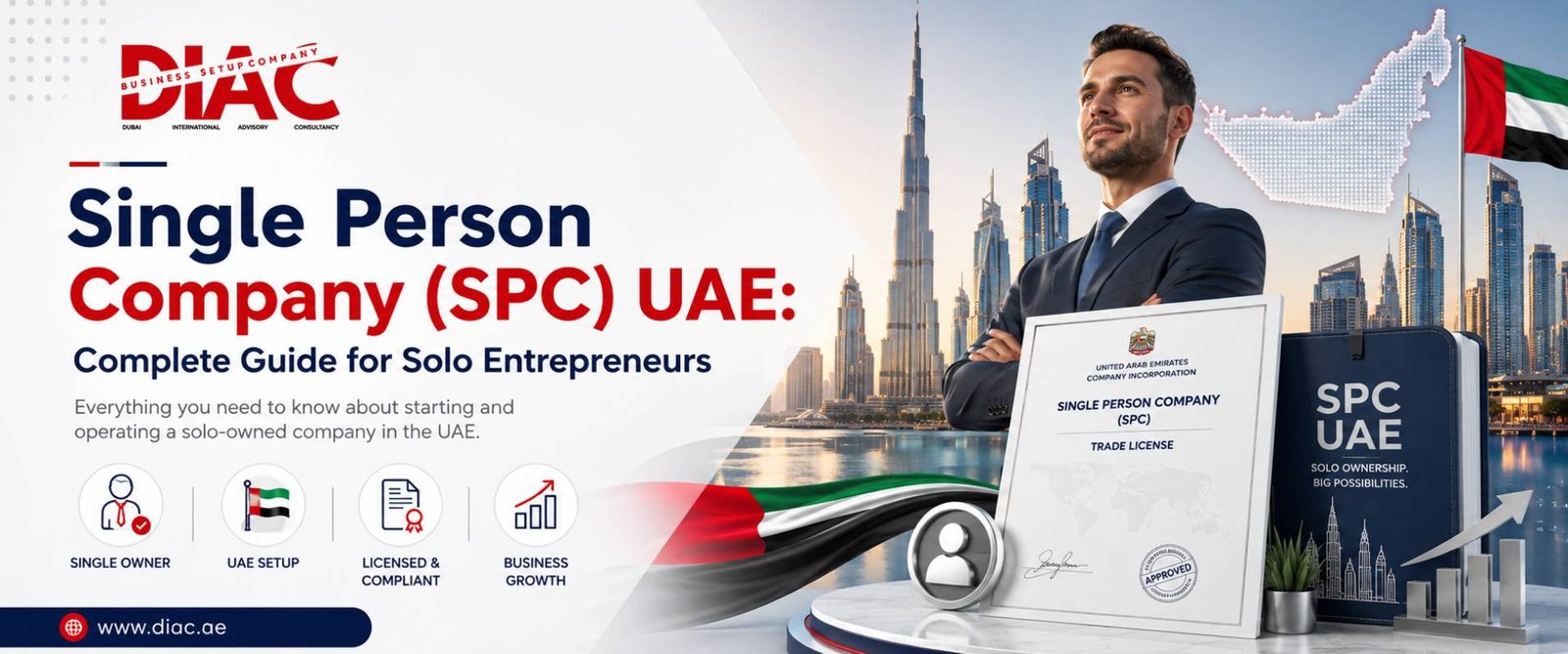
What Is a Single Person Company in the UAE?A Single Person Company (SPC) is a UAE Limited Liability Company structure with exactly one shareholder. Introduced under Federal Decree-Law No. 32 of 2021, it allows solo founders to run a formal corporate entity with limited liability protection, full UAE market access, and investor visa eligibility, without the requirement for a second shareholder. This guide covers mainland SPC versus free zone FZE, when each applies, costs, registration steps, and key compliance requirements. |
Before the UAE Companies Law reform of 2021, setting up a company on the UAE mainland required at least two shareholders. For solo entrepreneurs, this created a structural problem: either find a nominee second shareholder (often a family member with no real involvement), register in a free zone as a sole establishment, or pay a local service agent. None of these were ideal.
Federal Decree-Law No. 32 of 2021 changed this. It introduced the Single Person Company (SPC): a mainland LLC with one shareholder and full limited liability protection. For solo founders who need mainland UAE market access, the SPC closes the gap that previously pushed them toward free zone structures they did not always need. This guide covers what the SPC is, how it compares to the free zone equivalent, when to use each, and the full registration process.
All UAE entity formation options are covered at our Dubai business setup homepage. For the full mainland LLC process see our mainland company formation in Dubai guide.
What Is a Single Person Company (SPC) in the UAE?
An SPC is a type of Limited Liability Company established under UAE Federal Decree-Law No. 32 of 2021 (the Companies Law) that permits a single natural person or a single legal entity (another company) to be the sole shareholder. Before this law, UAE LLCs required a minimum of two shareholders. The SPC removed that restriction for the mainland.
Key Legal Characteristics
- Separate legal personality: The SPC is a distinct legal entity from its owner. Contracts, assets, and liabilities belong to the company, not to the individual founder personally
- Limited liability: The sole shareholder’s personal liability is limited to their capital contribution. Personal assets (home, savings, car) are protected from business debts in most circumstances
- Single shareholder: Only one shareholder permitted. If you later want to bring in a business partner or investor as a shareholder, the SPC must be converted to a standard multi-shareholder LLC
- Sole director: The sole shareholder typically acts as the sole manager/director, though a separate manager can be appointed
- Full DED activity access: An SPC can hold any commercial, industrial, or professional activity permitted on the mainland, subject to the same activity-specific restrictions that apply to all mainland entities
- UAE market access: The SPC can sell to any UAE customer, government entity, or business without restriction, exactly as a standard LLC
| Who created the SPC and why: The UAE introduced the SPC specifically to align its corporate law with international best practice (most developed economies allow sole-shareholder companies) and to simplify the entry path for individual entrepreneurs and investors who had previously been forced into either multi-shareholder structures or free zone alternatives. The reform was part of the broader 2021 Companies Law overhaul that also eliminated mandatory UAE national shareholding in most sectors. |
SPC vs FZE: The Two Single-Shareholder Structures in the UAE
The SPC is the mainland single-shareholder option. The Free Zone Establishment (FZE) is its free zone equivalent. Both allow a single owner, but they are fundamentally different in what they permit and where they operate.
| Feature | Single Person Company (SPC) – Mainland | Free Zone Establishment (FZE) – Free Zone |
| Governing law | UAE Federal Companies Law (Federal Decree-Law 32/2021) | Free zone authority regulations (each zone differs) |
| Issuing authority | DED / Department of Economy and Tourism | Free zone authority (DMCC, IFZA, JAFZA, etc.) |
| UAE mainland market access | Full and unrestricted | Via distributor or mainland branch; not direct |
| Government contracts | Eligible | Generally not eligible for federal tenders |
| Physical office required | Yes (Ejari-registered tenancy) | Flexi-desk or virtual address accepted in many zones |
| Minimum shareholders | 1 | 1 |
| Foreign ownership | 100% (most activities post-2021) | 100% always |
| Corporate tax | 9% above AED 375,000 | 0% if QFZP-eligible; 9% otherwise |
| Setup cost | Higher (office + DED fees) | Lower (flexi-desk + zone license) |
| Setup time | 5 to 15 working days | 1 to 5 working days (most zones) |
| Best for | Mainland clients; government contracts; professional services | International clients; digital; remote businesses |
| Decision rule: If your clients are UAE businesses, UAE consumers, or UAE government entities, the SPC gives you the direct market access that an FZE cannot. If your clients are international, your business is digital or service-based with no UAE domestic focus, and you want the fastest and cheapest setup, an FZE through a free zone like IFZA or DMCC is typically more practical. Both are single-shareholder structures with limited liability. The difference is market access and cost, not legal protection. |
Who Can Form a Single Person Company in the UAE?
The SPC is available to both individuals and corporate entities. There are two formation categories:
Individual SPC
A single natural person (any nationality) can be the sole shareholder of a UAE SPC. There is no UAE nationality requirement. A foreign national can own 100% of a mainland SPC in most commercial activity categories following the 2021 FDI reforms. The individual founder must have a valid passport and be of legal age under UAE law.
An individual SPC is appropriate for:
- Freelancers and independent professionals who want a corporate entity instead of a sole establishment
- Entrepreneurs launching a first UAE business without a co-founder
- International investors who want a UAE mainland entity without a joint venture partner
- Professionals in consulting, technology, legal, or other services who want limited liability protection
Corporate SPC (Single Legal Entity as Shareholder)
A corporate entity (another company, whether UAE or foreign) can also be the sole shareholder of a UAE SPC. This is used for:
- International companies establishing a UAE mainland subsidiary without a local partner
- Free zone companies that want a mainland branch entity through a single corporate shareholder
- Holding structures where a parent company owns a UAE operating entity as its single shareholder
| Restricted activities: Some professional activities on the UAE mainland still require the founder to hold specific professional qualifications. Legal consultancies need a Ministry of Justice registered lawyer as manager. Medical clinics need a DHA-licensed practitioner as PIC. Engineering companies need a UAE Society of Engineers registered engineer. The SPC structure does not bypass these professional qualification requirements: it only addresses the shareholder count issue. |
SPC vs Sole Establishment: Why the Difference Matters
Many solo founders in the UAE already operate as a sole establishment (sometimes called a sole proprietorship). This is a separate legal concept from an SPC and the distinction has practical consequences that affect your personal financial risk.
| Factor | Single Person Company (SPC) | Sole Establishment |
| Legal personality | Separate from owner (company is its own entity) | No separation; owner IS the business |
| Personal liability | Limited to capital contribution | Unlimited; personal assets fully at risk |
| Business debts | Creditors claim against company assets first | Creditors can pursue personal assets directly |
| Contracts | Signed in company name | Signed in individual name (or trading name) |
| Transfer of ownership | Can sell shares in the company | Cannot sell; must liquidate and restart |
| Investor suitability | Can accept investment by converting to multi-shareholder LLC | Cannot accommodate investors without restructuring |
| Annual compliance | Financial statements; audit for larger entities | Simpler; no mandatory audit for small sole establishments |
| Bank account | Corporate account in company name | Personal or trading account |
| Best for | Any business with financial or legal liability exposure | Very small; low-risk; purely personal professional services |
The most important difference is liability. A UAE sole establishment does not protect your personal assets if your business faces a legal claim or debt. An SPC does. For any business that handles client contracts with financial consequences, employs staff, or operates in a sector with litigation risk, the SPC’s limited liability structure is commercially significant.
Single Person Company Cost in Dubai
SPC costs follow the same structure as a standard mainland LLC because the SPC is simply an LLC with one shareholder. The costs below reflect Dubai mainland setup through DED.
| Cost Component | Amount (AED) | Notes |
| DED Trade Name Reservation | 600 – 900 | Non-refundable; step 1 |
| DED Initial Approval | 1,000 – 2,000 | Activity-specific; required before MoA |
| Memorandum of Association (MoA) | 1,500 – 3,000 | Notarised; single-shareholder format |
| DED Trade License (annual) | 10,000 – 22,000 | Depends on activity category |
| Commercial Premises (Ejari, annual) | 20,000 – 80,000+ | Physical office required; highly location-dependent |
| Investor/Partner Visa | 3,500 – 5,000 | Sole shareholder as investor; includes medical and Emirates ID |
| Document Attestation (if foreign shareholder) | 2,000 – 6,000 | Apostille and UAE embassy attestation |
| First-Year Total (typical professional SPC) | AED 45,000 – 120,000 | Excludes salary costs; premises drives most variation |
| Cost comparison with FZE: A UAE free zone FZE (single-shareholder free zone entity) costs significantly less in year one: from AED 12,000 to AED 25,000 for most free zones on a flexi-desk package. The SPC’s higher cost reflects the mandatory physical office requirement for mainland setup. If your business model justifies mainland market access (clients are UAE-based, you need government contracts, or you operate in a sector where an Ejari-registered office is operationally necessary), the cost difference is commercially rational. If your business is fully digital with international clients, the free zone FZE’s cost advantage is difficult to justify away. |
How to Register a Single Person Company in Dubai
The SPC registration process follows the mainland LLC pathway through the Dubai Department of Economy and Tourism. There is no separate SPC application form: you register as a standard LLC with one shareholder listed. The process is the same whether you have one or two shareholders.
- Define your business activity and confirm the DED activity code. Professional activities (legal, medical, engineering) require additional authority approvals alongside DED registration.
- Reserve your company trade name through the DED portal. The name must comply with UAE naming regulations and cannot duplicate an existing registered entity.
- Obtain DED initial approval for your chosen activity. This is a preliminary permit to proceed and is required before any legal documentation is drafted.
- Draft and notarise your Memorandum of Association (MoA). For an SPC, the MoA reflects a single-shareholder LLC structure. It must be signed by the sole shareholder and notarised by a UAE public notary.
- Secure your business premises and register the tenancy contract through Ejari (Dubai Land Department). A valid Ejari certificate is mandatory for the DED license.
- Submit all documents to DED for license issuance: initial approval letter, notarised MoA, Ejari, shareholder passport copies, and any activity-specific approvals.
- Receive your DED trade license. The license identifies the company as a single-owner LLC with your name as the sole shareholder.
- Apply for your investor residence visa as the company’s sole shareholder: GDRFA entry permit, DHA medical fitness, and ICA Emirates ID process takes two to four weeks.
- Open a UAE corporate bank account. The SPC’s DED license is accepted by all major UAE banks. Allow three to eight weeks for account approval.
DIAC manages the complete SPC registration process including document preparation, notarisation coordination, DED submission, visa processing, and bank introduction. Our PRO services team handles government liaison at every stage.
Converting an SPC to a Multi-Shareholder LLC
One of the most important planning considerations for SPC founders is what happens when the business grows. If you later want to bring in a business partner, take on an investor as a shareholder, or give equity to an employee, the SPC structure must be converted.
The Conversion Process
Converting an SPC to a standard multi-shareholder LLC involves:
- Amending the Memorandum of Association to add the new shareholder(s)
- Specifying the ownership percentages in the revised MoA
- Re-notarising the amended MoA
- Submitting the amendment to DED with updated shareholder documentation
- DED issues an amended license reflecting the new multi-shareholder structure
The conversion does not restart your license: your original trade license date is preserved. The company continues under the same commercial registration number with an updated shareholder structure.
| Plan for it early: If you know from the start that you will want to bring in investors or partners within two to three years, consider structuring as a standard two-shareholder LLC from day one (with a second shareholder holding a nominal 1% or agreed minority share) rather than converting later. The conversion process is manageable but involves professional fees and DED processing time. Setting up correctly at the start is always cheaper than restructuring later. |
SPC and UAE Corporate Tax: What Solo Founders Need to Know
The UAE corporate tax of 9% applies to business profits above AED 375,000 in any financial year. An SPC is not exempt from UAE corporate tax by virtue of being a single-shareholder entity. As a mainland LLC, it is subject to the standard corporate tax rules administered by the UAE Federal Tax Authority. Our dedicated UAE corporate tax guide covers all thresholds, exemptions, and filing requirements.
Key corporate tax points for SPC founders:
- Profits up to AED 375,000 per year are taxed at 0%: most early-stage solo businesses fall below this threshold
- Profits above AED 375,000 are taxed at 9%: applies to the excess portion only, not the full profit
- Small Business Relief may be available for businesses with revenue below AED 3,000,000: consult the FTA guidelines for current eligibility
- Salary paid to the sole shareholder is a deductible business expense, reducing taxable profit
- Dividends paid from an SPC to the sole shareholder carry no additional dividend tax: the 9% CT is the only corporate-level tax
- If the SPC holds only qualifying free zone income (which is less common for mainland entities), it would not qualify for the 0% QFZP rate: QFZP applies to free zone entities
Frequently Asked Questions About Single Person Company UAE
What is the difference between a Single Person Company and a sole proprietorship in the UAE?
A sole proprietorship (sole establishment) in the UAE has no separation between the business and the owner. The owner is personally liable for all business debts: their personal assets can be seized to satisfy business obligations. A Single Person Company is a Limited Liability Company with one shareholder. It is a separate legal entity: the company’s debts are the company’s, not the owner’s personally. The SPC provides limited liability protection that a sole establishment cannot. For any business with financial exposure, legal risk, or client contracts involving meaningful sums, the SPC’s liability protection is commercially significant.
Can a foreigner own 100% of a Single Person Company in Dubai?
Yes. The 2021 Companies Law reforms that introduced the SPC also substantially expanded foreign ownership rights on the Dubai mainland. A foreign national can be the sole shareholder of a UAE SPC in most commercial activity categories without a UAE national partner or service agent. There are a small number of restricted sectors where ownership conditions remain specific: confirm the current status of your activity code with DED or a business setup consultant at application time. Our mainland company formation guide covers the current activity-specific ownership rules.
Can I add a second shareholder to an SPC later?
Yes. An SPC can be converted to a standard multi-shareholder LLC by amending the Memorandum of Association to add the new shareholder, specifying the revised ownership percentages, re-notarising the amended MoA, and submitting the amendment to DED. The company’s commercial registration number and original license date are preserved. The process is straightforward but involves professional fees (notarisation, amendment fee) and DED processing time of one to three weeks.
Is a Single Person Company the same as a Free Zone Establishment (FZE)?
No. Both allow a single shareholder with limited liability but they are governed by different laws and serve different commercial purposes. An SPC is a mainland entity governed by UAE Federal Companies Law, issued by DED, that provides full access to the UAE domestic market. A Free Zone Establishment (FZE) is a free zone entity governed by the specific free zone’s regulations that can operate globally but faces restrictions on UAE mainland commercial activity. The SPC is the right choice for mainland market access. The FZE is typically cheaper and faster to set up. See our UAE business setup for a full comparison of both options.
Does a Single Person Company need an audited financial statement?
Under UAE Federal Companies Law, large companies are required to have their accounts audited by a UAE-registered auditor. Smaller companies may be exempt from mandatory external audit depending on their size thresholds. The UAE Corporate Tax Law also has financial statement requirements for CT-registered entities. As a general rule, SPC founders should maintain accurate bookkeeping and engage a UAE-registered accountant from the first year of operations, both for CT compliance and for banking purposes (UAE banks often request financial statements during KYC reviews). Specific audit requirements for your SPC should be confirmed with a UAE-licensed accountant based on your business size and activities.
Can an SPC apply for UAE government tenders and contracts?
Yes. An SPC is a mainland LLC and is eligible to apply for UAE government tenders and public sector contracts, subject to meeting the specific eligibility criteria of each tender (which may include minimum years of operation, financial standing requirements, and sector-specific certifications). This is one of the primary advantages of the SPC over a free zone entity for solo founders who want to target government or semi-government clients. A free zone entity generally cannot participate in UAE public sector tenders directly.
How long does it take to register a Single Person Company in Dubai?
The DED mainland LLC registration process (which covers SPC formation) typically takes five to fifteen working days from a complete document submission for standard commercial activity codes. Regulated professional activities (medical, legal, engineering) add two to six weeks for the additional professional authority approvals. The investor visa process adds two to four weeks on top of the license issuance. DIAC manages the full process from initial trade name reservation to active license and visa. Start the process at our UAE business setup.
What activities can an SPC hold in Dubai?
An SPC can hold any DED-permitted commercial, industrial, or professional activity on the Dubai mainland, subject to the same sector-specific approval requirements that apply to all mainland entities. This includes general trading, consulting and professional services, technology and IT, food and beverage, retail, real estate, construction, education, and healthcare (subject to DHA or relevant authority approvals for regulated activities). An SPC is not restricted to any particular activity category by virtue of being a single-shareholder entity: the activity code limitations are the same as for any standard mainland LLC.
Ready to Form Your Single Person Company in the UAE?DIAC’s business setup consultants manage the complete SPC registration process in Dubai and across all UAE emirates: activity code selection, DED trade name reservation, MoA drafting and notarisation, Ejari coordination, investor visa processing, and bank account introduction. We also advise on whether the SPC or a free zone FZE is the more commercially appropriate structure for your specific business. Free consultation at diac.ae. |
About the Author
Adil Ahmad is a business setup consultant at DIAC with expertise in single-shareholder company formation across UAE mainland and free zones, including SPC registration under the 2021 Companies Law, FZE formation, sole establishment setup, and the structural advice that helps solo founders choose the right entity from day one.