| Market Size | KSA Franchise Growth | Governing Law | Regulator |
| USD 30Bn+ | 20%+ since Vision 2030 | Min. Decision 1310/2019 | MOCI |
Summary
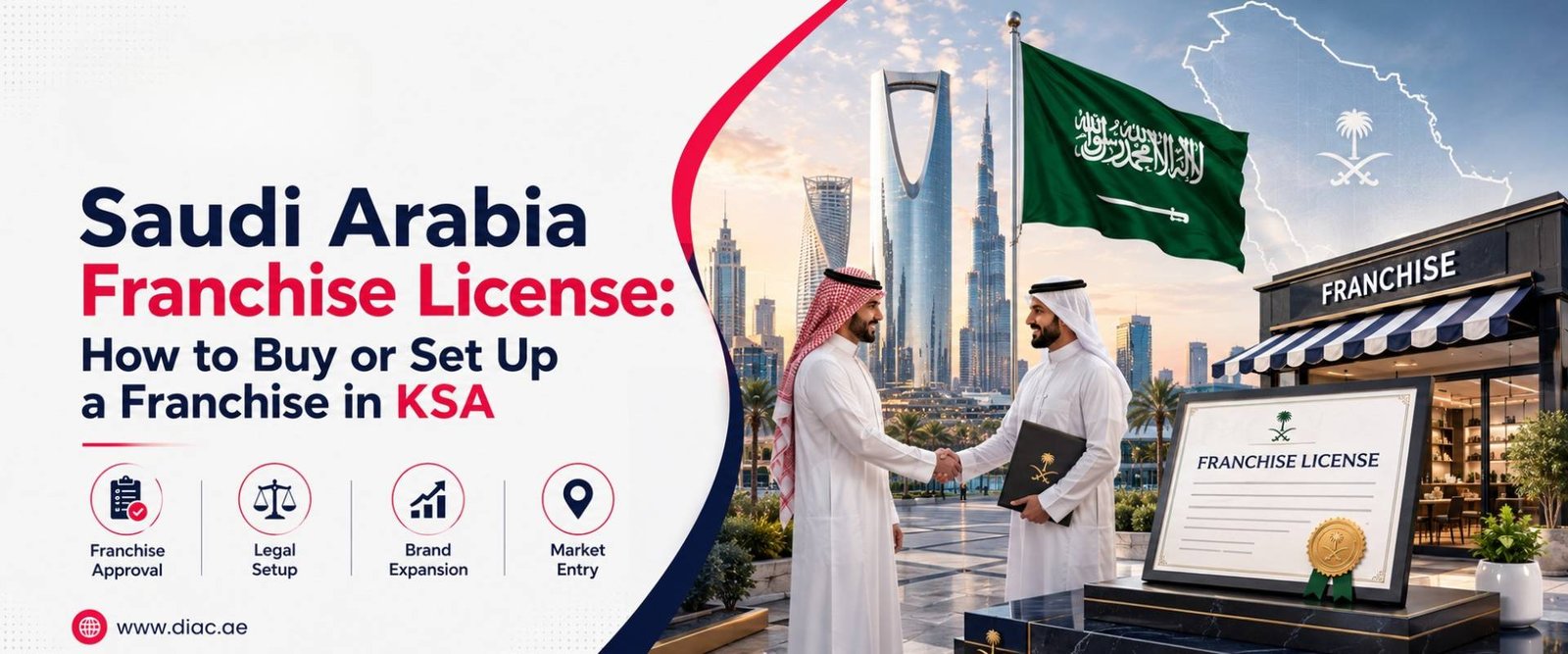
| Saudi Arabia’s franchise market exceeds USD 30 billion and is one of the fastest-growing in MENA. Franchise businesses in KSA are regulated by MOCI under Ministerial Decision No. 1310 of 2019, requiring both franchisors and franchisees to register and maintain a compliant franchise disclosure document. This guide covers the full registration process, MOCI requirements, FDD obligations, cost and timeline, and the specific differences that UAE-based franchisors must understand before expanding to Saudi Arabia. |
Saudi Arabia’s franchise sector is among the largest and fastest-expanding in the Middle East and North Africa. The country’s economic transformation under Vision 2030, a population of over 36 million with rapidly increasing consumer spending, and a youth demographic that drives demand for branded food, retail, education, and wellness concepts have created one of the world’s most attractive franchise expansion markets. Every major international F&B chain, fashion retailer, and service franchise considers Saudi Arabia a priority market.
For brands based in the UAE looking to expand to KSA, and for investors looking to acquire a franchise in Saudi Arabia, the process is more structured than many expect. Saudi Arabia enacted a formal franchise regulatory framework through Ministerial Decision No. 1310 of 2019, requiring both franchisors and franchisees to register with the Ministry of Commerce and Investment (MOCI) and maintain a compliant Franchise Disclosure Document (FDD). Operating a franchise in KSA without proper registration carries fines and the risk of contract unenforceability.
This guide covers the full picture: what Saudi franchise law requires, how MOCI registration works, what the FDD must contain, the cost and timeline, and what UAE-based franchisors specifically need to plan before entering the Saudi market. For UAE franchise setup, see our franchise business setup guide on the DIAC homepage.
Saudi Arabia Franchise Market: Size and Opportunity
Saudi Arabia is the GCC’s largest consumer economy and its franchise market reflects this scale. The country’s franchise sector is estimated at over USD 30 billion, with more than 2,500 franchise systems operating across the Kingdom. Since Vision 2030’s launch in 2016, franchise market growth has consistently exceeded 20 percent per year, driven by the government’s deliberate strategy of increasing private sector participation in consumer services previously dominated by government or informal operators.
The Strongest Franchise Sectors in KSA
- Food and beverage: The largest franchise category by revenue. McDonald’s, KFC, Starbucks, Pizza Hut, and Burger King all operate through Saudi master franchisees. The UAE’s own brands including Al Baik, Bateel, and various Emirati restaurant concepts have also expanded into KSA with significant success
- Fashion and retail: International luxury and mid-market fashion brands from Europe and the US have expanded rapidly since Saudi social reforms enabled mixed-gender retail environments. Franchise retail now represents a significant share of the country’s organised retail turnover
- Healthcare and wellness: Dental clinic chains, physiotherapy networks, optical retail, and gym franchises have all seen accelerated growth as Saudi consumers increase health spending
- Education and training: Language school franchises, professional training centres, and children’s education franchises serve a large young Saudi population with high parental investment in education
- Hospitality: International hotel brands operating through franchise and management agreements are expanding across Riyadh, Jeddah, and the Red Sea tourism project developments
| Why now: Vision 2030’s Saudisation policies, while sometimes complex for foreign businesses, have specifically exempted many franchise models from restrictive Saudisation quotas because they create Saudi employment across multiple layers. The government’s entertainment and tourism investments (NEOM, Red Sea Project, Diriyah) are creating entirely new franchise markets within Saudi Arabia that did not exist five years ago. |
What Is a Saudi Arabia Franchise License?
Saudi Arabia does not issue a specific document called a ‘franchise license’ in the same way that some jurisdictions issue a single-permit franchise authorisation. Instead, operating a franchise in KSA requires a combination of: a valid Saudi commercial registration (CR) for the franchisee entity, MOCI registration as a franchisee or franchisor, a compliant Franchise Disclosure Document (FDD), and a franchise agreement that meets the requirements of Saudi commercial and franchise law.
Think of the ‘Saudi franchise license’ as the combination of these elements rather than a single document. All must be in place before a franchise system can legally operate in the Kingdom.
The Two Parties and Their Obligations
| Party | Definition | Key Obligation | Registration Required? |
| Franchisor | The brand owner granting franchise rights | Prepare and register compliant FDD; register with MOCI; provide franchise training and support | Yes: MOCI franchisor registration |
| Franchisee | The entity purchasing the right to operate under the franchisor’s brand | Obtain Saudi commercial registration; register with MOCI; execute compliant franchise agreement | Yes: MOCI franchisee registration |
| Master Franchisee | A Saudi entity granted exclusive rights to sub-franchise a brand across the Kingdom | Both franchisor and franchisee obligations apply; must register in both capacities | Yes: dual MOCI registration |
MOCI Franchise Regulation: What Saudi Law Requires
Saudi Arabia’s franchise regulatory framework is established under Ministerial Decision No. 1310 of 2019, issued by the Ministry of Commerce and Investment (MOCI). This regulation introduced mandatory franchise disclosure requirements that are broadly equivalent to the FDD (Franchise Disclosure Document) frameworks used in the United States, Canada, and Australia.
Mandatory Franchise Disclosure Document (FDD) Contents
The Saudi FDD must be provided to the prospective franchisee at least ten calendar days before any franchise agreement is signed or any payment is made. The document must include, at minimum:
- Full identification of the franchisor: legal name, commercial registration number, registered address, and key management personnel
- Franchisor’s business history: how long the system has been operating, its development in Saudi Arabia and globally
- Litigation history: any material legal disputes involving the franchisor in the preceding three years
- Franchise fees: all initial fees, ongoing royalties, marketing contributions, and other financial obligations disclosed in full
- Financial performance representations: if the franchisor makes any earnings claims or revenue projections, these must be supported by documented evidence
- Franchisee obligations: training requirements, site selection criteria, operations standards, product sourcing obligations
- Territory rights: exclusive or non-exclusive territory, any reservation of rights by the franchisor
- Renewal and termination conditions: grounds for early termination, renewal rights, post-termination restrictions
- List of existing franchisees: contact information for current KSA franchisees who can be contacted for due diligence
- Current franchise agreement: the complete draft agreement to be signed
| Enforcement note: Saudi courts have taken an increasingly active approach to franchise agreement enforcement. An FDD that does not comply with Ministerial Decision 1310 requirements can make the entire franchise agreement legally unenforceable in Saudi courts, exposing both parties to significant commercial risk. Using a Saudi-qualified legal advisor to draft or review the FDD is not optional for any serious franchise transaction in KSA. |
MOCI Registration Process
Both franchisors and franchisees must register their franchise relationship with MOCI through the MOCI Franchise Registry portal. The registration requires submission of the executed franchise agreement, the FDD, and identification documents for both parties. MOCI maintains the registry as a public record of active franchise systems operating in the Kingdom.
How to Register a Franchise Business in Saudi Arabia
The registration process differs slightly depending on whether you are the franchisor entering KSA, a Saudi investor buying a franchise, or a UAE brand expanding to Saudi Arabia. Here is the consolidated process.
For Franchisors (Brands Entering KSA)
- Engage a Saudi-qualified legal advisor to draft or localise your FDD to comply with Ministerial Decision 1310 requirements. This step comes before any franchisee conversation.
- Identify your Saudi franchisee or master franchisee. For international brands, this is typically a Saudi commercial entity with local market knowledge, operational capability, and access to the required capital.
- Provide the completed FDD to the prospective franchisee at least ten calendar days before any agreement signing or payment.
- Negotiate and execute the franchise agreement. Both parties must have Saudi legal representation review the agreement’s compliance with KSA commercial law.
- Register the franchise relationship with MOCI through the MOCI Franchise Registry, submitting the executed agreement and FDD.
- Support the franchisee’s Saudi commercial registration (CR) application if required under the franchise agreement.
For Franchisees (Saudi Investors Buying a Franchise)
- Verify that the franchisor is registered with MOCI and maintains a valid FDD. Request the FDD and allow the full ten-day review period before signing anything.
- Engage a Saudi-qualified legal advisor to review the FDD and franchise agreement before execution.
- Establish your Saudi commercial entity (limited liability company or other appropriate structure) with the Saudi Companies General Authority (CGA).
- Execute the franchise agreement and register the franchise relationship with MOCI.
- Obtain any sector-specific licenses required for the franchised business: municipality health permits for F&B, GAZT tax registration, Chamber of Commerce membership.
- Complete the Saudisation (Nitaqat) workforce planning requirements for your business category before hiring.
UAE Franchise Expanding to Saudi Arabia: Key Differences
For UAE-based franchise brands looking to enter KSA, the process involves specific differences from the UAE franchise framework that must be planned for in advance. Saudi Arabia is not simply a larger market with a similar legal environment: it has distinct regulatory requirements, commercial norms, and cultural considerations that affect how a franchise system must be structured.
| Factor | UAE Franchise | Saudi Arabia Franchise |
| Primary regulator | DED (Dubai) or free zone authority | MOCI (Ministry of Commerce and Investment) |
| Franchise law basis | UAE Commercial Transactions Law (general) | Ministerial Decision 1310 of 2019 (specific) |
| FDD requirement | No specific mandatory FDD requirement under UAE law | Mandatory FDD; 10-day pre-signing delivery |
| MOCI registration | Not required for UAE operations | Mandatory for all franchise relationships |
| Foreign ownership | 100% for UAE free zone; up to 100% mainland post-2021 | Saudi Arabia allows up to 100% foreign ownership in most sectors since 2021 reforms |
| Saudisation (Nitaqat) | Emiratisation for certain quotas only | Mandatory Saudisation across all business categories |
| Governing language | Arabic and English both common in agreements | Arabic is the legally governing language of agreements |
| Dispute resolution | UAE courts or DIFC arbitration | Saudi courts (primary); SAGIA arbitration available |
| Prayer time operations | No mandatory closure | Operations historically affected by prayer times; increasingly flexible under Vision 2030 policies |
The most commercially significant structural difference for UAE franchisors is the FDD requirement. Most UAE franchise agreements are drafted without a standalone FDD because UAE law does not mandate one. Entering KSA requires creating a compliant Saudi FDD from scratch or adapting an existing international FDD to Saudi law requirements. This process takes time and professional advisory investment that should be built into the Saudi expansion budget. For UAE business setup comparison, see our UAE business setup homepage.
Franchise License Cost and Timeline in Saudi Arabia
The costs of establishing a franchise operation in Saudi Arabia span both business entity formation costs and franchise-specific registration and compliance costs.
Business Entity Formation Costs (Saudi Arabia)
| Cost Component | Estimated Cost (SAR) | Equivalent USD | Notes |
| Saudi commercial registration (CR) | SAR 1,200 – 2,500 | USD 320 – 665 | Annual; varies by business type and activity |
| Chamber of Commerce membership | SAR 500 – 3,000/yr | USD 133 – 800 | Required for most commercial entities |
| Municipality trade license | SAR 500 – 2,000 | USD 133 – 530 | Sector-specific; annual |
| MOCI franchise registration | SAR 1,000 – 5,000 | USD 265 – 1,330 | Per franchise relationship registered |
| Legal fees (FDD preparation) | SAR 15,000 – 80,000 | USD 4,000 – 21,300 | Depends on complexity and legal firm used |
| FDD translation to Arabic | SAR 3,000 – 15,000 | USD 800 – 4,000 | Mandatory; certified legal translation |
| First-unit fit-out and setup | Highly variable | Highly variable | F&B from USD 200k; retail from USD 100k |
| Franchise fee (to franchisor) | Varies by brand | Typically USD 20k – 100k+ | Brand-specific; paid to franchisor |
| Ongoing royalty | Varies by brand | Typically 4 to 8% of revenue | Brand-specific; ongoing monthly payment |
Timeline
| Stage | Activity | Duration |
| 1 | FDD preparation or localisation by Saudi-qualified legal advisor | 4 to 8 weeks |
| 2 | FDD delivery to franchisee and mandatory 10-day review period | 10 calendar days minimum |
| 3 | Franchise agreement negotiation and execution | 2 to 6 weeks (highly variable) |
| 4 | Saudi commercial registration (CR) for franchisee entity | 1 to 3 weeks |
| 5 | MOCI franchise relationship registration | 1 to 2 weeks |
| 6 | Sector-specific licenses (municipality, health, etc.) | 2 to 8 weeks depending on sector |
| 7 | Site fit-out and pre-opening preparations | 2 to 12 months depending on concept |
| Total: Legal to MOCI registered | Registration complete | 6 to 16 weeks |
| Total: Registration to open | Depends heavily on fit-out requirements | 3 to 18 months for most concepts |
| Budget reality: The legal costs of Saudi franchise compliance are consistently underestimated by UAE brands expanding to KSA for the first time. Building a compliant FDD, translating it into Arabic, having it reviewed by a Saudi-qualified attorney, and then registering it with MOCI costs SAR 20,000 to SAR 100,000 (approximately USD 5,000 to USD 27,000) in professional fees alone, before a single SAR is spent on the physical operation. Build this into your KSA expansion budget from the start. |
Frequently Asked Questions
Is a franchise disclosure document (FDD) mandatory in Saudi Arabia?
Yes. Under Ministerial Decision No. 1310 of 2019, Saudi Arabia requires franchisors to prepare and provide a compliant Franchise Disclosure Document to prospective franchisees at least ten calendar days before any franchise agreement is signed or any payment is made. The FDD must meet specific content requirements set out in the regulation. A franchise agreement entered into without a compliant FDD can be challenged in Saudi courts, potentially making the entire agreement legally unenforceable. Brands expanding from the UAE should note that UAE franchise agreements typically do not include a standalone FDD, so one must be created specifically for KSA market entry. The MOCI portal has the current regulatory framework and registration requirements.
Can a UAE company be a franchisor in Saudi Arabia without a Saudi entity?
Yes, a UAE-based franchisor can register as a franchisor with MOCI and enter into franchise agreements with Saudi franchisees without establishing a Saudi entity, provided the franchise arrangement involves a Saudi-based franchisee who holds the Saudi commercial registration and operates the local business. The franchisor’s registration with MOCI is based on the franchise relationship itself, not on whether the franchisor has a physical presence in Saudi Arabia. However, many established franchise systems find that having at least a Saudi representative office or a Saudi-registered entity simplifies the ongoing relationship management, support delivery, and dispute resolution that franchise operations require.
What is the difference between a franchisee and a master franchisee in KSA?
A standard franchisee in Saudi Arabia holds the right to operate one or a limited number of franchise units under the franchisor’s brand, in a specific location or territory. A master franchisee holds a broader right: the exclusive right to develop the franchise system across the Kingdom (or a defined region of it), including the right to sub-franchise to third parties within that territory. A master franchisee takes on both the franchisee’s operational obligations and the franchisor’s obligations to their own sub-franchisees. Master franchise arrangements require MOCI registration in both capacities and a more complex franchise agreement structure that covers both the master relationship and the sub-franchise framework.
What sectors have the most franchise opportunities in Saudi Arabia?
Food and beverage consistently accounts for the largest share of franchise activity in KSA by number of units and total investment. Healthcare and wellness is the fastest-growing franchise sector by new brand entries, reflecting Saudi government investment in health infrastructure and consumer spending on personal wellness. Education and professional training franchises serve a large and young population with high family investment in educational outcomes. Retail fashion franchises benefit from the relaxation of social restrictions and the growth of organised retail in Riyadh, Jeddah, and the Eastern Province. The NEOM, Red Sea Project, and Diriyah developments are creating new hospitality and leisure franchise opportunities in locations that did not exist as commercial markets five years ago.
How long does MOCI franchise registration take in Saudi Arabia?
MOCI franchise registration itself, once the FDD and executed franchise agreement are submitted, typically takes one to two weeks. The longer parts of the total timeline are the FDD preparation (four to eight weeks for a new FDD or Saudi localisation of an existing international FDD), the mandatory ten-day pre-signing disclosure period, and the franchise agreement negotiation (which can extend to several months for complex multi-unit or master franchise arrangements). Businesses that prepare their FDD in advance of identifying their Saudi franchisee have the smoothest overall timeline. The MOCI Franchise Registry portal provides current registration instructions and documentation requirements.
Do UAE-based franchise brands need to Saudise (Nitaqat) their KSA franchise operations?
Yes. Saudisation (the Nitaqat programme) applies to all businesses operating in Saudi Arabia regardless of whether they are franchised, directly operated, or any other commercial model. Saudi Arabia’s Nitaqat system requires businesses to maintain a defined percentage of Saudi national employees relative to total headcount, with the percentage varying by business size and sector. Franchise agreements for KSA operations should specifically address how Nitaqat compliance is managed between the franchisor (who may set operational standards) and the franchisee (who is the employer of record for Saudi labour purposes). Non-compliance with Nitaqat can result in fines, restrictions on visa issuance, and difficulty renewing commercial registrations.
Expanding Your UAE Franchise to Saudi Arabia?DIAC advises UAE franchise brands on the Saudi Arabia expansion process, including FDD compliance preparation, MOCI registration support, Saudi entity formation coordination, and franchisee identification and structuring. We work alongside Saudi-qualified legal partners to ensure your franchise system meets KSA regulatory requirements before the first franchisee conversation. |
About the Author
Adil Ahmad is a business setup consultant at DIAC with experience advising UAE-based franchise brands on GCC regional expansion including Saudi Arabia market entry, franchise disclosure document compliance, MOCI registration, and cross-border franchise structuring. He works alongside Saudi-qualified legal and commercial advisors to support complete franchise system establishment in the Kingdom.