| What This Guide Covers
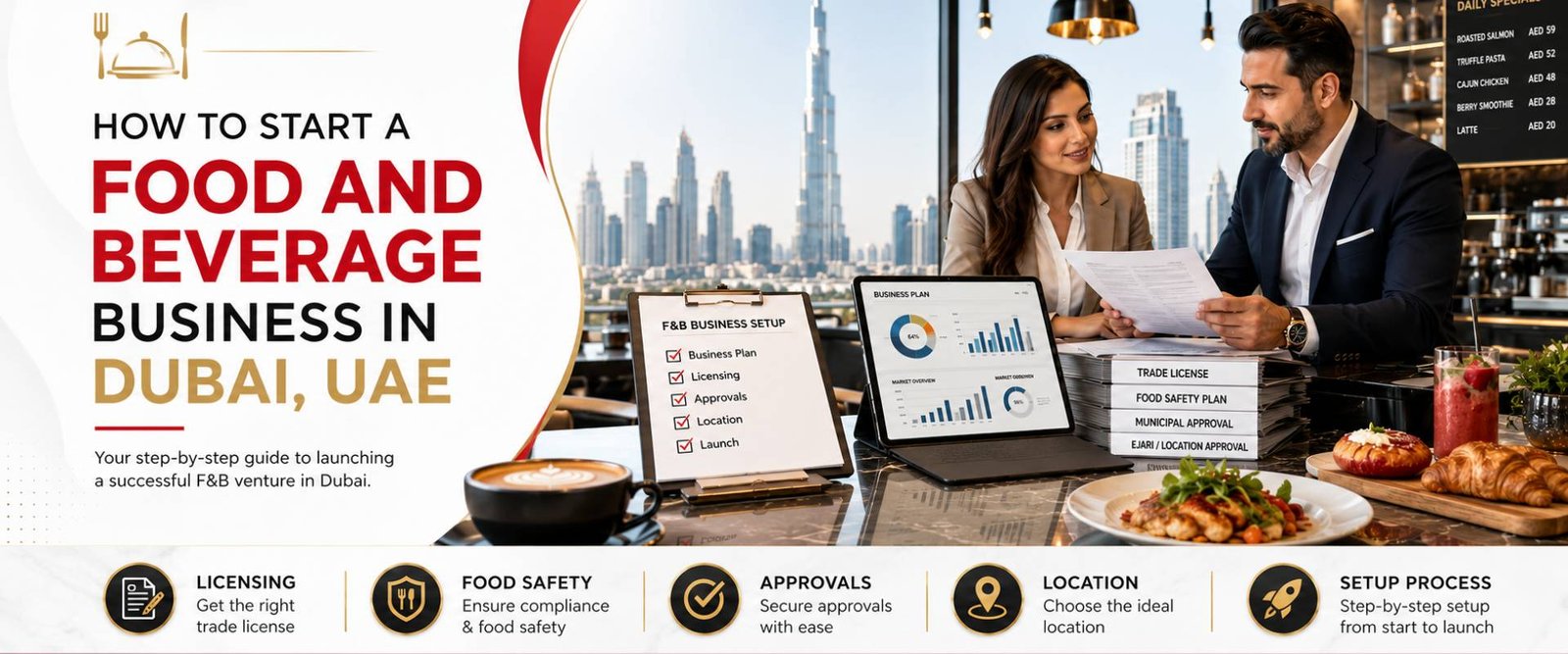
Every F&B business in Dubai needs two approvals: a DED commercial trade license and a Dubai Municipality (DM) food establishment permit. Whether you are opening a restaurant, cafe, cloud kitchen, or bakery, both are mandatory before you serve a single item. This guide covers the full process, business model comparison, Dubai Municipality inspection requirements, staff rules, realistic costs, and the choices that determine your timeline. |
The number of F&B businesses that open in Dubai every year is remarkable. The number that close within two years is also remarkable, and most of those closures trace back to the same two failures: a commercial decision made before the regulatory picture was understood, and a cost estimate that did not include everything that actually matters. This guide exists because those mistakes are preventable.
Dubai’s food and beverage market is one of the most competitive in the world: over 15,000 licensed F&B establishments in a city of 3.6 million, serving 17 million annual tourists who have high expectations and plenty of alternatives. The operators who succeed are the ones who understand the regulatory framework before they sign a lease, and who model their costs accurately before they commit to a concept. That is what this guide helps you do.
All UAE business formation options are covered at our UAE business setup. For Abu Dhabi F&B specifically, see our guide to opening a cafeteria in Abu Dhabi.
Which License Do You Need? Dubai F&B License Categories
The DED activity code you choose affects your permitted menu, your premises requirements, and your Dubai Municipality permit category. Getting this right from the start saves you from license amendments later.
| Business Type | DED Activity Code | Typical Menu Scope | DM Permit Category |
| Full-service restaurant | Restaurant (6201101) | Full food and beverage menu; kitchen and table service | Category A food establishment |
| Cafe or coffee shop | Cafeteria (6201202) | Hot and cold drinks; light food; snacks and pastries | Category B or C depending on food prep depth |
| Fast food or quick service | Fast Food Restaurant (6201103) | Standardised menu; counter service; limited customisation | Category B food establishment |
| Cloud kitchen (no dine-in) | Food Preparation Services (6201205) | Any food category; delivery-only; no customer access | DM cloud kitchen permit (specific category) |
| Bakery | Bakery and Pastry Shop (6201301) | Baked goods; pastries; confectionery; limited beverages | DM bakery permit |
| Catering | Catering Services (6201401) | Off-site food preparation for events and corporates | DM catering establishment permit |
| Food truck | Mobile Food Vendor (6201205) | Limited menu; location-specific permissions required | DM mobile vendor permit; RTA vehicle registration |
| The decision that most people get wrong: Many first-time F&B operators choose a ‘restaurant’ license because it sounds most comprehensive. But a full restaurant license triggers higher minimum area requirements, more complex DM fit-out standards, and higher license fees than a cafeteria or cafe license. If your concept is counter service, a cafe menu, and seating for under 50, the cafeteria license is cheaper, faster to approve, and carries lower DM inspection standards. Only choose the restaurant category if your concept genuinely requires it. |
Dubai Municipality Food Permit: What Actually Happens
The Dubai Municipality Food Safety Department runs one of the strictest food establishment approval processes in the region, and it is the part of F&B setup that most business setup guides summarise in three sentences. Here is what actually happens, in the detail that makes a difference to your timeline.
The DM process has four distinct stages. Each has its own timeline and its own way of slowing you down if you are not prepared.
Stage 1: Pre-Approval of Floor Plan
Before you begin fit-out, you submit a scaled floor plan of your proposed premises to DM for review. DM checks that your layout accommodates a properly separated kitchen zone, adequate handwashing stations, cold and dry storage arrangements, waste management access, and the correct customer-to-toilet ratio for your seating capacity. A floor plan rejection at this stage saves you building a non-compliant kitchen. Most experienced F&B fit-out consultants submit the floor plan for pre-approval before signing the full fit-out contract.
Stage 2: Fit-Out to DM Standards
Once your floor plan is approved, your fit-out contractor builds to those specifications. DM standards for Dubai food establishments specify wall and floor finishes (smooth, non-porous, washable in all food contact zones), ceiling requirements, ventilation extraction rates, grease trap sizing, lighting levels in food prep areas, and equipment placement rules that allow cleaning underneath and around all units. Shortcuts taken here are the primary reason for failed DM inspections.
Stage 3: DM Premises Inspection
DM inspects the fitted-out premises against the approved floor plan. The inspector checks all physical specifications and also verifies that your food safety management system documentation is in place: HACCP records, temperature logs, cleaning schedules, pest control contract, and waste management arrangements. A failed inspection generates a remediation list with deadlines. Common first-inspection failures include incorrect wall finishes in kitchens, missing handwashing stations, grease trap installation issues, and missing pest control documentation.
Stage 4: Permit Issuance and Annual Renewal
Once the inspection passes, DM issues the food establishment permit, which is valid for one year and must be renewed annually. DM conducts periodic unannounced inspections of all licensed food establishments throughout the year. Your DM permit number must be displayed at the premises and on your delivery packaging if you offer delivery. Current food establishment permit applications go through the Dubai Municipality Smart Services portal.
Cloud Kitchen vs Restaurant: The Decision That Changes Everything
Dubai has become one of the world’s most active markets for cloud kitchens (also called dark kitchens, ghost kitchens, or virtual restaurants). The shift to food delivery accelerated significantly in recent years and has created a genuinely viable alternative business model for first-time F&B operators.
| Factor | Cloud Kitchen | Traditional Restaurant or Cafe |
| Customer access | No dine-in; delivery-only | Walk-in and table service |
| Premises requirement | Kitchen unit only; 20 to 80 sqm | Kitchen plus dining area; 50 to 300+ sqm |
| DM permit category | Cloud kitchen permit (specific application) | Standard food establishment permit |
| Location flexibility | Industrial or commercial zones acceptable | Must be in customer-accessible location |
| First-year setup cost | AED 80,000 – 200,000 | AED 250,000 – 1,200,000+ |
| Revenue model | Commission to aggregator (15 to 30%) | Direct customer sales + optional delivery |
| Staff requirement | Smaller team; no front-of-house needed | Larger team; chefs + service + management |
| Marketing requirement | Platform-dependent; SEO on aggregator apps | Brand-dependent; footfall and social media |
| Risk profile | Lower capital exposure; easier to pivot | Higher capital; slower to adjust concept |
| Best for | First-time operators; testing a concept; limited capital | Established operators; brand-driven concepts; dine-in experience |
Several Dubai facilities specifically accommodate cloud kitchens with shared kitchen infrastructure, DM-compliant fit-out already in place, and month-to-month arrangement options. Kitopi, iKcon, and Cloud Restaurants are among the established operators offering managed cloud kitchen spaces in Dubai. For first-time F&B operators who want to test a menu concept before committing to full restaurant fit-out costs, a managed cloud kitchen with an existing DM permit is worth investigating seriously.
Staff Health Requirements: The Part That Delays Openings
Every F&B operator in Dubai who has been through the process will tell you: the staff health card and food handler certificate process is the thing that catches people off guard most often. Plan for it early.
Food Handler Certificates
All staff who handle food in Dubai must complete an accredited food safety training course. In Dubai, this is run through DM-approved training providers and covers basic hygiene, temperature control, cross-contamination prevention, and personal hygiene standards. The course typically takes one to two days and the certificate must be renewed. All certificates must be on file and available for inspection at any time.
Health Cards for Food Handlers
In addition to food safety training, food-handling staff in Dubai require a health card from the Dubai Health Authority (DHA) confirming they are free from communicable diseases. The health card process involves a medical examination at a DHA-approved health centre and takes three to five working days. Health cards are renewed annually. This process must be completed for every new hire and before they begin food-handling duties, not after.
Staff Visa Allocation
Your DED license determines your employment visa quota, calculated at approximately one visa per nine square metres of licensed commercial space. A cafe with 80 square metres of leased and Ejari-registered space supports approximately eight to nine employment visas. If you need more visas than your initial premises allocation allows, either increasing your registered area or securing an additional visa quota allocation through your PRO services provider are the available routes. See our PRO services page for visa processing support.
F&B Business Setup Costs in Dubai: Three Real Scenarios
Rather than ranges that span from AED 50,000 to AED 2,000,000, here are three specific scenarios that reflect real Dubai market setups.
| Cost Component | Cloud Kitchen (Solo Operator) | Cafe or Kiosk (40-80 sqm) | Full Restaurant (100-200 sqm) |
| DED Trade License (annual) | AED 8,000 – 14,000 | AED 10,000 – 18,000 | AED 14,000 – 25,000 |
| DM Food Permit (annual) | AED 1,500 – 3,500 | AED 2,500 – 5,000 | AED 4,000 – 10,000 |
| Premises Fit-Out | AED 30,000 – 80,000 | AED 80,000 – 200,000 | AED 200,000 – 600,000+ |
| Kitchen Equipment | AED 20,000 – 60,000 | AED 40,000 – 100,000 | AED 100,000 – 350,000+ |
| Annual Premises Rent | AED 30,000 – 80,000 | AED 80,000 – 200,000 | AED 200,000 – 700,000+ |
| Staff Health Cards (per person) | AED 300 – 500 each | AED 300 – 500 each | AED 300 – 500 each |
| Employee Visas (per person) | AED 3,500 – 5,000 | AED 3,500 – 5,000 | AED 3,500 – 5,000 |
| Pest Control Contract (annual) | AED 1,500 – 3,000 | AED 2,000 – 4,000 | AED 3,000 – 8,000 |
| Opening Stock | AED 5,000 – 15,000 | AED 15,000 – 40,000 | AED 40,000 – 120,000+ |
| First-Year Realistic Total | AED 100,000 – 270,000 | AED 260,000 – 600,000 | AED 600,000 – 1,900,000+ |
| What this table does not include: Working capital for the gap between opening and reaching revenue breakeven (typically three to six months for a new F&B business in Dubai), pre-opening staff salaries during training and setup, and mall or hotel operator fit-out levies if your location requires them. These are real costs that a business plan must account for. Most new Dubai F&B businesses underestimate the working capital requirement by 30 to 50 percent. |
Location Intelligence: Where Dubai F&B Businesses Actually Succeed
Location advice in most business setup guides is generic. Here is the reality from the operator perspective.
| Area | Customer Profile | Rent Pressure | Best Concept Type | Reality Check |
| Dubai Marina and JBR | High-income expats; tourists; weekend crowds | Very high | Premium casual; international cuisine; rooftop | Strong weekend footfall; quiet weekday lunch |
| Downtown and Business Bay | Corporate daytime; tourists evenings; high income | High | Business lunch; grab-and-go; premium delivery | Competition is intense; high standards expected |
| DIFC | Senior corporate; finance professionals; high spend | Very high | Fine dining; premium cafe; imported concepts | Small captive market; extremely high expectations |
| Jumeirah (1, 2, 3) | Established expat families; Emirati customers | High to very high | Family dining; healthy cafe; brunch destination | Loyal customers if quality is consistent; slow build |
| Al Barsha and Tecom | Mixed expat community; media professionals; budget-conscious | Moderate | Casual dining; delivery-focused; office catering | Strong delivery demand; lower dine-in footfall |
| Deira and Bur Dubai | South Asian community; budget dining; high volume | Low to moderate | Value meals; South Asian cuisine; quick service | Very high volume; very low average spend |
| Industrial zones (Al Quoz, etc.) | Workers; creative industry; delivery | Low | Cloud kitchen; bakery; catering; wholesale | Good for cloud kitchens; weak for dine-in |
The Setup Journey: Realistic Timeline and Key Decisions
- Define your concept, target customer, and business model (dine-in, delivery-only, hybrid). This determines your activity code, premises requirements, and cost bracket before anything is submitted.
- Pre-search your location with a DM area check. Confirm the proposed premises can accommodate DM’s kitchen and ventilation requirements for your activity code before negotiating the rent.
- Submit ADDED or DED trade name reservation and initial activity approval. Processing: three to seven working days for most standard F&B codes.
- Sign commercial lease and complete Ejari registration with the Dubai Land Department.
- Submit scaled floor plan to Dubai Municipality Food Safety Department for pre-approval. Do this before engaging your fit-out contractor for the full build.
- Engage a DM-experienced fit-out contractor. Brief them against the approved DM floor plan, not against a generic kitchen design.
- During fit-out, obtain Dubai Civil Defence fire safety certificate. This requires a separate CDD inspection and adds one to three weeks.
- Complete fit-out and request DM premises inspection. DM scheduling typically takes one to two weeks from request.
- Pass DM inspection, receive food establishment permit, and finalise DED trade license with DM permit attached.
- Process staff employment visas and health cards, food handler certificates, and start pre-opening staff training.
- Complete opening stock procurement, technology setup (POS, delivery platform onboarding), and soft launch.
The critical path is almost always the fit-out and DM inspection. Operators who begin the DED application and DM floor plan submission simultaneously, and who use a DM-approved contractor, consistently launch eight to twelve weeks faster than those who complete each step sequentially.
Questions F&B Investors Ask Before They Commit
Can a foreigner own 100% of a restaurant in Dubai?
Yes. Restaurant, cafe, and food and beverage businesses are among the commercial activities open to 100% foreign ownership on the Dubai mainland under the 2021 UAE FDI reforms. No UAE national partner or service agent is required. In any UAE free zone, 100% foreign ownership has always been the rule. Confirm the current DET approved activity list at your time of application, as the list is updated periodically. Our mainland company formation guide covers the ownership rules.
What is the difference between a restaurant license and a cafeteria license in Dubai?
A restaurant license under DED code 6201101 covers full-service dining with table service and a comprehensive food and beverage menu. A cafeteria license under code 6201202 covers counter-service or self-service operations with lighter food menus alongside hot and cold drinks. The cafeteria license has lower minimum area requirements and simpler DM fit-out standards than the restaurant license. For concepts that are essentially coffee shops with food, or counter-service eateries with a limited menu, the cafeteria license is less expensive, faster to approve, and operationally appropriate. The restaurant license is necessary only when your concept requires waiter-service dining and a full kitchen-to-table menu.
Do I need a separate license for food delivery in Dubai?
No, if you already hold a valid DED F&B license and a DM food establishment permit, those same documents authorise you to operate delivery as part of your business. What you need to add is an account on the delivery aggregator platforms (Talabat, Careem Food, Deliveroo, Noon Food) using your license documents, and food packaging that complies with DM labelling requirements for delivered food. A separate government license for delivery is not required. Cloud kitchens that operate exclusively through delivery use a specific DM cloud kitchen permit category but still go through the same ADDED and DM process as any other F&B establishment.
How long does it take to open a food business in Dubai?
For a cloud kitchen with a simple concept and a premises that passes DM inspection first time: eight to twelve weeks. For a standard cafe in a pre-existing commercial space that requires moderate fit-out: twelve to sixteen weeks. For a full restaurant requiring substantial fit-out in a new or stripped shell premises: sixteen to twenty-four weeks or longer. The variables that most extend timelines are the DM floor plan pre-approval process (two to four weeks), the fit-out duration itself, and DM re-inspection if the first inspection requires remediation. Running the ADDED and DM applications simultaneously, not sequentially, is consistently the most effective time-saving approach.
Can I open a restaurant inside a Dubai free zone?
Yes. Some Dubai free zones permit F&B businesses within their campus, typically to serve the captive population of zone employees and residents. Dubai Healthcare City, Dubai Silicon Oasis, and DIFC all have F&B operators within their boundaries. A free zone F&B business can serve customers within the zone. To also serve the general public outside the free zone, a separate mainland DED license or a branch entity is required. Most F&B businesses targeting the broader Dubai market register directly on the mainland for simplicity. For free zone formation options, see our business setup in Dubai free zone guide.
What happens if my food business fails a Dubai Municipality inspection?
A failed DM inspection produces a written remediation notice specifying each deficiency and the deadline for correction. Minor violations typically receive 15 to 30 days for rectification. Structural violations (inadequate ventilation, non-compliant surfaces, missing grease trap) require physical remediation before a re-inspection can be scheduled, adding two to four weeks. Operating after a failed inspection without addressing the violations results in escalating fines and potential closure orders. The most effective strategy is hiring a DM-experienced fit-out contractor who knows the inspection criteria and builds to a compliant standard from day one, making first-time inspection passes the norm rather than the exception.
What is the minimum investment to open a food business in Dubai?
Realistically, a cloud kitchen with a delivery-only model is the lowest entry point: a total first-year investment of AED 100,000 to AED 200,000 is achievable with an industrial-zone premises, a modest fit-out, and a small team. A proper cafe or restaurant with dine-in seating in a visible commercial location requires AED 350,000 minimum for a basic setup and AED 600,000 to AED 1,000,000 for a concept that will compete credibly in Dubai’s market. These figures exclude working capital for the pre-revenue and ramp-up period. For a personalised estimate, speak to a DIAC consultant at diac.ae.
Most F&B Mistakes Are Made Before the License ApplicationWrong activity code, a premises that fails DM pre-approval, a fit-out contractor with no DM experience, or a cost model that does not include working capital: these decisions happen in the first two weeks and shape everything that follows. DIAC advises F&B investors on the regulatory, location, and commercial decisions that determine whether a Dubai food business launches on time and within budget. Book a free consultation at diac.ae before you sign a lease or commit to a concept. |
About the Author
Adil Ahmad is a business setup consultant at DIAC with specific experience in food and beverage business formation in Dubai and Abu Dhabi, including restaurants, cafes, cloud kitchens, bakeries, and catering companies. He advises investors on DED activity code selection, Dubai Municipality approval coordination, fit-out compliance guidance, and staff licensing requirements for UAE F&B operators.