By Adil Ahmad, Senior Business Setup Consultant, Dubai International Advisory Consultants
Summary
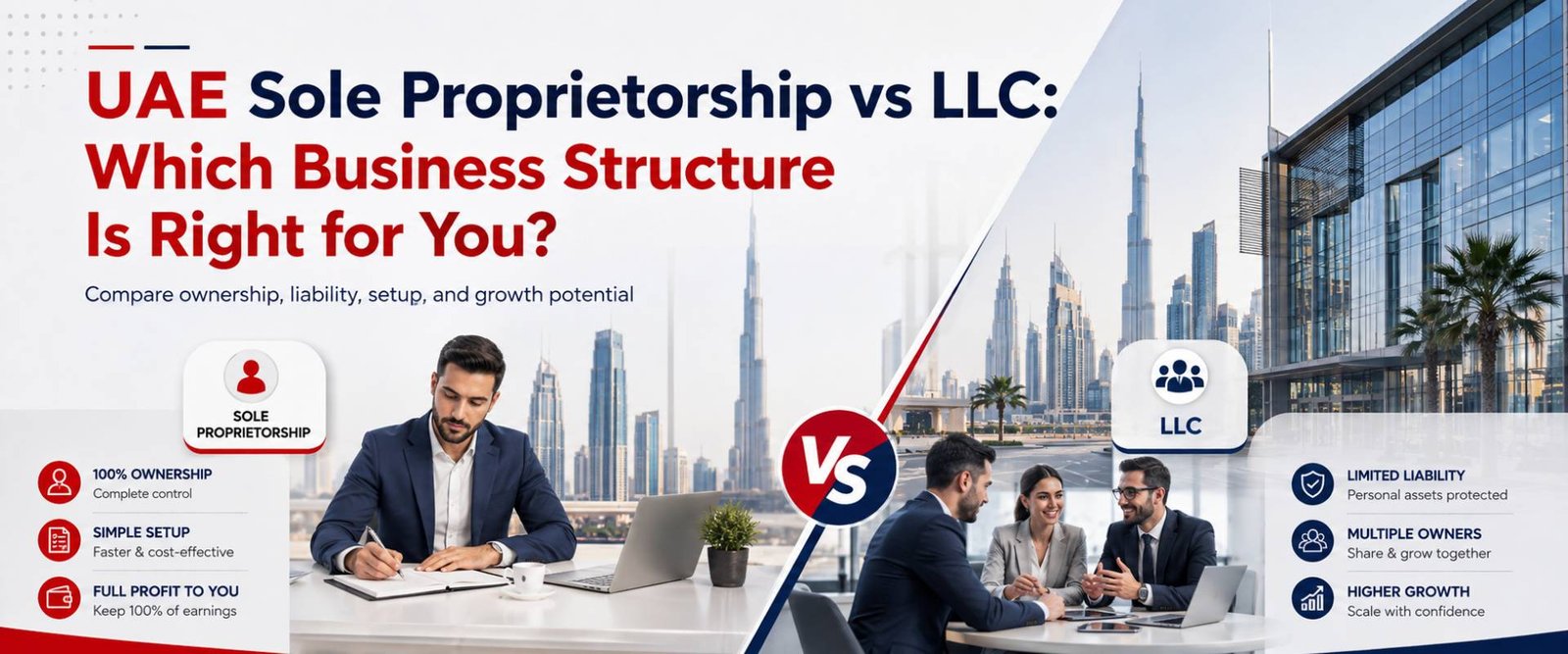
A sole proprietorship in the UAE, called a sole establishment, belongs to one person who carries unlimited personal liability, and foreigners can usually open one only for professional services. An LLC is a separate company with one to 50 shareholders, limited liability and access to trading, commercial and industrial activities. Pick a sole proprietorship for low-risk solo services and an LLC when you plan to trade, hire or grow.
Sole Proprietorship vs LLC in the UAE at a Glance
| Point | Sole proprietorship (sole establishment) | Limited Liability Company (LLC) |
|---|---|---|
| Legal status | Not separate from the owner | Separate legal entity |
| Owners | One individual | 1 to 50 shareholders (people or companies) |
| Foreign ownership | 100% for professional activities | 100% for most activities |
| Activities | Professional and artisan services | Commercial, trading, industrial and professional |
| Liability | Unlimited, personal assets at risk | Limited to your share capital |
| Local Service Agent | Usually required for foreign owners | Not required for most activities |
| Corporate tax | Owner taxed as a natural person once business turnover passes AED 1 million a year | Must register; 0% up to AED 375,000 of taxable income, 9% above |
| Best for | Freelancers, consultants, solo professionals | Traders, growing teams, partners, investors |
What Is a Sole Proprietorship in the UAE?
In the UAE, a sole proprietorship is officially called a sole establishment. The trade licence is issued in one person’s name by the Department of Economy and Tourism (DET) in Dubai, or by the economic department of the emirate you choose. The business has no legal identity of its own, so its contracts, debts and bank account legally belong to you.
Foreign nationals can own 100% of a sole establishment when the activity is professional. Typical examples include:
- Management, business and IT consultancy
- Graphic design, interior design and architecture
- Marketing, training and coaching services
- Engineering consultancy and translation
Foreign owners usually need to appoint a Local Service Agent. This UAE national handles government paperwork for a fixed annual fee and holds no shares, profit or control. UAE and GCC nationals can also hold sole establishments for commercial activities. If you plan to run a solo advisory firm, our guide to getting a consultancy licence in Dubai explains the licence in detail.
What Is an LLC in the UAE?
A Limited Liability Company is a separate legal entity governed by Federal Decree-Law No. 32 of 2021 on Commercial Companies. It can have between 1 and 50 shareholders, so a single-owner LLC is allowed. Since the 2021 reforms, foreign investors can own 100% of an LLC for most mainland activities without an Emirati partner. A short list of strategic activities still carries extra conditions.
As its own legal person, an LLC can sign contracts, own assets, trade across the UAE and bid for government work, which is why most trading, retail and hospitality businesses choose it. You can read more in our guides to mainland company formation in Dubai and the general trading licence.
Key Differences Between a Sole Proprietorship and an LLC
1. Ownership and Who Can Apply
A sole establishment always has one owner. An LLC can start with one shareholder and later add partners or investors by amending the Memorandum of Association.
2. Liability and Personal Risk
This difference matters most. A sole establishment has no wall between you and the business. If a client dispute ends in a claim of AED 400,000, your savings, car or property can be used to settle it. With an LLC, creditors can normally claim only against company assets. Personal guarantees you sign, for example on a bank facility or office lease, still bind you personally.
3. Permitted Business Activities
A foreign-owned sole establishment is limited to professional and artisan activities. You cannot use it to buy and sell goods, import stock or run a shop. An LLC can cover commercial, industrial and professional activities under one licence, which gives you room to add services later.
4. Corporate Tax and VAT
- Sole establishment: you are taxed as a natural person. Under Cabinet Decision No. 49 of 2023, you must register for corporate tax once turnover from your business passes AED 1 million in a calendar year. Taxable income above AED 375,000 is then taxed at 9%.
- LLC: the company must register for corporate tax whatever its size. Taxable income up to AED 375,000 is taxed at 0% and the rest at 9%.
- Small Business Relief: resident businesses with revenue of AED 3 million or less can elect to be treated as having no taxable income for tax periods ending on or before 31 December 2026.
- VAT: the rules are the same for both. Registration is mandatory once taxable supplies pass AED 375,000 a year and optional from AED 187,500.
The Federal Tax Authority’s guide on taxation of natural persons covers the individual rules in detail. Our VAT consultants and accounting services team can handle registration and filing for either structure.
5. Visas, Banking and Credibility
Both structures can sponsor residence visas for the owner, staff and family. The number of visas depends mainly on your office size. Banks, landlords and large clients often prefer an LLC because its ownership and liability are clearly documented. See our guide to corporate bank account opening in Dubai to prepare for the bank’s checks.
Cost of a Sole Proprietorship vs LLC in Dubai
Your activity, office and visa count drive the cost more than the legal form. The main items are:
- Trade licence and DET registration fees
- Local Service Agent annual fee (sole establishment only)
- Memorandum of Association notarisation (LLC only)
- Office space and Ejari registration
- Establishment card, visas, medical tests and Emirates ID
- Bookkeeping, and an audit where required
As a guide, a professional sole establishment usually costs a little less than an LLC in the first year. A trading LLC with a physical office costs more. DIAC mainland packages start from around AED 18,500. For a figure based on your own plan, try our business setup cost calculator.
Pros and Cons at a Glance
Sole Proprietorship
- Pros: simple to set up, lower running costs, full control, no corporate tax registration until business turnover passes AED 1 million
- Cons: unlimited personal liability, limited to professional activities for foreigners, Local Service Agent fee, harder to bring in partners
LLC
- Pros: limited liability, wide range of activities, easy to add shareholders, stronger image with banks and clients
- Cons: higher setup cost, more paperwork, mandatory corporate tax registration and filing
What About Free Zones?
Free zones do not issue sole establishment licences. If you want to work alone with limited liability, the free zone option is a Free Zone Establishment (FZE) or a single-shareholder FZ-LLC. You get 100% ownership and can pay 0% corporate tax on qualifying income if you meet the free zone conditions. The trade-off is that selling goods directly to mainland customers usually needs a distributor or a mainland branch. Compare zones in our free zone business setup guide, or look at a cost-friendly option like an IFZA free zone company.
Which One Should You Choose?
In our experience, the choice comes down to your activity and your risk:
- Choose a sole proprietorship if you are a freelancer or consultant, work alone, serve UAE clients and your work carries low financial risk.
- Choose an LLC if you will trade goods, hold stock, run a restaurant or shop, sign high-value contracts or bring in partners.
- Choose a free zone FZE if most of your clients are outside the UAE and you want limited liability at a lower cost.
If unsure, starting as an LLC is usually safer than restructuring later.
How to Set Up Either Structure in Dubai
- Choose your business activity on the DET activity list.
- Reserve a trade name. If the name matters to you, consider trademark registration as well.
- Get initial approval from the DET.
- Sign a Local Service Agent agreement (sole establishment) or the Memorandum of Association (LLC).
- Lease an office and register the Ejari.
- Pay the fees and collect your trade licence.
- Apply for the establishment card and visas. Our PRO services team can handle this for you.
- Open a corporate bank account and register for tax where required.
The DET’s Invest in Dubai portal lists current activities and fees if you want to check them yourself.
Can You Change from a Sole Proprietorship to an LLC Later?
Yes. As your business grows, you can move to an LLC. In most cases this means forming a new LLC and moving your contracts, staff and visas across, then cancelling the sole establishment. Any debts or claims from your sole establishment years stay with you personally, so it pays to plan the move before you take on large contracts.
Common Mistakes to Avoid
- Applying for a sole establishment for a trading activity, which foreign owners cannot hold.
- Ignoring unlimited liability when signing large client or supplier contracts.
- Assuming an LLC with low profit does not need to register for corporate tax.
- Signing a Local Service Agent agreement without reading the fee and exit terms.
Frequently Asked Questions
Is a sole establishment the same as a sole proprietorship in the UAE?
Yes. Sole establishment is the official UAE term for a business owned by one person with no separate legal identity.
Can a foreigner open a sole proprietorship in Dubai?
Yes, for professional activities such as consultancy, design or IT services. Foreign owners keep 100% ownership but usually need a Local Service Agent. Commercial and trading activities need an LLC instead.
Can one person open an LLC in the UAE?
Yes. UAE law allows an LLC with a single shareholder, and you can add partners later by amending the Memorandum of Association.
Which is cheaper, a sole proprietorship or an LLC?
A professional sole establishment is usually slightly cheaper to set up and run, though office size and visas affect the total more.
Do sole proprietorships pay corporate tax in the UAE?
Only when business turnover passes AED 1 million in a calendar year. After that, the owner registers as a natural person and pays 9% on taxable income above AED 375,000.
Does a sole proprietorship need a Local Service Agent?
A foreign-owned professional sole establishment in Dubai mainland usually does. The agent is a UAE national with no ownership or profit share, paid a fixed yearly fee.
Can a sole proprietorship sponsor visas?
Yes. A sole establishment can sponsor visas for the owner, employees and family, based on its office space and approvals.
Can I convert my sole establishment into an LLC?
Yes, usually by forming a new LLC and transferring your business. Liabilities from the sole establishment period stay personal.
Talk to a Business Setup Consultant
Your legal structure shapes your liability, tax and growth for years. At DIAC, we review your activity and plans, then recommend the right structure with a clear cost breakdown. Explore our full business setup in Dubai services or book a free consultation today.