| Summary
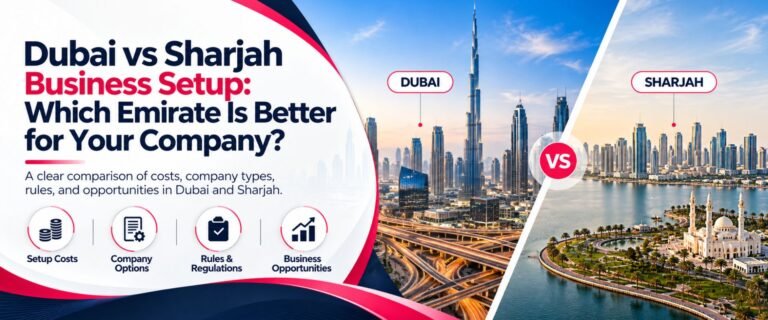
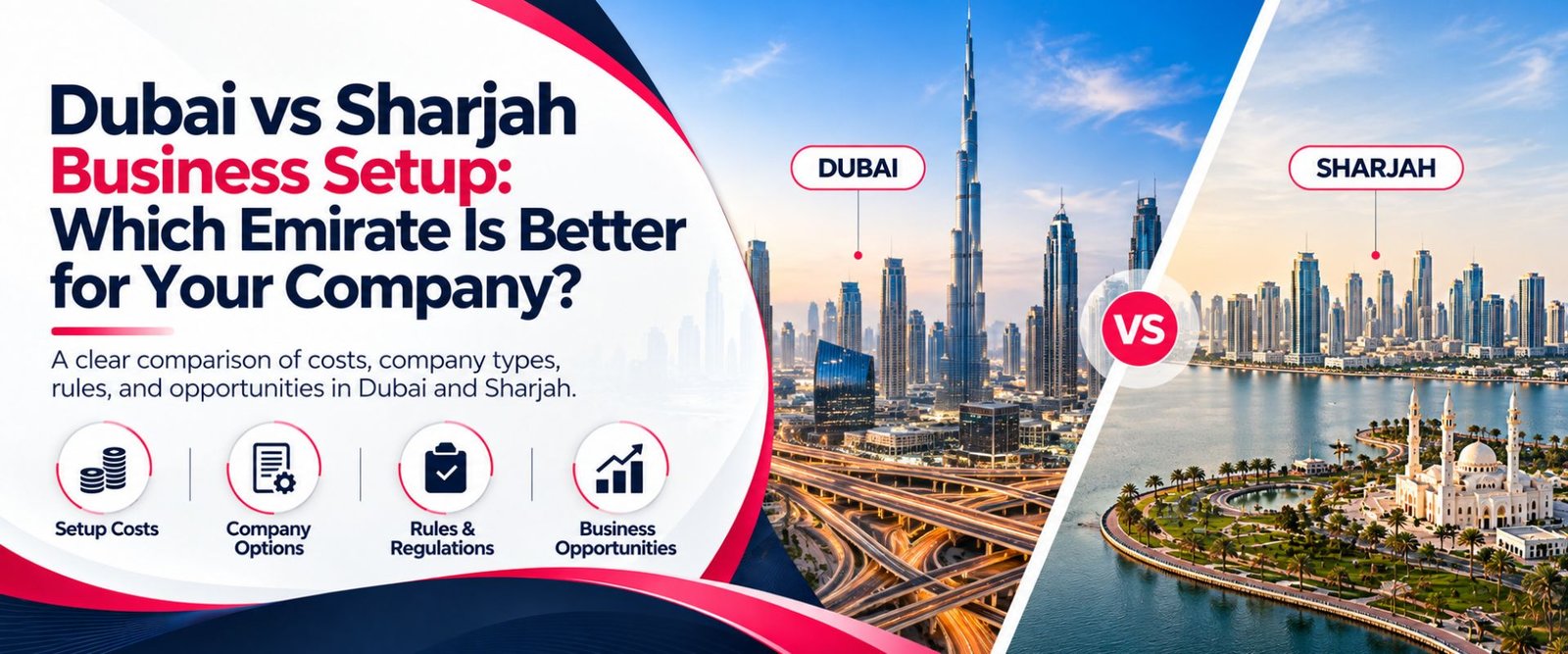
Dubai and Sharjah sit just 15 km apart on the UAE coastline — but they serve very different business profiles. Dubai offers global brand recognition, premium infrastructure and 30+ specialised free zones. Sharjah is 15-25% cheaper across licences, office space and industrial land, with a growing portfolio of free zones and a manufacturing-first economy. This guide breaks down every factor that matters for your UAE company formation decision. |
Dubai vs Sharjah: Quick Comparison at a Glance
| Factor | Dubai | Sharjah |
| Trade Licence (Mainland, commercial) | AED 12,000-25,000 / yr | AED 9,500-13,000 / yr |
| Free Zone Entry Package (1 visa) | From AED 11,500 (IFZA) | From AED 5,750 (SHAMS) |
| Office Space (shared / flexi) | AED 25,000-60,000 / yr | AED 15,000-30,000 / yr |
| Industrial Land / Warehouse | Premium (limited availability) | 10-20% lower vs Dubai equivalent |
| Number of Free Zones | 30+ | 6 (SAIF, SHAMS, Hamriyah, SPC, SRTIP, SFZA) |
| Regulator (Mainland) | Dubai Economy and Tourism (DET) | Sharjah Economic Development Dept (SEDD) |
| Port Access | Jebel Ali Port (world’s 9th largest) | Khalid Port + 3 seaports (incl. Gulf of Oman) |
| Airport | Dubai International (DXB), Al Maktoum (DWC) | Sharjah International Airport (SHJ) |
| Corporate Tax | 0-9% (AED 375K threshold) | 0-9% (AED 375K threshold) |
| 100% Foreign Ownership | Yes (most activities) | Yes (most activities) |
| Key Sectors | Finance, tech, luxury, FMCG, logistics | Manufacturing, printing, education, logistics |
| Social Environment | Liberal, cosmopolitan | Conservative — alcohol ban, dress code |
Source: Dubai Economy and Tourism (DET), Sharjah Economic Development Department (SEDD), SAIF Zone, SHAMS, official authority websites. Costs indicative — request formal quotes before committing.
The UAE mainland company formation question most first-time investors get wrong is assuming they must set up in Dubai. Sharjah — just 10-15 minutes from Deira — offers genuine cost advantages, a rapidly growing free zone ecosystem and direct access to three seaports including one on the Gulf of Oman coast. For the right business profile, the savings can be substantial.
That said, Dubai remains the right choice for businesses targeting global markets, financial services, technology or luxury sectors where the emirate’s brand value and infrastructure are non-negotiable. At DIAC we help clients choose between emirates, structure their licence correctly and avoid the setup mistakes that cost money down the line.
Dubai vs Sharjah: The Business Case for Each
Why Businesses Choose Dubai
Dubai is the UAE’s commercial capital and one of the world’s top 10 business destinations. Its appeal for company formation is well-documented:
- Global brand recognition that immediately signals credibility to international partners and clients
- Dubai International Airport: the world’s busiest for international passengers, connecting to 240+ destinations
- Jebel Ali Port: Middle East’s largest port with 19.4 million TEU capacity and 140+ shipping routes
- 30+ specialised free zones including DIFC (financial services), Dubai Media City, Dubai Internet City (MENA’s largest ICT hub) and DMCC (commodities)
- World-class banking infrastructure with 50+ international banks represented
- Multinational HQ ecosystem — 70% of Fortune 500 companies have a regional presence in Dubai
- Instant Licence option for some activities (same-day issuance via Invest in Dubai portal)
Dubai’s strengths are most relevant for businesses in financial services, international trading, technology, luxury retail, hospitality, FMCG distribution and any company where global partnerships, investor confidence or premium brand positioning drives commercial outcomes.
Why Businesses Choose Sharjah
Sharjah is UAE’s most underrated emirate for business setup. It contributes 15-20% of the UAE’s total GDP and hosts more than 48% of the UAE’s industrial output — a statistic most first-time UAE entrants find surprising.
- Lower licence fees: Sharjah mainland commercial licences from AED 9,500 vs AED 12,000+ in Dubai
- Cheaper office and warehouse space: typically 15-25% below comparable Dubai locations
- Three seaports (including Port Khalid and Hamriyah Port) plus access to the Gulf of Oman coastline via Khor Fakkan — the only emirate with access to both UAE coastlines
- 19 industrial areas with large-format plots for manufacturing, logistics and storage
- Sharjah International Airport (SHJ): budget carrier hub with 12+ airlines and cargo services
- Six free zones from AED 5,750 entry packages at SHAMS
- 15% cheaper labour costs and more affordable residential rents for staff
Sharjah is the natural choice for manufacturing businesses, printing and publishing companies, logistics operators, education providers and any SME where keeping operational costs low is a competitive necessity rather than a preference.
Cost of Business Setup: Dubai vs Sharjah Side by Side
Cost is the single biggest decision driver for businesses comparing these two emirates. Here is how the numbers actually stack up across every major cost component.
Mainland Licence Fees Compared
| Licence Type | Dubai (DET) | Sharjah (SEDD) |
| Commercial / Trading | AED 12,000-25,000 / yr | AED 9,500-13,000 / yr |
| Professional Services | AED 10,000-20,000 / yr | AED 8,000-12,000 / yr |
| Industrial | AED 15,000-25,000 / yr | AED 10,000-18,000 / yr |
| Trade Name Reservation | AED 620-750 | AED 300-500 |
| Initial Approval Fee | AED 120 | AED 100-150 |
| Minimum Office Rent (shared) | AED 25,000-40,000 / yr | AED 15,000-25,000 / yr |
| Typical Year-1 Total (commercial) | AED 40,000-65,000 | AED 30,000-45,000 |
Source: Dubai Economy and Tourism (DET), Sharjah Economic Development Department (SEDD). Costs vary by activity type, number of partners and premises selected. Request a formal quote for your specific activity.
Free Zone Licence Fees Compared
| Free Zone | Emirates | Entry Package (1 visa) | Best For |
| SHAMS | Sharjah | AED 5,750 | Media, creative, freelancers |
| IFZA | Dubai | AED 12,900 (0 visa) | Multi-activity trading |
| SAIF Zone | Sharjah | AED 10,800 (3 visas) | Trading, import/export |
| DMCC | Dubai | AED 18,000+ | Commodities, trading |
| HAMRIYAH FZ | Sharjah | AED 11,000-18,000 | Manufacturing, industrial |
| SPC Free Zone | Sharjah | AED 9,500-14,000 | Publishing, printing, e-commerce |
| SRTIP | Sharjah | AED 8,500-13,800 | Tech, innovation, R&D |
| Dubai South | Dubai | AED 7,000-8,500 | Aviation, logistics near DWC |
Source: Individual free zone authority websites. Packages change regularly — verify current pricing with each zone directly or via DIAC.
The headline finding: Sharjah’s SHAMS (from AED 5,750) is the most affordable free zone entry package in the entire UAE. For micro-businesses, consultants and freelancers who need a UAE licence without a heavy capital commitment, SHAMS consistently undercuts every Dubai competitor.
Location and Market Access: Dubai vs Sharjah
Distance between Dubai and Sharjah is one of the most misunderstood aspects of this comparison. The two emirate borders are less than 15 km apart. A company registered in Sharjah can be operating from an office in Sharjah’s industrial area while its sales team visits Dubai clients, a 20-minute drive in off-peak traffic.
Sharjah’s Geographic Superpower
Sharjah is the only emirate in the UAE with territory on both the Arabian Gulf coast (west) and the Gulf of Oman coast (east, via Khor Fakkan and Dibba Al Hisn). This gives Sharjah-registered businesses direct access to Indian Ocean shipping lanes without routing through the Strait of Hormuz, a significant strategic and cost advantage for East Asia-facing trade routes.
- Port Khalid: Arabian Gulf coast, general cargo and RoRo operations
- Hamriyah Port: industrial and bulk cargo terminal linked to Hamriyah Free Zone
- Khor Fakkan Port: East coast deep-sea container terminal, direct Indian Ocean access
For businesses importing from India, Pakistan, Sri Lanka or Southeast Asia, Khor Fakkan avoids the additional 6-8 hours of sailing time required to enter the Arabian Gulf via the Strait of Hormuz, translating to real freight cost savings at scale.
Dubai’s Connectivity Advantage
Dubai’s Jebel Ali Port is the 9th busiest container port in the world and the Middle East’s undisputed logistics anchor. Combined with Dubai International Airport, the world’s busiest for international passengers, Dubai offers a depth of logistics connectivity Sharjah cannot currently match for volume and route frequency. For businesses where fastest-to-market is the priority, Dubai’s infrastructure wins outright.
Sharjah Free Zones vs Dubai Free Zones
Sharjah has six established free zones, each with a distinct sector focus. Dubai has 30+, many of them highly specialised. Understanding which free zones serve your industry is more important than the number of options available.
Sharjah’s Free Zone Ecosystem
- SAIF Zone (Sharjah Airport International Free Zone): Trading, commercial, e-commerce, gold — entry from AED 10,800 including 3 visas. Located adjacent to Sharjah Airport. Strong for import/export businesses.
- SHAMS (Sharjah Media City): Media, publishing, creative services, consultancy, e-commerce — entry from AED 5,750 including 1 visa. Most affordable free zone in the UAE.
- Hamriyah Free Zone: Manufacturing, industrial, heavy equipment, logistics — from AED 11,000-18,000. Hamriyah Port access. 22 million sqm of industrial and commercial land.
- SPC Free Zone (Sharjah Publishing City): Publishing, printing, media, e-commerce — from AED 9,500. Only publishing-dedicated free zone in the world.
- SRTIP (Sharjah Research, Technology and Innovation Park): Tech startups, R&D, innovation — from AED 8,500.
- Sharjah Free Zone Authority (SFZA): Industrial and commercial activities near Sharjah’s industrial hub.
Dubai’s Free Zone Ecosystem
Dubai’s 30+ free zones are categorised by sector and location. Key zones for our clients include IFZA (multi-activity, from AED 12,900), DMCC (commodities), DIFC (financial services), Dubai Media City, Dubai Internet City, JAFZA (port logistics), and Dubai South (aviation/logistics near DWC). See our full Dubai free zone setup guide for a complete comparison.
The depth of Dubai’s free zone ecosystem is its true competitive advantage. Each zone offers a dedicated regulatory environment, specialised community of sector peers, and often preferential access to government approvals relevant to that industry. For tech companies, DIFC and Dubai Internet City give credibility that Sharjah’s SRTIP — though growing — cannot yet match.
Industry Clusters: Where Each Emirate Excels
| Industry / Activity | Recommended Emirate | Key Reason |
| Finance and banking | Dubai (DIFC) | DIFC common law jurisdiction, global credibility |
| Tech startups and SaaS | Dubai | Dubai Internet City ecosystem, investor access |
| Manufacturing and industrial | Sharjah | 48% of UAE’s industrial output, land availability |
| Printing and publishing | Sharjah (SPC) | World’s only publishing-dedicated free zone |
| Import/export trading (east-west) | Sharjah (SAIF / Khor Fakkan) | Both coastline access, lower freight cost |
| Logistics and 3PL | Dubai (JAFZA) | Jebel Ali Port depth and volume |
| Education and training | Sharjah | Conservative market, lower cost, KHDA proximity |
| E-commerce and digital retail | Either (SHAMS or Dubai South) | SHAMS: cheapest licence; Dubai South: DWC proximity |
| Media and creative services | Dubai or Sharjah (SHAMS) | Dubai for scale; SHAMS for budget |
| Luxury retail and hospitality | Dubai | Market presence, tourist footfall, international clientele |
| Pharmaceuticals and healthcare | Dubai (DHCC) or Sharjah | Dubai for DHCC; Sharjah for cost-effective operations |
| SME with mainland Dubai customers | Sharjah (with dual activity) | Lower cost base, mainland access via SEDD |
Quality of Life and Business Environment
For business owners and their teams, the emirate you set up in shapes daily working life. There are meaningful differences between Dubai and Sharjah that go beyond costs and logistics.
Sharjah’s Conservative Environment
Sharjah operates under a stricter interpretation of Islamic social norms than Dubai. Key distinctions that affect business operations and staff recruitment:
- Alcohol is banned throughout Sharjah, no licensed venues, no sale of alcohol in the emirate
- Conservative dress code applies in public spaces — more enforced than in Dubai
- Entertainment restrictions: no live music in public venues; family-focused leisure infrastructure
- Lower residential rents: 20-30% cheaper than comparable Dubai areas, stretching employee take-home pay
For businesses with international staff from markets accustomed to Dubai’s lifestyle, Sharjah’s environment can be a recruitment friction point. Many employees based in Sharjah commute to Dubai for social activities, which is feasible given proximity, but it is a genuine consideration.
Dubai’s Cosmopolitan Environment
Dubai is one of the world’s most cosmopolitan cities with 200+ nationalities represented in its workforce. Its relatively liberal social environment, world-class entertainment, international schools, healthcare and lifestyle infrastructure make it the preferred choice for multinationals recruiting globally. The trade-off is higher residential rents, living costs and salary expectations, all of which flow through into operating costs for your business.
Regulatory and Approval Process
Both emirates have streamlined their business setup processes significantly in recent years. Dubai’s Invest in Dubai portal offers some of the fastest digital approvals in the region, including same-day licence issuance for certain activities. Sharjah’s SEDD has also moved much of its process online, with mainland licences typically processed within 5-10 business days for standard activities.
One practical difference: Sharjah’s approval ecosystem is smaller and sometimes faster for simpler applications precisely because of lower volume. Dubai’s large volume of applications can occasionally extend processing timelines during peak periods, though its digital infrastructure mitigates this significantly.
Talent Pool, Labour Costs and Workforce Planning
UAE Labour law (federal) is identical in both emirates, MOHRE (Ministry of Human Resources) governs employment contracts, visa processing and labour standards across all seven emirates. The practical differences lie in costs and availability.
- Salary expectations: Dubai-based professionals typically command 10-20% higher salaries than equivalents in Sharjah, driven by higher living costs
- Labour supply: Dubai’s larger talent pool means faster hiring for specialised roles; Sharjah excels for skilled blue-collar and industrial roles
- Visa processing: identical federal process via MOHRE and GDRFA; timelines similar in both emirates
- Accommodation costs: residential rents in Sharjah run 20-30% below comparable Dubai areas — this directly reduces your staff’s cost-of-living pressure and can allow lower salary packages
For manufacturing businesses requiring large blue-collar workforces, Sharjah’s lower accommodation costs and well-established industrial workforce community are a genuine operational advantage.
Mainland vs Free Zone: Which Company Structure Makes Sense?
Whether you choose Dubai or Sharjah, you will face the mainland vs free zone question. Here is the decision logic:
Mainland Company (DET or SEDD)
- Can trade directly on the UAE mainland with no restrictions on customers or contracts
- Can bid for government and semi-government contracts in most cases
- Requires a physical office (Ejari-registered tenancy)
- Activities covering both supply and retail typically need mainland, no agent or distributor required
- 100% foreign ownership now available in most activity categories under 2021 FDI law reforms
Free Zone Company
- 100% foreign ownership, full profit repatriation, always has been
- Can trade internationally without restriction
- UAE mainland trading requires a local distributor or agent (or a mainland subsidiary)
- Lower minimum setup costs in some zones (SHAMS from AED 5,750)
- Faster setup for some activities (some zones issue licences within 24-48 hours)
Businesses that need to operate freely on the UAE mainland, retail, B2B services, contracting, typically need a Dubai mainland company formation or Sharjah mainland company. Businesses primarily serving export markets or needing a cost-efficient UAE presence often find free zone the right starting point.
How to Set Up a Company in Dubai or Sharjah: The Process
Both mainland and free zone processes follow broadly similar steps. Here is what the journey looks like:
- Step 1: Choose your emirate, jurisdiction (mainland / free zone / offshore) and business activity: this determines your regulator and licence structure
- Step 2: Reserve your trade name: online via Invest in Dubai (DET) or SEDD portal for mainland; via the free zone portal for free zone companies
- Step 3: Submit your application with required documents: passport copy, visa page, no-objection letter if applicable, business plan for some activities
- Step 4: Initial approval: 1-5 business days for most standard activities
- Step 5: Sign and notarise your Memorandum of Association (mainland only)
- Step 6: Secure your Ejari-registered office / free zone facility agreement
- Step 7: Receive your trade licence
- Step 8: Open a corporate bank account (allow 2-8 weeks depending on the bank and activity)
- Step 9: Process investor and employee visas via MOHRE / GDRFA
Total timeline for a straightforward commercial or service activity: 7-21 business days from document submission to licence issuance. Complex activities (healthcare, financial services, education) require additional approvals and typically take 4-12 weeks.
Frequently Asked Questions
Is it cheaper to set up a business in Sharjah than Dubai?
Generally yes. Sharjah mainland commercial licences start from AED 9,500 vs AED 12,000+ in Dubai. Sharjah free zone entry packages start from AED 5,750 at SHAMS — the most affordable free zone licence in the UAE. Office space and warehouse rents in Sharjah run 15-25% below comparable Dubai locations. However, the cheapest licence is not always the most valuable: Dubai’s brand recognition and market access often justify the premium for international businesses.
Can I set up in Sharjah and do business in Dubai?
Yes. A Sharjah mainland company can trade with customers across the UAE including Dubai. A Sharjah free zone company can supply clients in Dubai through a local distributor or agent, or by setting up a mainland branch. There is no legal restriction on a Sharjah-registered business serving Dubai customers — the UAE is a single domestic market.
What are the best free zones in Sharjah?
The best Sharjah free zone depends on your business type. SHAMS (Sharjah Media City) is the most affordable option from AED 5,750, suited to media, creative and consultancy businesses. SAIF Zone (Sharjah Airport International Free Zone) is ideal for trading and import/export from AED 10,800 with 3 visas included. Hamriyah Free Zone is the strongest option for manufacturing and industrial businesses, with port access and large industrial plots. SPC Free Zone suits publishing, printing and e-commerce.
Is Sharjah a good place for manufacturing businesses?
Sharjah is arguably the UAE’s best emirate for manufacturing. It hosts more than 48% of the UAE’s total industrial output, with 19 dedicated industrial areas offering large-format plots at significantly lower per-sqm rates than Dubai. Hamriyah Free Zone provides direct port access, while the broader Sharjah industrial ecosystem includes established supplier networks and affordable labour and accommodation costs.
Does Sharjah allow alcohol?
No. Sharjah operates under a strict alcohol ban throughout the emirate — there are no licensed venues, no hotel bars and no retail sale of alcohol in Sharjah. This is a meaningful lifestyle difference compared to Dubai and should be factored into workforce planning for businesses planning to recruit internationally. Many professionals live in Sharjah and commute to Dubai for entertainment, but the restriction is a real consideration.
How long does it take to set up a company in Sharjah?
A standard Sharjah mainland company (SEDD) typically takes 7-15 business days from document submission to licence issuance for standard commercial and professional activities. Sharjah free zones such as SHAMS and SAIF Zone can often process applications faster — sometimes 2-5 business days for straightforward licence types. Activities requiring additional regulatory approvals (healthcare, education, food) take longer in both Sharjah and Dubai.
Can I get 100% foreign ownership in Sharjah?
Yes. Following UAE federal law reforms in 2021, 100% foreign ownership is available across most commercial and professional activity categories in Sharjah mainland without requiring a UAE national partner. All Sharjah free zone companies (FZE and FZCO structures) have always allowed 100% foreign ownership. A small number of strategic or restricted activities still require UAE national partnership — your consultant can confirm whether your specific activity falls under this exception.
Not Sure, Dubai or Sharjah?Our UAE business setup consultants compare both emirates for your specific activity and budget — and recommend the right fit. Book a free call. |
| About the Author
Adil Ahmad is a UAE business setup consultant with over a decade of experience guiding entrepreneurs, SMEs and multinationals through mainland and free zone company formation in Dubai, Sharjah and across all seven emirates. He specialises in licence structuring, cost optimisation and emirate selection for businesses entering the UAE for the first time. |