
| Summary
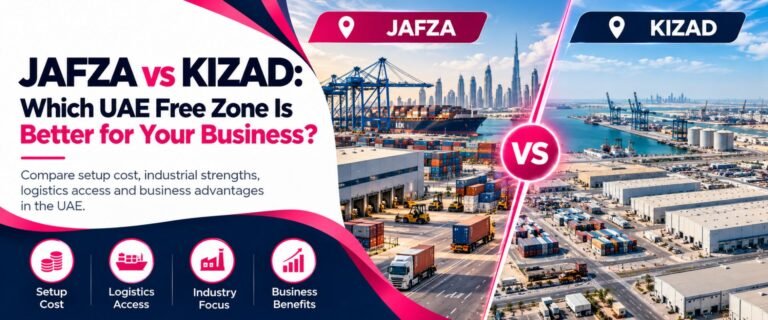
JAFZA (Jebel Ali Free Zone) and KIZAD (Khalifa Industrial Zone Abu Dhabi, now KEZAD) are the UAE’s two largest port-linked free zones. JAFZA sits beside Jebel Ali Port in Dubai, handling 15.5 million TEUs annually, while KIZAD adjoins Khalifa Port in Abu Dhabi, one of the most automated deep-sea terminals in the region. This guide compares costs, sector strengths, location advantages and who each zone suits best, so you can choose with confidence. |
JAFZA vs KIZAD: Quick Facts at a Glance
| Feature | JAFZA | KIZAD / KEZAD |
| Location | Jebel Ali, Dubai | Taweelah, Abu Dhabi |
| Regulator / Operator | Jebel Ali Free Zone Auth. (DP World) | AD Ports Group (KEZAD Group) |
| Port | Jebel Ali Port | Khalifa Port |
| Total Area | 57 sq km | 410 sq km |
| Registered Companies | 11,000+ | 700+ (rapidly expanding) |
| Year Established | 1985 | 2010 |
| Entry Package (1 visa) | AED 15,000-25,000 / yr | AED 9,450 / yr |
| Warehouse (starting) | AED 400 / sqm / yr | AED 250-350 / sqm / yr (pre-built) |
| Industrial Land Lease | On request | AED 10-45 / sqm / yr |
| Min. Paid-up Capital (FZE) | AED 10,000 (guidance) | AED 150,000 |
| Key Sectors | Logistics, petrochem, FMCG, electronics | Heavy industry, aluminium, pharma, polymers |
| 100% Foreign Ownership | Yes | Yes |
| Corporate Tax | 0% (FZ qualifying income) | 0% (FZ qualifying income) |
| Dual Licence (mainland) | Available via JAFZA-LLC | Available via Abu Dhabi mainland link |
Source: jafza.ae, kizad.ae / kezad.ae, adports.ae, data current to the date of publication. Fees are indicative; request a formal quote before committing.
When businesses need a UAE free zone with direct port access and serious industrial capacity, two names dominate the conversation: JAFZA and KIZAD. Both offer 100% foreign ownership, zero personal income tax, full profit repatriation and a direct link to world-class seaports. Yet the two zones serve different ends of the UAE industrial spectrum, and choosing the wrong one can cost you significantly in logistics, time and regulatory headaches.
At DIAC we have helped hundreds of trading, manufacturing and logistics businesses choose the right UAE free zone. In this guide we break down every factor that matters: port capacity, licence costs, warehouse rates, industrial land, sectors, location and the decision criteria you should actually be using.
The Ports: Jebel Ali vs Khalifa Port
The most important differentiator between these two zones is not the free zone itself but the port it sits beside. Every day, thousands of containers move through these terminals and your business benefits, or suffers, from the choice.
Jebel Ali Port (JAFZA)
Jebel Ali Port is the largest port in the Middle East and Africa and the 9th busiest container port in the world. In the most recently reported year, Jebel Ali handled 15.5 million TEUs, the highest throughput since 2015. The port spans a 25 km quayside with over 100 berths, a 19.4 million TEU annual capacity, and direct shipping routes to more than 150 countries. It is operated by DP World, one of the world’s largest port operators.
For importers and exporters, this translates to frequency: Jebel Ali offers some of the densest container shipping schedules in the region. If your business depends on speed to market across Asia, Europe and Africa, JAFZA’s port connectivity is unmatched in the UAE.
Khalifa Port (KIZAD / KEZAD)
Khalifa Port, managed by AD Ports Group, is the first semi-automated deep-sea port in the Middle East. It is currently ranked in the top 40 container ports globally by Lloyd’s List and handles 20 major shipping lines serving 60+ destination ports worldwide. Current capacity stands at 2.4 million TEUs with a long-term potential of 6 million TEUs as Abu Dhabi continues its port expansion programme.
Khalifa Port’s COSCO-Hutchison Ports terminal partnership gives it strong connectivity into China trade lanes, a significant advantage for businesses in heavy industry, raw materials and bulk manufacturing who source heavily from Asia. The semi-automated terminal also delivers faster turnaround times for container handling.
Sector Strengths: Where Each Zone Excels
| Industry | JAFZA | KIZAD / KEZAD |
| Logistics & 3PL | Strong — port-adjacent warehousing | Growing — strong for bulk/break-bulk |
| Petrochemicals / Chemicals | Very strong — dedicated storage zones | Strong — ADNOC supply chain adjacency |
| Aluminium / Metals | Moderate | Exceptional — EGA (largest aluminium smelter outside China) adjacent |
| Pharmaceuticals / Life Sciences | Good | Strong — dedicated pharma clusters |
| Food & Beverage / FMCG | Excellent — 100+ Fortune 500 food brands | Growing |
| Electronics / Electrical | Excellent — major global brands based here | Growing |
| Automotive | Very strong — regional distribution hub | Moderate |
| Heavy Industry / Manufacturing | Good — mainly light-medium industrial | Excellent — designed for heavy industry |
| Polymers / Plastics | Good | Very strong — polymer park infrastructure |
| Renewable Energy / Cleantech | Moderate | Strong — Abu Dhabi’s green economy push |
The pattern is clear: JAFZA dominates for trading, distribution, FMCG and electronics — businesses that need to move goods in and out fast. KIZAD dominates for heavy manufacturing, processing and industries that benefit from proximity to Abu Dhabi’s raw material infrastructure (aluminium, polymers, petrochemicals).
Licence, Office and Facility Costs Compared
| Cost Component | JAFZA | KIZAD / KEZAD |
| Trading Licence | AED 5,500-8,000 / yr | Included in packages |
| Industrial Licence | AED 8,000-12,000 / yr | Included in packages |
| Service Licence | AED 8,000 / yr | Included in packages |
| Entry Package (1 visa) | AED 15,000-25,000 / yr | AED 9,450 / yr |
| Entry Package (4 visas / 3 yrs) | AED 35,000-50,000 est. | AED 32,813 (3-yr package) |
| Flexi Desk / Workstation | AED 15,000 / yr | Included in base package |
| Executive Office | AED 25,000-40,000 / yr | On request |
| Pre-built Warehouse | AED 400 / sqm / yr (est.) | AED 250-350 / sqm / yr |
| Industrial Land Lease | On request (limited) | AED 10-45 / sqm / yr + AED 3 CAM |
| Min. Paid-up Capital (FZE) | AED 10,000 (guidance) | AED 150,000 |
| Typical Year-1 Cost (FZE, trading) | AED 40,000-60,000 | AED 50,000-80,000 |
| Light Industrial Unit Year-1 | AED 80,000-120,000+ | AED 150,000-300,000 |
Source: jafza.ae, kezad.ae, adports.ae. Costs shown are indicative ranges. Request formal quotations from each zone authority for accurate current pricing. DIAC does not endorse or guarantee any pricing shown.
For a lean trading company or service business, JAFZA’s entry costs are broadly comparable to KIZAD’s. The gap widens significantly when you move to industrial land and large-scale manufacturing, where KIZAD’s published per-sqm land rates give greater transparency for budgeting, though JAFZA’s established supply chain network often offsets higher facility costs through operational efficiency.
Location: Dubai vs Abu Dhabi, What It Means for Your Business
Geography is not just about where your warehouse sits. It determines your talent pool, your customer proximity, your banking options, your supplier ecosystem and your daily commute for staff.
JAFZA’s Dubai Location Advantage
JAFZA is located just 35 km from Dubai International Airport and 15 km from Al Maktoum International Airport, the world’s largest airport by planned capacity. It sits within Dubai’s logistics corridor alongside Expo City Dubai and Dubai South (see our
It sits within Dubai’s logistics corridor alongside Expo City Dubai and Dubai South (see our Dubai South vs DAFZA guide). Access to Dubai’s 3.6 million workforce, 115+ nationalities, sophisticated banking infrastructure and regional HQ ecosystem makes JAFZA attractive for multinationals and SMEs alike.
KIZAD’s Abu Dhabi Location Advantage
KIZAD is located approximately 35 km from Abu Dhabi city centre and 50 km from Abu Dhabi International Airport. It sits within Abu Dhabi’s industrial heartland, adjacent to ADNOC’s refining complex, EGA’s Taweelah aluminium smelter and Borouge’s polymers facility. If your supply chain plugs directly into Abu Dhabi’s energy and materials sector, KIZAD’s location eliminates inter-emirate logistics friction.
The Abu Dhabi-Dubai E11 highway connects KIZAD to Dubai in approximately 75-90 minutes, so regional distribution remains workable, but for businesses dependent on Dubai’s import/export consumer market, the extra distance adds cost.
Free Zone Structures: Company Types and Licence Options
Both free zones offer the standard UAE free zone company structures. Understanding what is available helps you choose the right setup from day one.
JAFZA Company Structures
- Free Zone Establishment (FZE) — single shareholder entity, most common for SMEs and solo entrepreneurs
- Free Zone Company (FZCO) — 2-50 shareholders, preferred for joint ventures and partnerships
- Branch of a Foreign Company — for established overseas businesses entering the UAE without forming a new legal entity
- Branch of a UAE Mainland Company — for UAE businesses expanding into free zone operations
- JAFZA-LLC — dual-licence option that gives free zone benefits with the ability to trade on the UAE mainland
KIZAD / KEZAD Company Structures
- Free Zone Establishment (FZE) — AED 150,000 paid-up capital required
- Free Zone Company (FZCO) — 2 or more shareholders, same capital requirements
- Branch of a Foreign Company — no minimum capital requirement
- Industrial Licence holders — may apply for special status including industrial permits for manufacturing, processing and assembly
A key structural difference: KIZAD imposes a formal AED 150,000 minimum paid-up capital for FZE formations. JAFZA’s guidance figure is AED 10,000, making JAFZA significantly more accessible for early-stage businesses that need to preserve working capital.
Logistics Infrastructure and Supply Chain Connectivity
For trading and distribution businesses, the infrastructure within the free zone — not just the port — determines operational efficiency. Both JAFZA and KIZAD have invested heavily in their logistics infrastructure, but in different ways.
JAFZA Logistics Infrastructure
JAFZA offers a mature, purpose-built logistics ecosystem developed over 40 years. Within the zone you will find:
- Port Rashid and Jebel Ali Port direct customs-bonded corridors
- Dedicated bonded warehousing with 24-hour customs clearance
- Cold storage facilities for food, pharmaceutical and perishable goods
- Al Maktoum International Airport cargo terminal connectivity
- Over 100 logistics and 3PL operators already based in the zone
JAFZA’s existing tenant base is itself an advantage: established multinationals bring established supplier and buyer ecosystems. If you are a 3PL provider, electronics distributor or FMCG importer, you are moving into a zone where your customers and partners are already established.
KIZAD Logistics Infrastructure
KIZAD is designed for heavy logistics and bulk movement at industrial scale:
- Integrated rail connectivity (Etihad Rail) planned and partially operational
- Road links to Abu Dhabi Port’s multi-modal terminal
- Dedicated bulk and break-bulk cargo handling at Khalifa Port
- Large-format industrial plots from 2,500 sqm to several hundred hectares
- Pre-built warehouses of 250-1,500 sqm for smaller industrial tenants
The Etihad Rail project will eventually connect KIZAD with the wider GCC rail network, significantly reducing overland freight costs. This makes KIZAD particularly compelling for businesses with a long-term UAE manufacturing footprint. For aviation-related logistics, see our best UAE free zone for aviation guide.
Visa Allocations and Workforce Planning
The number of work visas your free zone licence allows is a critical operational constraint, especially for manufacturing businesses that need large on-site workforces.
JAFZA Visa Policy
JAFZA allocates visas based on your facility type and size. A flexi desk or executive office typically grants 3-6 visas. Warehouse and industrial unit tenants can obtain significantly more, scaled to their facility square footage. JAFZA’s established processes mean visa applications are typically processed efficiently, with most investor visas issued within 5-10 business days.
KIZAD / KEZAD Visa Policy
KIZAD’s entry package (1 visa, 1 year) starts at AED 9,450. The 4-visa, 3-year package costs AED 32,813. For large-scale industrial operations with significant headcount, KIZAD works with investors to structure appropriate visa allocations tied to the size of the industrial plot or facility leased. Heavy manufacturers employing hundreds of workers typically negotiate custom visa quota arrangements directly with KEZAD Group.
Recent Developments and Strategic Direction
Both zones are evolving, and understanding their strategic direction helps you assess long-term suitability.
JAFZA: DP World’s Global Integration
JAFZA is deeply integrated into DP World’s global port and logistics network. This gives JAFZA tenants access to preferential rates, cross-terminal data visibility and a global supply chain network that smaller regional free zones cannot match. JAFZA attracted 23.9% of Dubai’s FDI and continues to be the anchor of Dubai’s trade-based economy. Recent additions include expanded cold chain capacity, e-commerce fulfilment zones and sustainability-focused facility certifications.
KIZAD / KEZAD: Abu Dhabi’s Industrial Ambition
KIZAD rebranded to KEZAD (Khalifa Economic Zones Abu Dhabi) to reflect its expanded scope under AD Ports Group. Abu Dhabi’s economic diversification strategy positions KIZAD/KEZAD as the industrial backbone of the emirate, with significant government investment in pharma clusters, renewable energy manufacturing, advanced materials and food production facilities. The zone is growing rapidly, from fewer than 400 companies to 700+, as Abu Dhabi actively courts heavy manufacturing FDI away from Asia and Europe.
Regulatory Environment and Business Setup Process
Both zones offer clear regulatory frameworks with digital-first application processes. There are, however, important differences in what each authority requires.
JAFZA Setup Process
JAFZA operates under the Jebel Ali Free Zone Authority, a regulatory body under the Government of Dubai. Setup typically takes 7-15 business days for standard trading and service licences. Required documents include passport copies, business plan, CV, and proof of address. JAFZA’s long history means its processes are refined and its support team experienced in handling complex multi-activity licences.
KIZAD / KEZAD Setup Process
KIZAD is regulated by KEZAD Group under AD Ports Group, which operates under the Abu Dhabi Government. The paid-up capital requirement (AED 150,000 for FZE) adds a step not present in JAFZA — investors must demonstrate capital availability before entity formation. Industrial licence holders are subject to additional environmental, health and safety compliance requirements due to the nature of heavy industry operations. Setup typically takes 10-20 business days.
JAFZA or KIZAD: The Decision Framework
Use this framework to match your business profile to the right zone:
| Business Profile | Recommended Zone | Key Reason |
| Import/export trading, FMCG | JAFZA | Highest global port connectivity, mature ecosystem |
| Electronics / tech distribution | JAFZA | Fortune 500 supply chain proximity |
| 3PL / freight forwarding | JAFZA | Dense logistics operator community, bonded warehousing |
| Heavy manufacturing | KIZAD | Industrial land scale and lower per-sqm rates |
| Aluminium / metals processing | KIZAD | Direct EGA supply chain adjacency |
| Pharma / life sciences manufacturing | KIZAD | Dedicated pharma cluster infrastructure |
| Petrochemicals / polymers | KIZAD | ADNOC and Borouge supply chain adjacency |
| Early-stage trading (low capital) | JAFZA | Lower paid-up capital requirement |
| Long-term industrial land investment | KIZAD | Transparent land lease pricing, larger plots |
| China-sourced manufacturing | KIZAD | COSCO terminal partnership at Khalifa Port |
| Regional HQ for multinational | JAFZA | Brand recognition, Dubai ecosystem |
Can You Register in Both JAFZA and KIZAD?
Yes — and some businesses do. A company with a trading arm and a manufacturing arm might register the trading entity in JAFZA (for port access and distribution) and the manufacturing entity in KIZAD (for industrial land and raw material proximity). The two free zones are in different emirates and subject to different regulatory authorities, so there is no barrier to operating in both.
If you are comparing free zones more broadly across Dubai, our guide to setting up in a Dubai free zone covers the full landscape including JAFZA, Dubai South, DAFZA and more.
For a deep-dive on KIZAD’s standalone proposition, read our dedicated KIZAD Free Zone guide.
| Related Reads
● JAFZA Official Website — jafza.ae ● KIZAD / KEZAD Official Website — kezad.ae ● UAE Ministry of Economy — economy.gov.ae |
Frequently Asked Questions
Is JAFZA cheaper than KIZAD?
For basic trading and service licences, JAFZA and KIZAD are broadly comparable in year-1 costs (AED 40,000-60,000 for a standard FZE). However, JAFZA requires a lower minimum paid-up capital (approximately AED 10,000 vs AED 150,000 for KIZAD), making it more accessible for early-stage businesses. For large industrial units or land plots, KIZAD’s published per-sqm rates often give more cost predictability.
Is JAFZA good for import/export businesses?
JAFZA is one of the best UAE free zones for import/export. Jebel Ali Port is the largest port in the Middle East, handling over 15 million TEUs annually with routes to 150+ countries. The zone’s bonded warehousing, mature customs processes and dense logistics ecosystem make it a leading choice for trading, distribution and freight operations.
Is KIZAD suitable for manufacturing businesses?
KIZAD (now KEZAD) is purpose-built for manufacturing. It offers industrial land from AED 10/sqm/yr, large-format plots, pre-built warehouse units and direct supply chain access to EGA (aluminium), ADNOC (petrochemicals) and Borouge (polymers). For heavy manufacturing, processing and industrial-scale production, KIZAD is typically the stronger choice over JAFZA.
Which is better for 3PL and warehousing?
JAFZA is generally preferred for 3PL and warehousing given its direct adjacency to Jebel Ali Port, its large existing base of logistics operators and its mature bonded warehousing infrastructure. KIZAD’s logistics facilities are growing but still developing relative to JAFZA’s 40-year head start. That said, KIZAD offers competitive pre-built warehouse rates (AED 250-350/sqm/yr vs JAFZA’s AED 400+/sqm/yr estimate).
What is the minimum investment to set up in KIZAD?
The minimum paid-up capital for a KIZAD Free Zone Establishment (FZE) is AED 150,000. The entry package for 1 visa over 1 year starts at AED 9,450. A realistic year-1 budget for a standard trading or service FZE in KIZAD — including registration, licence, facility deposit and visa costs — is AED 50,000-80,000, plus the paid-up capital requirement.
How far is KIZAD from Dubai?
KIZAD (Khalifa Industrial Zone Abu Dhabi / KEZAD) is located in Taweelah, approximately 80-90 km from Dubai’s central business district. The drive on the Abu Dhabi-Dubai E11 highway takes approximately 75-90 minutes under normal traffic conditions. For businesses whose customers and suppliers are primarily based in Dubai, this logistics distance should be factored into your operational cost calculations.
Can a foreign national own 100% of a JAFZA or KIZAD company?
Yes. Both JAFZA and KIZAD allow 100% foreign ownership of free zone entities. There is no requirement for a UAE national shareholder or sponsor. This applies to Free Zone Establishments (FZE), Free Zone Companies (FZCO) and branch offices of foreign companies in both zones.
Ready to Set Up in JAFZA or KIZAD?Our consultants compare all UAE free zones so you get the right fit the first time. Book a free call today. |
About the AuthorAdil Ahmad is a UAE business setup consultant with over a decade of experience helping entrepreneurs, SMEs and multinationals establish operations in Dubai and Abu Dhabi free zones. He specialises in free zone selection, licence structuring and cost optimisation across JAFZA, KIZAD, Dubai South, DAFZA and 30+ other UAE zones. |