| Summary
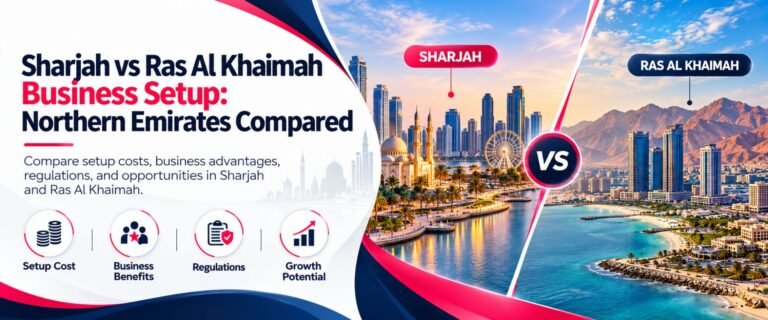
Sharjah and Ras Al Khaimah are the UAE’s two strongest non-Dubai business destinations. Sharjah sits 10 minutes from Dubai Deira, leads UAE industrial output, and offers SHAMS from AED 5,750. RAK offers RAKEZ from AED 6,000, lower mainland costs, and is transforming fast with the Wynn Al Marjan Island resort. This guide compares both emirates across cost, free zones, industry strengths, lifestyle and long-term outlook. |
Sharjah vs RAK: Quick Comparison at a Glance
| Factor | Sharjah | Ras Al Khaimah (RAK) |
| Free Zone Entry (0 visa) | From AED 5,750 (SHAMS) | From AED 6,000 (RAKEZ) |
| Free Zone (1 visa, all-in) | ~AED 13,175 (SHAMS) | AED 14,000 (RAKEZ) |
| Mainland Licence (commercial) | AED 9,500-15,000 / yr | AED 8,000-15,000 / yr |
| Year-1 Total (mainland, 1 visa) | AED 30,000-50,000 | AED 25,000-45,000 |
| Primary Free Zones | SHAMS, SAIF Zone, Hamriyah | RAKEZ, RAK DAO |
| Industrial Strength | Very High (34% UAE industrial GDP) | High (RAKEZ industrial cluster) |
| Port Access | Hamriyah Port, Khorfakkan (Indian Ocean) | Saqr Port (bulk / industrial) |
| Distance from Dubai | 10 min from Deira / 30 min from Downtown | 100 km (~75-90 min by car) |
| Web3 / Crypto Licence | Limited | RAK DAO (from AED 6,600) |
| Tourism Growth | Moderate | High (Wynn Al Marjan, 2027) |
| Alcohol / Lifestyle | Restricted (dry emirate) | Licensed hospitality venues |
| Golden Visa (property) | AED 2M+ property | AED 2M+ (RAK property qualifies) |
| S&P Credit Rating | Not separately rated | A/A-1 (stable outlook) |
| Corporate Tax | 0-9% (AED 375K threshold) | 0-9% (AED 375K threshold) |
Source: SHAMS, SAIF Zone, Hamriyah FZ, RAKEZ, RAK DAO, S&P Global. Costs indicative — verify current pricing directly or via DIAC.
When a business rules out Dubai on cost, the next question is almost always Sharjah or RAK. Both are northern emirates with serious free zone infrastructure, 100% foreign ownership, competitive licence fees, and a genuine commercial ecosystem. They are not interchangeable, however. Sharjah is an industrial powerhouse with proximity to Dubai that no other northern emirate can match. RAK is a fast-growing investment destination with one of the UAE’s most competitive free zones and a tourism transformation underway that will reshape its economy through the late 2020s.
This guide covers every factor that matters for the Sharjah vs RAK decision: cost, free zone selection, industry strengths, banking, lifestyle and long-term trajectory.
At DIAC we advise clients on Sharjah and RAK setups alongside Dubai, covering the full UAE comparison every day. Here is what the data actually shows.
Sharjah vs RAK: The UAE’s Two Leading Non-Dubai Emirates for Business
Between them, Sharjah and RAK account for a significant share of the UAE’s non-oil GDP, non-Dubai manufacturing, and non-Dubai free zone licences. They are not budget-tier alternatives to Dubai — they are genuine business destinations that serve distinct commercial purposes.
Sharjah: Scale, Industry and Dubai Adjacency
Sharjah is the UAE’s third-largest emirate by population and the country’s industrial hub. The emirate accounts for approximately 34% of the UAE’s total industrial activity — a larger share than any other emirate except Dubai. It hosts three major free zones (SHAMS, SAIF Zone, Hamriyah), a dual-coastline port network, Sharjah International Airport, and one of the UAE’s most developed manufacturing sectors covering food processing, chemicals, plastics, pharmaceuticals, printing and metal fabrication.
The defining advantage is geography. Sharjah shares a continuous border with Dubai. The Sharjah-Dubai Deira crossing takes 10-15 minutes by car under normal traffic conditions. For businesses that need proximity to Dubai’s market without a Dubai address cost, Sharjah’s position is unmatched among northern emirates.
The trade-off is lifestyle. Sharjah is a dry emirate — no alcohol is sold or consumed within its borders. Its social norms are more conservative than Dubai or RAK, which affects lifestyle choices for relocating founders and their families, and limits certain entertainment and hospitality business types.
RAK: Cost Efficiency, Growth Trajectory and Tourism Transformation
Ras Al Khaimah sits 100 kilometres north of Dubai — approximately 75-90 minutes by car. For businesses without daily Dubai client interaction requirements, this distance is commercially irrelevant. For businesses with daily Dubai requirements, it is a meaningful friction point.
RAK has the most transparent and consistently priced free zone in the UAE in RAKEZ, with published all-in costs across every visa tier. The emirate has received a sovereign credit rating upgrade to A/A-1 (stable) from S&P Global, reflecting fiscal strength and institutional confidence. RAK DAO, the world’s first dedicated digital assets free zone, launched in the emirate and attracts Web3, blockchain, and crypto businesses that have few comparable options elsewhere in the UAE.
The most significant RAK story is Wynn Al Marjan Island — a USD 3.9 billion integrated gaming and resort complex confirmed to open in 2027, representing the UAE’s first federally licensed gaming property. The development is projected to represent approximately 40% of RAK’s current GDP and is already driving hotel development, real estate investment, and ancillary business demand across hospitality, F&B, entertainment, logistics and construction sectors.
Sharjah: Free Zones, Proximity to Dubai, and Regulatory Environment
Sharjah’s three primary free zones each serve a distinct commercial purpose. Choosing the right one is the foundational decision for any Sharjah free zone setup.
SHAMS — Sharjah Media City: Lowest-Cost All-Rounder
SHAMS (Sharjah Media City) is the most popular Sharjah free zone for consultants, digital businesses, e-commerce operators, and service companies. It offers the UAE’s lowest published all-in free zone pricing at this visa level — AED 5,750 for a zero-visa licence and approximately AED 13,175 all-in for a 1-visa setup including government fees.
- Media Package (AED 5,750 base): digital marketing, content creation, software/IT, e-commerce, media production.
- Standard Package (AED 6,875 base): any five activities including trading — AED 1,125 more at every visa tier.
- Visa scaling: AED 1,600 per additional visa, making SHAMS one of the most cost-efficient zones for multi-visa setups.
- Setup speed: 2-5 working days for licence; 8-13 working days for investor visa processing.
SHAMS does not have industrial facilities, warehousing, or port access. It is designed for knowledge-economy businesses, digital entrepreneurs, media professionals and consultants. For any business requiring physical goods storage or UAE mainland distribution, SAIF Zone or Hamriyah is more appropriate.
SAIF Zone — Sharjah Airport International: Trading and Light Industrial
SAIF Zone (Sharjah Airport International Free Zone) is positioned around Sharjah International Airport and serves trading, logistics, and light manufacturing companies that benefit from air freight access. Sharjah International Airport handles significant cargo volumes and offers direct freight routes to South Asia, East Africa, and Central Asia.
- Standard Office (3 visas): AED 10,800 per year, including flexi-desk workspace.
- Suite (8 visas): AED 28,650 per year, including a 21 sqm private office.
- Multi-activity licences available — businesses handling related activities under one licence.
- Additional facility options: warehouses, land plots, Jewelry Park for precious metals traders.
SAIF Zone suits importers, exporters, commodity traders, and manufacturers who need airport proximity and strong logistics infrastructure. The zone has an on-site customs office, bonded warehouses, and direct access to Sharjah’s road network connecting to all seven UAE emirates.
Hamriyah Free Zone: Heavy Industrial, Port and Warehousing
Hamriyah Free Zone is Sharjah’s industrial and port-access zone, one of the largest in the northern emirates. Its 14-metre-deep seaport handles bulk cargo, chemicals, construction materials, and large industrial shipments. The zone spans 26 million square metres and accommodates everything from small warehouse units to full industrial land plots.
- 1-visa trading or services licence: AED 11,000 per year.
- 7-visa trading/import/export: AED 31,500 per year.
- Warehousing from AED 56,000 per year for 200 sqm (with 20% discount in years 1-2).
- Warehouse visa quota: up to 50 visas for larger operations.
For businesses that need deep-water port access, large warehousing, or industrial land in Sharjah, Hamriyah is the natural choice. See our dedicated Hamriyah Free Zone guide for the full setup breakdown.
RAK: Lower Cost, RAKEZ, and a Growing Investment Story
RAK’s free zone landscape is simpler than Sharjah’s — two primary zones, each with a clear purpose — which actually makes the decision easier. RAKEZ serves mainstream businesses; RAK DAO serves the digital assets and Web3 sector.
RAKEZ: The UAE’s Most Transparent Free Zone Pricing
RAKEZ (Ras Al Khaimah Economic Zone) publishes its all-in package pricing publicly at every visa tier, which is unusual in the UAE free zone market where most zones require a quote. This transparency makes RAKEZ the default comparison point for any UAE free zone cost calculation.
- Coworking Pro (0 visa): AED 6,000 per year.
- Coworking Pro (1 visa): AED 14,000 per year.
- Coworking Pro (2 visas): AED 18,000 per year.
- Coworking Pro (3 visas): AED 22,000 per year.
- Serviced Office (1 visa): AED 20,500 per year.
- Standard Office (1 visa): AED 27,000 per year.
- Multi-year discount: 3-year package at AED 15,300 (saves 15% vs annual).
RAKEZ covers the full commercial spectrum: trading, services, consulting, e-commerce, light manufacturing, and industrial activities. It has its own industrial cluster (RAKIA) with warehouses, factories, and land plots for businesses requiring physical production facilities. For manufacturing companies, RAKEZ’s industrial infrastructure combined with RAK’s Saqr Port for bulk goods makes it one of the strongest northern-emirates choices.
RAK DAO: The UAE’s Digital Assets and Web3 Free Zone
RAK DAO (Digital Assets Oasis) is the world’s first dedicated free zone for digital asset and virtual asset businesses. For crypto exchanges, blockchain development companies, NFT platforms, DeFi businesses, and Web3 startups, RAK DAO provides a regulated UAE home with a dedicated digital assets framework that SHAMS, SAIF Zone, and most mainstream free zones cannot match.
- Idea Package (0 visa): AED 6,600 per year.
- Seed Package (1 visa): AED 13,200 per year.
- Startup Package: AED 15,400 per year.
- Growth Package: AED 22,550 per year.
RAK DAO operates under the UAE’s Virtual Assets Regulatory Authority (VARA) framework and the RAK Digital Assets Regulatory Authority, providing the compliance foundation that digital asset businesses require for banking relationships, investor confidence, and operational legitimacy.
Cost Comparison: Sharjah vs RAK Free Zone and Mainland
Here is a direct cost comparison across the most common setup configurations in both emirates:
Free Zone Cost: Sharjah vs RAK by Visa Tier
| Package / Zone | Emirates | Cost | Visas |
| SHAMS Media (0 visa) | Sharjah | AED 5,750 / yr | 0 |
| SHAMS Media (1 visa, all-in) | Sharjah | ~AED 13,175 | 1 |
| SHAMS Media (2 visas) | Sharjah | AED 8,950 licence+ | 2 |
| SHAMS Standard (0 visa) | Sharjah | AED 6,875 / yr | 0 |
| SAIF Zone Standard (3 visas) | Sharjah | AED 10,800 / yr | 3 |
| Hamriyah (1 visa, trading) | Sharjah | AED 11,000 / yr | 1 |
| RAKEZ Coworking Pro (0 visa) | RAK | AED 6,000 / yr | 0 |
| RAKEZ Coworking Pro (1 visa) | RAK | AED 14,000 / yr | 1 |
| RAKEZ Coworking Pro (3 visas) | RAK | AED 22,000 / yr | 3 |
| RAK DAO Idea (0 visa) | RAK | AED 6,600 / yr | 0 |
| RAK DAO Seed (1 visa) | RAK | AED 13,200 / yr | 1 |
Source: SHAMS, SAIF Zone, Hamriyah FZ, RAKEZ, RAK DAO published pricing. Government fees (establishment card, e-channel, Emirates ID, medical) additional for visa tiers. Confirm current rates before committing.
At the zero-visa entry level, SHAMS is the cheapest option in either emirate at AED 5,750. At the 1-visa all-in level, SHAMS (approximately AED 13,175) and RAK DAO Seed (AED 13,200) are almost identical. RAKEZ at 1-visa (AED 14,000) costs slightly more but covers a broader range of business activities including trading and industrial without additional charges.
Mainland Cost: Sharjah vs RAK
| Cost Component | Sharjah (SEDD) | RAK (DED) |
| Commercial Licence | AED 9,500-15,000 / yr | AED 8,000-15,000 / yr |
| Professional Licence | AED 8,000-14,000 / yr | AED 7,000-12,000 / yr |
| Office Rent (flexi minimum) | AED 12,000-25,000 / yr | AED 10,000-20,000 / yr |
| PRO Services (outsourced) | AED 2,000-5,000 / yr | AED 2,000-5,000 / yr |
| Year-1 Total (LLC, 1 visa) | AED 30,000-50,000 | AED 25,000-40,000 |
Source: Sharjah SEDD, RAK Department of Economic Development. Fees vary by activity type, office size and number of shareholders. Figures indicative.
Both emirates offer mainland company formation at a significant discount to Dubai (AED 50,000-80,000+ year 1 for a comparable Dubai DET LLC). RAK mainland tends to run slightly lower than Sharjah across most cost components — office rent in RAK is generally 10-20% below comparable Sharjah space, and DED fees are competitive. Sharjah’s advantage is that its mainland company sits 10 minutes from Dubai, making it viable for businesses that need daily Dubai client access without a Dubai address cost.
Industry Strengths: Where Each Emirate Has a Structural Advantage
The Sharjah vs RAK decision for most businesses comes down to sector fit as much as cost. Both emirates have genuine strengths in specific industries.
| Industry | Stronger Emirate | Key Reason |
| Manufacturing / Industrial | Sharjah | 34% UAE industrial output; SAIF, Hamriyah infrastructure |
| Trading (air freight) | Sharjah | Sharjah Int’l Airport cargo; South Asia / Africa routes |
| Trading (bulk / sea freight) | RAK | Saqr Port for bulk commodities; RAKEZ industrial cluster |
| Media / Digital / Consulting | Sharjah (SHAMS) | AED 5,750 entry; media-specific licence category |
| Web3 / Crypto / Digital Assets | RAK (RAK DAO) | Dedicated digital assets regulatory framework |
| Pharmaceuticals / Chemicals | Sharjah | Established industrial cluster; port access |
| Tourism / Hospitality | RAK | Wynn Al Marjan; Jebel Jais; fastest-growing tourism |
| Real Estate Investment | RAK | AED 2M buys more; Wynn-driven capital appreciation |
| Light Manufacturing | Both (RAKEZ / Hamriyah) | Comparable industrial infrastructure; check port need |
| E-Commerce | Sharjah (SHAMS) | AED 5,750 entry vs AED 6,000 RAKEZ; marginal difference |
The industrial split is the clearest: if your business involves physical goods, manufacturing, or supply chain logistics, the decision hinges on whether you need air freight access (Sharjah) or bulk sea freight (RAK Saqr Port). If your business is knowledge-economy, digital, or service-based, SHAMS and RAKEZ compete directly — and the cost difference is marginal enough that proximity to Dubai or business activity type becomes the deciding factor.
Banking: Sharjah vs RAK Company Account Opening
Both Sharjah and RAK company registrations are treated similarly by UAE banks. The emirate of registration matters less than the business activity, structure, and documentation quality.
- Digital-first banks (Wio Bank, Mashreq NeoBiz): accept SHAMS, SAIF Zone, RAKEZ and RAK DAO licences with fast approval. Ideal for service businesses and e-commerce.
- Mid-tier traditional banks (RAK Bank, ADIB, Ajman Bank): accept northern-emirate licences on a case-by-case basis. RAK Bank, headquartered in RAK, has natural familiarity with RAKEZ entities.
- Premium banks (Emirates NBD, FAB, ADCB): apply standard due diligence. SHAMS and RAKEZ applications are both accepted with strong documentation — trade history, client contracts, UBO declaration.
One practical distinction: SHAMS is known for attracting a high volume of entry-level and investment-holding companies, which creates statistical noise in bank underwriting models. A well-documented SHAMS application with clear business activity succeeds at any tier. A generic SHAMS setup with vague activities and thin business documentation faces more scrutiny than a comparable RAKEZ or SAIF Zone application.
Lifestyle: Living in Sharjah vs Ras Al Khaimah
For business owners and their teams relocating to the UAE, the emirate-of-residence decision is as important as the company structure decision. Sharjah and RAK offer very different living environments.
Sharjah: Cultural Capital with Dubai Access
Sharjah is the UAE’s self-described cultural capital, home to more than 20 museums, a thriving arts community, the Sharjah Art Foundation, and major cultural events including the Sharjah International Book Fair (one of the world’s largest). Its universities and international schools make it a family-friendly destination, and its proximity to Dubai means residents have immediate access to the Dubai lifestyle when they want it.
The lifestyle constraints are real. Sharjah does not permit alcohol sales or consumption within the emirate. Mixed-gender social settings in public spaces are more conservative than Dubai. For families with school-age children who value cultural richness, lower rents, and a quieter environment than Dubai, Sharjah works well. For entrepreneurs who want weekend hospitality options in their home emirate, it does not.
Rent in Sharjah runs roughly 30% lower than comparable Dubai locations, and significantly below central Dubai areas.
RAK: Nature, Adventure and a Rapidly Improving Lifestyle Offer
RAK offers a fundamentally different lifestyle proposition: natural landscapes, adventure tourism, lower urban density, and a fast-improving hospitality infrastructure. Jebel Jais, the UAE’s highest peak at 1,934 metres, hosts the world’s longest zipline and increasingly sophisticated mountain tourism. The emirate has licensed hotel bars and restaurants, making it the most permissive of the northern emirates for expat lifestyle choices.
Rental costs in RAK are approximately 12-13% lower than in Sharjah according to Numbeo data, though non-rent living costs (restaurants, groceries, transport) tend to run somewhat higher than in Sharjah given the smaller scale of the local market. The commute to Dubai, 75-90 minutes by car, is a meaningful friction point for anyone who needs to travel to Dubai regularly.
The Wynn Al Marjan Island development is already transforming the residential and commercial real estate market. RAK property investors are buying ahead of a hospitality and tourism surge that will bring international hotel brands, upgraded restaurants, entertainment venues, and a new class of high-spending visitor to the emirate from 2027 onwards.
Which Northern Emirate Is Right for Your Business?
Neither Sharjah nor RAK is categorically better. The right choice depends on your business type, team setup, client proximity needs, and lifestyle priorities.
| Business Profile | Recommended | Key Reason |
| Digital / media / consulting | Sharjah (SHAMS) | AED 5,750 entry; media licence; lowest-cost zone |
| Manufacturing / industrial | Sharjah (SAIF / Hamriyah) | 34% UAE industrial activity; airport and port access |
| Air freight trading | Sharjah (SAIF Zone) | Sharjah Int’l Airport; established cargo routes |
| Bulk/sea freight, logistics | RAK (RAKEZ) | Saqr Port; RAKEZ industrial cluster |
| Web3 / crypto / digital assets | RAK (RAK DAO) | Dedicated framework; cheapest digital asset licence |
| Cost-focused SME (1-3 visas) | Either (SHAMS / RAKEZ) | Cost difference is marginal; check proximity need |
| Family relocation, school focus | Sharjah | International schools; AUS; 10 min from Dubai |
| Lifestyle / hospitality | RAK | Licensed venues; Jebel Jais; Wynn 2027 |
| Property investor (Golden Visa) | RAK | AED 2M buys more; Wynn-driven appreciation |
| Needs daily Dubai access | Sharjah | 10-15 min to Dubai Deira; unmatched proximity |
| Industrial scale-up | RAK (RAKEZ) | RAKIA industrial land; competitive unit costs |
| New UAE market entrant | Sharjah (SHAMS) | AED 5,750 minimum commitment; fastest test setup |
The clearest divide is industrial vs knowledge-economy for Sharjah, and mainstream vs digital-assets for RAK. Businesses testing the UAE market with a low-cost licence should go where the activity licence fits — SHAMS for media/digital, RAKEZ for trading and services.
Setting Up in Sharjah vs RAK: Process and Timeline
Both emirates offer streamlined registration processes. Here is what to expect:
Sharjah Free Zone (SHAMS / SAIF / Hamriyah)
- SHAMS: Fully remote document submission. Licence issued in 2-5 working days. Physical presence only for visa biometrics. Investor visa processing: 8-13 working days.
- SAIF Zone: Document submission online or in person. Standard licence: 3-7 working days. Warehouse/industrial licences may require site inspection.
- Hamriyah: Warehouse and industrial setups require site visit. Standard trading/service licence: 5-10 working days.
RAK (RAKEZ / RAK DAO)
- RAKEZ: Fully remote for Coworking Pro packages. Licence: 1-3 working days for standard categories. Investor visa: 2-4 weeks. Physical office and industrial licences may require inspection.
- RAK DAO: Dedicated digital assets onboarding team. Licence: 3-7 working days. Additional regulatory approval may apply for exchanges and custodians.
Both emirates offer faster and simpler processes than most Dubai free zones for standard commercial and service licences. The difference between Sharjah and RAK timelines is negligible for straightforward setups — the choice should be driven by commercial fit, not registration speed.
Regulatory Environment: Sharjah’s Stricter Norms vs RAK’s Business Flexibility
Both emirates operate under UAE federal law for commercial, tax, employment, and immigration matters. The differences are at the emirate regulation level.
- Sharjah applies stricter social regulations: no alcohol licence, more conservative public-space norms, restrictions on entertainment business types. This affects businesses in hospitality, F&B, entertainment, and nightlife.
- RAK is one of the more permissive northern emirates for hospitality licensing. Hotels, restaurants, and venues can obtain alcohol licences. This makes RAK viable for hospitality and F&B businesses in a way that Sharjah is not.
- Sharjah’s dual-coastline geography, Arabian Gulf and Indian Ocean (via Khorfakkan Port), gives it a regulatory advantage for businesses handling goods that need to move between ocean routes without transiting the Strait of Hormuz.
- RAK’s digital assets regulatory framework (RAK Digital Assets Regulatory Authority, operating alongside VARA) is the most purpose-built environment for crypto and blockchain businesses in any UAE emirate.
Neither emirate creates meaningful friction for mainstream commercial or professional businesses. The regulatory distinctions matter primarily for hospitality, entertainment, financial services, and digital assets, all of which point clearly toward RAK when the licence type requires it.
Frequently Asked Questions: Sharjah vs RAK Business Setup
Is Sharjah or RAK cheaper for business setup?
At the zero-visa entry level, Sharjah (SHAMS at AED 5,750) edges out RAK (RAKEZ at AED 6,000) by AED 250. At the 1-visa all-in level, SHAMS (approximately AED 13,175) is slightly cheaper than RAKEZ (AED 14,000). For mainland setups, RAK tends to run slightly lower across most cost components than Sharjah. Over three years, the total cost difference between comparable SHAMS and RAKEZ setups is modest — the decision should be driven by business activity fit and proximity needs rather than the cost gap.
Can a Sharjah or RAK company serve Dubai clients?
Yes. Both Sharjah and RAK mainland companies carry UAE-wide trading rights and can serve Dubai clients directly. Free zone companies in both emirates can invoice Dubai-based clients for services without restriction. For physical goods sold to UAE mainland retailers, a commercial agent or distributor registered on the UAE mainland is required — the same rule applies in both emirates, and in all other UAE free zones.
What is SHAMS and who is it for?
SHAMS (Sharjah Media City) is Sharjah’s most popular free zone for digital businesses, consultants, e-commerce operators, media professionals and service companies. Its Media Package starts from AED 5,750 per year with up to 10 mixed activities. The Standard Package at AED 6,875 covers trading and non-media activities. SHAMS is not suitable for businesses needing warehousing, industrial facilities, or port access — SAIF Zone or Hamriyah Free Zone serve those needs in Sharjah.
Why is RAK DAO significant for Web3 businesses?
RAK DAO (Digital Assets Oasis) is the world’s first free zone dedicated specifically to digital asset and virtual asset businesses. It operates under a dedicated regulatory framework, the RAK Digital Assets Regulatory Authority, that provides the compliance foundation for crypto exchanges, blockchain platforms, NFT businesses, and DeFi companies. Packages start from AED 6,600 (zero visa), making it the most cost-efficient dedicated digital assets licence in the UAE. For Web3 businesses, RAK DAO provides regulatory clarity that general-purpose free zones like SHAMS or RAKEZ cannot match.
Is Sharjah a dry emirate? How does this affect business setup?
Yes — Sharjah does not permit the sale or consumption of alcohol within its borders. This does not affect most commercial businesses but is a decisive factor for hospitality, F&B, entertainment, and nightlife businesses, which cannot operate with alcohol licensing in Sharjah. For these business types, Dubai or RAK (which does issue hospitality alcohol licences) are the correct emirate choices. The lifestyle restriction also affects personal living choices for founders and staff who prefer access to licensed venues in their home emirate.
How far is Sharjah from Dubai vs RAK from Dubai?
Sharjah shares a continuous border with Dubai. The Sharjah-Dubai crossing via the Al Ittihad or Al Wahda crossings takes 10-20 minutes under normal conditions, though the Sharjah-Dubai highway corridor experiences significant congestion during peak hours. Ras Al Khaimah is approximately 100 kilometres from Dubai, taking 75-90 minutes by car under normal conditions. For businesses with daily Dubai client requirements, Sharjah’s proximity is a material commercial advantage. For businesses operating remotely or serving international clients, the 75-90 minute RAK-to-Dubai commute is an acceptable trade-off for lower costs and a different lifestyle.
What is the Wynn Al Marjan Island project and how does it affect RAK business setup?
Wynn Al Marjan Island is a USD 3.9 billion integrated gaming and luxury resort confirmed to open in September 2027 on Al Marjan Island in RAK. Operated by Wynn Resorts (Las Vegas and Macau), it will be the UAE’s first federally licensed gaming property. The development is projected to represent approximately 40% of RAK’s current GDP, drive 20+ new hotel openings, and significantly increase RAK tourism arrivals and ancillary business demand across F&B, retail, entertainment, logistics, construction and real estate. For businesses in these sectors, RAK is becoming an increasingly compelling setup destination ahead of the 2027 opening.
Sharjah or RAK, Which Emirate Fits Your Business?Our UAE business setup consultants compare both emirates against your activity, budget and lifestyle needs — and recommend the right zone and structure from day one. Book a free call. |
| About the Author
Adil Ahmad is a UAE business setup consultant with over a decade of experience guiding entrepreneurs, SMEs and international companies through company formation in Sharjah, Ras Al Khaimah and across all seven UAE emirates. He specialises in northern-emirate free zone selection, cost optimisation and mainland vs free zone decisions for businesses entering the UAE market. |