| Summary
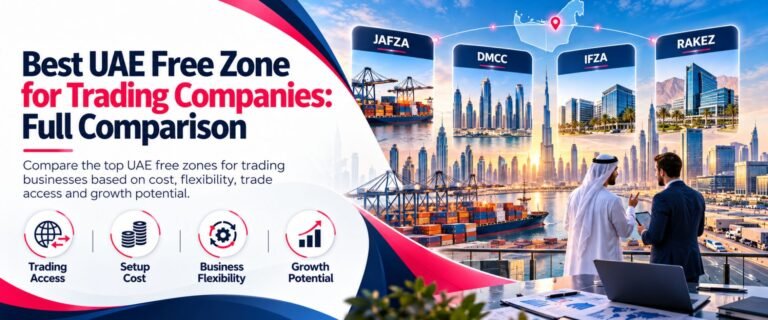
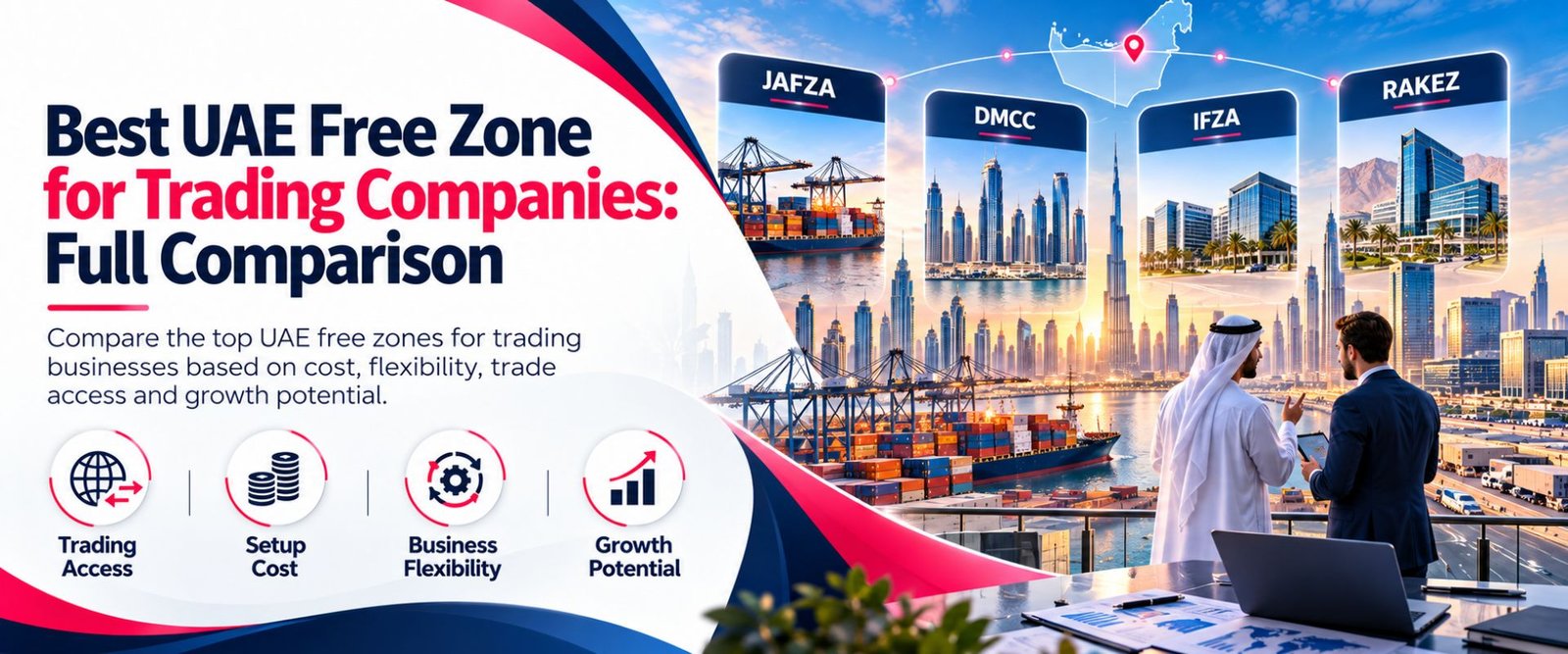
Choosing the right UAE free zone for trading depends on your commodity, volume and budget. DMCC leads for commodity and physical goods traders. JAFZA gives unmatched access to Jebel Ali Port for high-volume import/export. IFZA, Ajman and UAQ offer the lowest cost entry for general merchandise. This guide compares all major options with verified pricing, VAT status and a decision matrix. |
UAE Free Zones for Trading: Quick Comparison at a Glance
| Factor | DMCC | JAFZA | IFZA | Ajman / UAQ |
| Licence (0 visa) | AED 20,285 | AED 15,000 | AED 14,900 | AED 5,555 – 7,000 |
| Year-1 All-In (1 visa) | ~AED 43,780 | ~AED 52,636 | ~AED 22,450 | ~AED 13,000 – 15,000 |
| VAT Designated Zone | Yes | Yes | Yes | Ajman: Yes; UAQ: No |
| Port / Logistics Access | Jebel Ali (nearby) | Jebel Ali (on-port) | Third-party logistics | Ajman Port; UAQ Port |
| Best For | Commodity trading | High-volume import/export | General merchandise | Lowest-cost general trading |
| Physical Office Required | Flexi-desk option | Yes (min. unit) | Flexi-desk option | Flexi-desk option |
| Commodity Specialisation | Gold, diamonds, agri, energy | All categories | General only | General only |
| Multi-Activity Licence | Yes (up to 3 activities) | Yes | Yes | Yes (up to 10 activities) |
| Mainland Sales Allowed | Via local distributor only | Via local distributor only | Via local distributor only | Via local distributor only |
Source: DMCC, JAFZA, IFZA, Ajman FZ, UAQ FTZ published pricing. Government fees (establishment card, e-channel, Emirates ID, medical) additional for visa tiers. Confirm current rates before committing.
Trading is the most common business activity registered in UAE free zones. Whether you are importing finished goods, exporting commodities, re-exporting to third markets, or running a general merchandise operation, the UAE’s general trading licence framework gives you 100% foreign ownership, 0% import/export duties, and a base from which to service markets across the Gulf, Africa, South Asia and beyond.
The challenge is not access to a UAE trading licence. It is choosing the right free zone for your specific commodity, volume, market and cost structure. DMCC is exceptional for commodity traders but premium-priced. JAFZA is unbeatable for port-dependent import/export. IFZA, Ajman and UAQ are the right answer for general merchandise traders who need a cost-efficient legal base.
At DIAC we work with trading companies across all these free zones every day. This guide gives you the honest comparison.
What Does a UAE Trading Licence Cover?
A UAE free zone trading licence authorises your company to buy, sell, import, export and re-export goods. The scope depends on whether your licence is for specific trading activities or general trading.
Specific Trading Licence
A specific trading licence covers one category of goods — electronics, building materials, medical devices, foodstuff, or a similar defined product group. It is sufficient for businesses with a narrow product range and typically costs slightly less than a general trading licence.
General Trading Licence
A general trading licence covers multiple, unrelated product categories under a single licence. This is the right structure for traders who deal in diverse merchandise or want the flexibility to expand their product range without applying for additional approvals.
Key features of a UAE general trading licence:
- 100% foreign ownership in all major free zones
- 0% customs duty on goods that remain within or pass through the free zone
- 0% corporate tax on qualifying income (free zone qualifying conditions apply)
- No restriction on number of trading transactions or shipment volume
- Re-export to third countries permitted without UAE customs duties
- Import to UAE mainland permitted via a licensed mainland distributor or customs clearance
- Multiple activities on one licence — varies by free zone from 3 to 10 activities
Free Zone vs. Mainland for Trading
The most important operational limitation of a free zone trading licence is direct mainland sales. A free zone trading company cannot sell goods directly to UAE mainland customers without going through a mainland distributor, paying UAE customs duty (typically 5%), or establishing a separate mainland branch.
For trading companies whose primary market is export or re-export, this restriction is irrelevant. For trading businesses that want significant UAE domestic sales volume, a mainland DED licence may be the more efficient structure despite higher setup costs.
Top UAE Free Zones for General Trading Companies
There are over 45 free zones in the UAE but only a handful are genuinely fit for purpose for trading companies. The rest either restrict trading activities, lack logistics infrastructure, or carry prohibitive warehouse requirements. These are the zones that actually work:
| Free Zone | Licence Cost (0 visa) | Year-1 All-In (1 visa) | VAT Designated | Best Suited For |
| DMCC | AED 20,285 | ~AED 43,780 | Yes | Commodity, precious metals, agri, energy |
| JAFZA | AED 15,000 | ~AED 52,636 min. | Yes | High-volume import/export, port users |
| IFZA | AED 14,900 + MOA | ~AED 22,450 | Yes | General merchandise, e-commerce, mid-tier |
| Ajman FZ | AED 5,555 (0V) | ~AED 13,131 (1V) | Yes | Budget general trading, SMEs |
| UAQ FTZ | AED 7,000 all-in | ~AED 7,000 (flexi) | No | Lowest-cost entry, no UAE VAT supply needed |
| RAKEZ | AED 6,000 (0V) | ~AED 14,000 (1V) | Partial | Industrial trading, manufacturing-linked |
| Dubai South | AED 45,000+ | AED 45,000 – 95,000+ | Yes | Air cargo, e-commerce, Al Maktoum Airport |
| SHAMS | AED 6,875 base | ~AED 13,175 (1V) | No | Media/digital products; NOT for physical goods |
Source: DMCC, JAFZA, IFZA, Ajman FZ, UAQ FTZ, RAKEZ, Dubai South, SHAMS official pricing. All figures indicative — verify before submission.
| Important: SHAMS (Sharjah Media City) and UAQ FTZ are NOT UAE VAT designated zones. Trading companies that supply goods within the UAE VAT system should use a designated zone free zone (DMCC, JAFZA, IFZA, Ajman FZ) to maintain proper VAT compliance. Confirm your VAT obligations with a registered tax agent before choosing. |
DMCC for Commodity Trading: Metals, Energy and Agricultural Goods
The Dubai Multi Commodities Centre (DMCC) is the UAE’s flagship commodity trading free zone and has been ranked the world’s best free zone for multiple consecutive years. With over 26,000 member companies, DMCC operates as a full-service commodity trading ecosystem — not just a licence authority.
What DMCC Offers Trading Companies
- Commodity-specific licence categories: gold, diamonds, pearls, coloured gemstones, tea, coffee, cotton, petroleum, petrochemicals, iron and steel, agricultural commodities
- Physical vaulting and storage infrastructure for precious metals and gemstones at Almas Tower
- DMCC Tradeflow: a digital platform for inventory-backed, Sharia-compliant commodity financing; processed over AED 1.32 trillion in transactions
- JLT (Jumeirah Lakes Towers) location with excellent road access to Jebel Ali Port
- Access to Dubai Diamond Exchange and Dubai Gold and Commodities Exchange (DGCX)
- Strong banking relationships, Emirates NBD, HSBC, Standard Chartered familiar with commodity trade finance
DMCC Trading Licence Costs
DMCC is a premium free zone and pricing reflects this. The standard trading licence starts at approximately AED 20,285 per year. The DMCC Jumpstart package for new businesses starts at approximately AED 43,780 all-in for 1 visa including establishment card and government fees. A minimum share capital of AED 50,000 is required for trading companies.
DMCC is not the lowest-cost option. It is the right option for businesses where commodity credibility, trade finance access, and Dubai address value justify the premium.
Corporate Tax and DMCC
DMCC qualifying businesses can benefit from 0% corporate tax on qualifying income under the UAE Free Zone Person rules. The de minimis threshold is the lower of 5% of total revenue or AED 5 million — if non-qualifying income exceeds this threshold, the company becomes a taxable person subject to 9% on all profits for that tax year. DMCC trading companies dealing extensively with UAE mainland customers should review their qualifying income status with a UAE tax advisor.
JAFZA for Import/Export: Jebel Ali Port Access
The Jebel Ali Free Zone (JAFZA) is the operational home for high-volume import/export businesses that need direct, seamless access to Jebel Ali Port. Jebel Ali is currently ranked 9th globally (Lloyd’s List 2025) and handled 15.5 million TEUs in 2024, making it the Arab world’s busiest and most globally connected container port.
JAFZA is co-located with the port. Goods flow directly from container to warehouse to re-export or customs clearance without transiting public roads or third-party logistics hubs. For import/export companies dealing in high-volume consumer goods, building materials, electronics, FMCG, or raw materials, this operational efficiency is a meaningful commercial advantage.
JAFZA Trading Licence Costs
JAFZA general trading licences start at approximately AED 15,000 per year for the licence itself, but total first-year setup costs are higher due to mandatory warehouse or office facility requirements. A minimum facility commitment typically brings year-1 all-in costs to AED 52,636 or above depending on the facility size and visa count.
JAFZA is not a low-cost free zone entry. It is the right choice when port proximity directly reduces operational costs through lower drayage, faster customs clearance, and shorter storage cycles — for high-volume traders, these savings typically exceed the higher setup cost.
JAFZA Re-Export and Compliance
JAFZA operates under UAE federal customs regulations and uses the Mirsal 2 electronic customs declaration system. Re-exporters dealing in sensitive or dual-use goods must comply with UAE export control regulations, UN sanctions screening, and CBUAE compliance requirements. JAFZA’s compliance infrastructure and proximity to DP World’s logistics network makes it the natural home for international re-export traders.
IFZA, Ajman and UAQ: Low-Cost Trading Licence Options
For general merchandise traders — consumer goods, textiles, light industrial products, household items, foodstuff — the most cost-efficient UAE free zone structures are IFZA, Ajman Free Zone and UAQ Free Trade Zone.
IFZA: Mid-Tier Value with VAT Compliance
The International Free Zone Authority (IFZA) is a Dubai-based free zone offering one of the most straightforward all-in pricing structures for small and mid-size trading companies. The trading licence starts at AED 14,900 plus MOA, with total year-1 all-in costs of approximately AED 22,450 for a 1-visa setup including government fees.
IFZA is a UAE VAT designated zone, meaning goods held within IFZA can be treated as outside the scope of UAE VAT until they enter the mainland. This is commercially important for trading companies managing inventory cycles.
IFZA allows general trading with multiple activities, a flexi-desk option avoiding physical warehouse requirements at entry level, and a straightforward remote document submission process. It is a solid mid-tier option for general merchandise traders who want a Dubai address without DMCC or JAFZA premium pricing.
Ajman Free Zone: Budget General Trading with Port Access
The Ajman Free Zone (AFZA) is the most cost-effective general trading licence in the UAE with VAT designated zone status. Licence packages start at AED 5,555 for a zero-visa setup and approximately AED 13,131 all-in for a 1-visa company.
Ajman has its own seaport — Ajman Port — giving trading companies basic port infrastructure without Jebel Ali pricing. For smaller volume traders importing general merchandise from Asia, Ajman FZ offers a legitimate UAE licensed structure at a fraction of the cost of Dubai free zones.
The trade-off is address prestige and banking ease. Dubai-address free zones (DMCC, JAFZA, IFZA) are more readily accepted by international banks for trade finance, letters of credit and remittance. Ajman FZ works well for trading companies where banking is handled at the principal’s home country or through established relationships.
UAQ Free Trade Zone: Lowest-Cost Entry
UAQ Free Trade Zone (Umm Al Quwain) offers the UAE’s most affordable all-in trading licence at approximately AED 7,000 per year including the licence and basic facility. UAQ FTZ is not a UAE VAT designated zone, which limits its suitability for companies planning to supply goods within the UAE VAT network.
UAQ is appropriate for trading companies focused entirely on import, re-export and third-country supply, with no UAE mainland distribution requirements.
Dubai South: E-Commerce and Air Cargo Trading
Dubai South Free Zone is co-located with Al Maktoum International Airport, positioning it as the natural choice for trading companies dealing in high-value, time-sensitive goods that move by air: electronics, fashion, luxury goods, pharmaceutical products, and e-commerce inventory.
Dubai South trading licence costs run from AED 45,000 to AED 95,000+ for year-1 all-in depending on facility type and visa count. It is a premium setup cost justified only where air cargo access, airport logistics adjacency, or the Dubai South e-commerce ecosystem provide direct commercial value.
For e-commerce traders, Dubai South offers integration with fulfilment infrastructure. For businesses primarily doing sea or land freight, JAFZA or IFZA will be more cost-efficient.
VAT and Corporate Tax: What UAE Trading Licence Holders Must Know
VAT Designated Zones
A UAE VAT designated zone is a fenced, surveilled area treated as outside the UAE for VAT purposes. Goods stored within a designated zone and not released to the UAE mainland are outside the scope of UAE VAT. Movement between designated zones can be VAT-free under specific conditions.
The major trading-relevant designated zones are: DMCC, JAFZA, IFZA, Ajman Free Zone, RAKEZ (certain areas) and Dubai South. SHAMS and UAQ FTZ are NOT designated zones. Trading companies holding physical inventory and supplying within the UAE VAT system should operate from a designated zone free zone.
Corporate Tax for Free Zone Trading Companies
UAE corporate tax at 9% applies to taxable income above AED 375,000. Free zone companies can elect Qualifying Free Zone Person (QFZP) status and benefit from 0% tax on qualifying income. For trading companies, qualifying income typically includes:
- Sales of goods to customers outside the UAE
- Sales to other free zone persons (transactions that remain within the free zone system)
- Ancillary services directly related to qualifying trading transactions
Non-qualifying income (such as UAE mainland sales above the de minimis threshold) can trigger taxable status on all income. The de minimis rule allows non-qualifying income up to the lower of 5% of total revenue or AED 5 million per year without losing QFZP status.
Trading companies with significant UAE mainland distribution should model their tax position carefully. A structured mainland distribution arrangement through a separately licensed entity often produces a better tax outcome than a single free zone entity with mixed income.
Best Trading Free Zone by Commodity Type and Volume
The right UAE free zone for a trading company is determined primarily by what you trade, how much volume you move, and where your customers are. Use this decision matrix to shortlist your options:
| Business Profile | Recommended Free Zone | Key Reason |
| Commodity trader (gold, diamonds, precious metals) | DMCC | Vault infrastructure, exchange access, Tradeflow financing |
| Commodity trader (coffee, tea, cotton, agri) | DMCC | DMCC Tradeflow, commodity-specific licence categories |
| Commodity trader (oil, gas, petrochemicals) | DMCC or JAFZA | DMCC commodity expertise; JAFZA port access for bulk tankers |
| High-volume import/export (sea freight) | JAFZA | On-port location, Mirsal 2 integration, DP World adjacency |
| General merchandise (consumer goods, textiles) | IFZA | Dubai address, VAT designated, lowest mid-tier cost |
| Budget general trading (SME, startup) | Ajman FZ or UAQ FTZ | AED 5,555 – 7,000 entry; Ajman = VAT designated |
| E-commerce / direct-to-consumer product trading | Dubai South or IFZA | Dubai South: Al Maktoum air cargo; IFZA: cost-efficient |
| Industrial supplies and heavy equipment | JAFZA or RAKEZ | Port access or industrial cluster proximity |
| Food and beverage import/distribution | JAFZA or Ajman FZ | Port access; food-category licence clarity |
| Web3 / digital asset commodity products | RAK DAO via RAKEZ | Digital assets regulatory framework |
| Re-export to GCC, Africa, South Asia | JAFZA or IFZA | Port/logistics infrastructure; VAT designated |
| Pharmaceutical and medical device trading | DMCC or JAFZA | Regulatory compliance infrastructure, trade finance access |
Source: DIAC consultant analysis. Recommendations based on cost, operational infrastructure and regulatory fit. Confirm suitability with a UAE business setup consultant before proceeding.
Economic Substance Requirements for UAE Trading Companies
UAE Economic Substance Regulations (ESR) apply to companies conducting relevant activities, which includes distribution and service centre businesses. Trading companies that import goods manufactured outside the UAE and re-export or distribute them may fall within ESR scope depending on their activity classification.
Under ESR, companies may need to demonstrate:
- Adequate employees and physical presence in the UAE
- Adequate operating expenditure in the UAE
- Core income-generating activities conducted in the UAE
Most active free zone trading companies with genuine UAE operations meet ESR requirements naturally. Shell structures using a free zone licence with no real UAE activity are at greater ESR and corporate tax risk. The Ministry of Finance ESR portal handles annual notification and reporting requirements.
How to Set Up a UAE Trading Company: Process and Timeline
Step 1: Choose Free Zone and Licence Category
Decide between general trading licence (multiple product categories) and specific trading licence (one category). Confirm VAT designated zone status if you plan to hold UAE inventory.
Step 2: Reserve Company Name and Submit Application
Most UAE free zones accept document submission online. Standard required documents: passport copies, personal bank statement (last 6 months), business plan summary. DMCC requires a No Objection Letter from current UAE visa sponsor if applicable.
Step 3: Receive Licence and Establishment Card
Standard timelines: DMCC 3-5 working days; JAFZA 5-10 working days; IFZA 2-4 working days; Ajman FZ 2-3 working days. Establishment card (free zone ID card for the company) follows licence issuance.
Step 4: Open Corporate Bank Account
UAE corporate banking for trading companies requires: free zone trade licence, Memorandum of Association, passport copies of all shareholders, source of funds declaration and business plan. DMCC and JAFZA companies typically have strongest acceptance rates at major UAE banks. Ajman and UAQ companies may need to consider digital banking options (Wio Business, Mashreq NeoBiz) or regional bank relationships.
Step 5: Arrange Logistics and Customs Codes
Register with UAE customs via the Federal Customs Authority. Obtain your customs code for import/export. JAFZA companies integrate directly with Mirsal 2 for customs declarations. Other free zone companies use a licensed customs broker for clearance.
Frequently Asked Questions: UAE Free Zone Trading Licences
Which UAE free zone is cheapest for a general trading licence?
Ajman Free Zone is the cheapest UAE VAT designated zone for general trading, starting at AED 5,555 for a zero-visa licence and approximately AED 13,131 all-in for a 1-visa company. UAQ Free Trade Zone starts at AED 7,000 all-in, but is not a VAT designated zone, which limits its suitability for companies supplying within the UAE VAT system.
Can a UAE free zone trading company sell directly to UAE mainland customers?
No, not directly. A free zone trading company cannot sell goods directly to UAE mainland buyers without customs clearance, which triggers UAE import duty (typically 5%) on the goods. To sell consistently in the UAE domestic market, trading companies use a licensed mainland distributor, establish a mainland branch, or use a local service agent structure.
Is DMCC the best free zone for commodity trading in the UAE?
DMCC is the leading choice for physical commodity traders in gold, diamonds, agricultural commodities, energy products and precious metals, due to its commodity-specific infrastructure, DMCC Tradeflow financing platform, vault facilities, and access to DGCX and the Dubai Diamond Exchange. For generic general merchandise trading, IFZA or JAFZA may offer a better cost-to-infrastructure ratio.
What is a UAE VAT designated zone and which free zones qualify?
A VAT designated zone is a fenced, surveilled area treated as outside the UAE for VAT purposes. Goods held within a designated zone can be transacted between businesses without UAE VAT until they enter the mainland. The major trading-relevant designated zones are DMCC, JAFZA, IFZA, Ajman Free Zone, and Dubai South. SHAMS and UAQ FTZ are not designated zones.
Do UAE free zone trading companies pay corporate tax?
UAE corporate tax at 9% applies above AED 375,000 in taxable income. Free zone trading companies can qualify for 0% tax on qualifying income as a Qualifying Free Zone Person (QFZP). Qualifying income for traders typically includes export sales and inter-free-zone sales. Non-qualifying income (such as mainland UAE sales) above a de minimis threshold (5% of revenue or AED 5 million, whichever is lower) can trigger taxable status on all profits for that year.
How long does it take to get a UAE trading licence in a free zone?
Standard processing times are 2-5 working days for most free zones including IFZA, Ajman FZ and RAKEZ. DMCC typically takes 3-5 working days. JAFZA can take 5-10 working days depending on facility type and activity complexity. All major free zones offer online document submission. Physical presence is only required for visa biometrics and Emirates ID processing.
Can a UAE free zone trading company hold physical inventory in the UAE?
Yes. Free zone companies can lease warehouse or storage space within their free zone to hold physical inventory. Inventory held inside a VAT designated zone is outside UAE VAT scope. Once goods are released to the UAE mainland, they are subject to UAE customs duty and VAT as applicable. JAFZA has the most developed port-adjacent warehousing infrastructure for high-volume traders.
Not Sure Which UAE Free Zone Fits Your Trading Business?DIAC’s consultants compare DMCC, JAFZA, IFZA, Ajman and more against your commodity, volume and budget. Get a tailored recommendation before you commit. |
| About the Author
Adil Ahmad is a UAE business setup consultant with over a decade of experience helping trading companies, commodity exporters, and import/export businesses choose the right free zone or mainland licence. He advises clients across DMCC, JAFZA, IFZA, Ajman and all major UAE free zones. |