| Summary
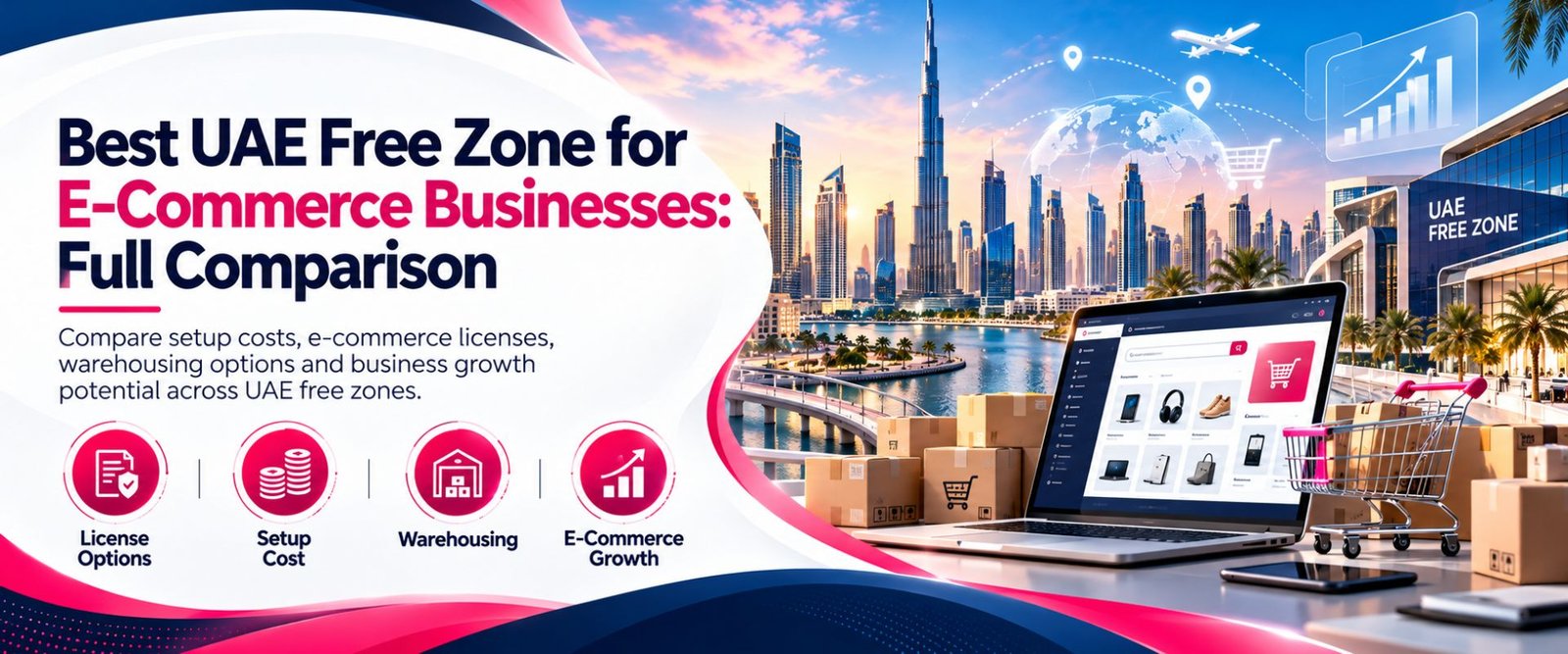
UAE free zones offer e-commerce entrepreneurs 100% foreign ownership, 0% import duties and a legal base to sell on Amazon, Noon, TikTok Shop and your own website. The right zone depends on your model: Dubai South for FBA fulfilment, IFZA or Meydan for a mid-cost Dubai address, Ajman or UAQ for the lowest cost entry. This guide compares all major options with verified pricing and a clear decision matrix. |
UAE Free Zones for E-Commerce: Quick Comparison at a Glance
| Factor | Dubai South / EZDubai | IFZA / Meydan | Ajman FZ / SPC | UAQ FTZ |
| Licence (0 visa) | AED 11,000 (yr-1) | AED 12,500 – 14,900 | AED 5,555 – 5,750 | AED 8,000 |
| Year-1 All-In (1 visa) | ~AED 20,000+ | ~AED 13,250 – 14,500 | ~AED 8,500 – 12,000 | ~AED 13,500 |
| Flexi-Desk / Virtual | Yes (licence only option) | Yes | Yes | Yes |
| Warehouse / Fulfilment | Yes (EZDubai hub) | No (third-party) | No (third-party) | No (third-party) |
| Amazon Seller Accepted | Yes | Yes (Meydan: confirmed) | Yes (RAKEZ: confirmed) | Yes |
| Noon Seller Accepted | Yes | Yes | Yes | Yes |
| TikTok Shop / Social | Yes | Yes | SPC / SHAMS: ideal | Yes |
| VAT Designated Zone | Yes | IFZA: Yes; Meydan: No | Ajman: Yes; SPC: No | No |
| Best For | FBA, air cargo, high-vol. | Amazon / Noon, mid-budget | Dropshipping, social, budget | Lowest-cost virtual |
Source: Dubai South, IFZA, Meydan FZ, Ajman FZ, SPC Free Zone, UAQ FTZ published pricing. Government fees (e-channel, Emirates ID, medical) additional for visa tiers. Confirm current rates before committing.
The UAE is one of the most accessible e-commerce markets in the world. A young, high-spending population, near-universal smartphone penetration, and a logistics infrastructure built around business setup in Dubai free zone structures make it a natural base for online sellers targeting the GCC, South Asia, Africa and beyond.
What many first-time e-commerce entrepreneurs get wrong is the licence structure. Not every UAE free zone is suitable for e-commerce. Not every e-commerce licence covers physical product sales on Amazon and Noon. And choosing the wrong zone at setup can create banking friction, VAT complications and marketplace registration problems that take months to resolve.
At DIAC we set up e-commerce businesses across UAE free zones every week — Amazon sellers, Noon merchants, TikTok Shop creators, dropshippers and DTC brands. This guide gives you the honest breakdown of what each zone offers, what it costs, and which model each one suits.
What Does an E-Commerce Business Need from a UAE Free Zone?
The core requirements for a UAE e-commerce business differ from a traditional trading company. Understanding them before you choose a free zone saves significant cost and friction.
Licence Activity Coverage
Your UAE trade licence must explicitly cover e-commerce or online trading as an activity. A general trading licence covers physical goods but does not always include the “electronic commerce” or “online retail” activity code. Some free zones (IFZA, Meydan, Dubai South) issue a specific e-commerce licence with activities covering online retail, drop shipping and digital storefront operation.
When registering as a seller on Amazon.ae or Noon, you will be required to upload your trade licence. Marketplace compliance teams check that the licence activity matches the product category you are selling. A licence without a clear e-commerce or trading activity can trigger rejection or account suspension.
Physical Address vs. Virtual Office
Most UAE e-commerce businesses do not need a physical warehouse. Dropshippers, digital product sellers, Amazon FBA sellers using third-party logistics, and social commerce brands can operate legally with a flexi-desk or virtual office licence. All the free zones in this guide offer a flexi-desk option for e-commerce, which is the most cost-efficient starting point.
The exception is if you plan to hold your own inventory in the UAE. In that case, you either need a warehouse unit within a free zone or a third-party logistics (3PL) arrangement. Dubai South’s EZDubai sub-zone is the only purpose-built e-commerce fulfilment option in this guide.
Bank Account and Payment Gateway Access
E-commerce businesses need a UAE corporate bank account to receive payments from Amazon, Noon and other marketplaces. Stripe is not available for UAE-registered companies. The main payment gateway options for UAE e-commerce are PayTabs, Telr, Checkout.com, Network International and Tap Payments.
For fast bank account opening, Wio Business and Mashreq NeoBiz offer the quickest setup timelines (typically 3-7 working days) with lower documentation thresholds. For higher-volume e-commerce requiring trade finance or letters of credit, Emirates NBD, FAB and HSBC are the main options, with stricter onboarding requirements.
| Note: Stripe is not currently available for UAE-incorporated companies. E-commerce businesses selling internationally should check payment gateway compatibility with their marketplace and target customer geography before selecting a UAE entity structure. |
Top UAE Free Zones for E-Commerce Companies
These are the free zones that actually work for e-commerce — based on licence activity coverage, accepted by major UAE marketplaces, available with flexi-desk setup, and with verified pricing:
| Free Zone | E-Commerce Licence (0V) | Year-1 (1 visa) | Amazon Accepted | Noon Accepted | VAT Designated |
| Dubai South / EZDubai | AED 11,000 | ~AED 20,000+ | Yes | Yes | Yes |
| IFZA | AED 12,900 + MOA | ~AED 13,250 | Yes | Yes | Yes |
| Meydan Free Zone | AED 12,500 | ~AED 14,500 | Yes (confirmed) | Yes | No |
| SPC Free Zone | AED 5,750 | ~AED 8,500 | Yes | Yes | No |
| Ajman Free Zone | AED 5,555 | ~AED 8,500 – 12,000 | Yes | Yes | Yes |
| RAKEZ | AED 6,000 (0V) | ~AED 14,000 (1V) | Yes (official partner) | Yes | Partial |
| UAQ FTZ | AED 8,000 | ~AED 13,500 (2V) | Yes | Yes | No |
| SHAMS | AED 6,875 (Standard) | ~AED 13,175 (1V) | Limited* | Limited* | No |
Source: Official free zone pricing portals, consultant-verified rates. *SHAMS Standard package covers online trading; confirm activity wording covers your product category. All figures indicative — verify before submission.
Dubai South: E-Commerce Fulfilment District
Dubai South is the UAE’s purpose-built e-commerce logistics zone. Its EZDubai sub-zone is co-located with Al Maktoum International Airport and houses operational fulfilment centres operated by Emirates Post and Kuehne+Nagel. It is the only UAE free zone in this guide where you can register a company and physically fulfil orders from within the same zone.
Dubai South for Amazon FBA
For Amazon FBA sellers, Dubai South is the most operationally integrated option. Amazon UAE’s fulfilment infrastructure in the UAE is clustered in the Dubai South/Al Maktoum corridor. Sellers registering for Amazon FBA in the UAE can use EZDubai-based 3PL providers (Emirates Post fulfilment, Kuehne+Nagel) as their pick-pack-ship operation while maintaining a Dubai South free zone company licence.
Dubai South e-commerce licences start at approximately AED 11,000 for year-1 total cost at the base entry level. The zone offers flexi-desk options for sellers who do not need their own warehouse unit, alongside physical warehouse units for sellers with volume requirements.
When Dubai South Is the Right Choice
- Amazon FBA sellers who want UAE-based fulfilment infrastructure
- High-volume importers receiving air freight through Al Maktoum Airport
- Cross-border e-commerce businesses serving GCC, South Asia and East Africa
- Sellers who want a UAE VAT designated zone for inventory management
- Businesses that intend to scale from a virtual setup to a physical warehouse
When Dubai South Is Not the Right Choice
- Pure dropshippers with no UAE inventory — flexi-desk at Ajman or UAQ is more cost-efficient
- Digital product sellers (courses, software, media) — SHAMS or SPC is better suited
- Social commerce brands on a startup budget — SPC or Ajman FZ is more appropriate
IFZA and Meydan: Dubai E-Commerce Licence at Mid-Range Cost
For Amazon and Noon sellers who want a Dubai-address free zone licence without Dubai South’s logistics focus, IFZA and Meydan Free Zone are the two leading mid-range options.
IFZA for E-Commerce
The International Free Zone Authority (IFZA) is a Dubai-based free zone offering a straightforward e-commerce licence at approximately AED 12,900 (plus MOA) for zero visas, with year-1 all-in costs of approximately AED 13,250 for a 1-visa setup.
IFZA is a UAE VAT designated zone. For e-commerce businesses holding UAE inventory, VAT designated zone status means goods can be stored within IFZA before mainland delivery without triggering VAT at the point of storage — only at the point of release to the UAE mainland. This is commercially relevant for sellers using UAE-based 3PL warehouses registered within the IFZA ecosystem.
IFZA’s e-commerce licence covers online retail of physical goods, digital products and dropshipping activities within a single licence. It is accepted by Amazon.ae, Noon and TikTok Shop for seller registration.
Meydan Free Zone for Amazon Sellers
Meydan Free Zone has established itself as one of the most popular Dubai free zones for Amazon UAE sellers, partly due to its confirmed acceptance by Amazon.ae’s seller verification process and its straightforward e-commerce activity coverage.
Meydan e-commerce licences start at approximately AED 12,500 for zero visas and approximately AED 14,500 all-in for a 1-visa setup. Meydan is not a UAE VAT designated zone, which is a relevant consideration for sellers managing significant UAE inventory.
Meydan’s practical advantages: Dubai address on documents and packaging, fast online company registration, flexi-desk setup with no physical office requirement, and a dedicated support team familiar with marketplace seller requirements. It is a strong option for Amazon sellers who prioritise Dubai credibility and speed over VAT designated zone status.
Ajman, SPC and UAQ: Lowest-Cost E-Commerce Free Zone Options
For dropshippers, social commerce sellers, digital product businesses and early-stage e-commerce entrepreneurs who need a legal UAE entity at the lowest possible cost, three free zones stand out: Ajman Free Zone, SPC Free Zone (Sharjah) and UAQ Free Trade Zone.
SPC Free Zone: Best for Social Commerce
SPC Free Zone (Sharjah Publishing City) is one of the most affordable UAE free zones for e-commerce and social commerce at approximately AED 5,750 for a zero-visa licence including a flexi-desk. SPC packages cover both online trading and media/content creation activities, making it especially well-suited for TikTok Shop sellers, Instagram sellers, and content-commerce brands who combine product selling with content creation.
SPC offers unlimited visa eligibility, zero paid-up capital requirement, and a fully remote setup process. It is not a UAE VAT designated zone, so sellers using SPC should confirm their VAT obligations if supplying goods within the UAE system at scale.
Ajman Free Zone: Budget E-Commerce with VAT Designation
Ajman Free Zone is the lowest-cost UAE VAT designated zone for e-commerce, with e-commerce licences starting at AED 5,555 for zero visas. Year-1 all-in costs with 1 visa run approximately AED 8,500 – 12,000 depending on establishment card and government fee components.
For e-commerce sellers who need VAT designated zone status (particularly those holding inventory in UAE warehouses), Ajman FZ is the most cost-efficient option. Its port (Ajman Port) gives it some logistics infrastructure, though sellers typically use Dubai-based 3PL providers for fulfilment into the UAE market.
Banking is the main trade-off for Ajman FZ e-commerce companies. Major UAE banks (Emirates NBD, FAB) have higher documentation thresholds for non-Dubai addresses. Wio Business and Mashreq NeoBiz are the most accessible banking options.
UAQ Free Trade Zone: Lowest All-In Cost
UAQ Free Trade Zone offers e-commerce licences starting at approximately AED 8,000 for zero visas, with 2-visa packages at approximately AED 13,500. UAQ FTZ is the overall lowest-cost option for an e-commerce company needing a visa.
UAQ FTZ is not a UAE VAT designated zone. It is most appropriate for dropshippers, digital product sellers and cross-border e-commerce businesses with no UAE inventory holdings and no plans to supply goods within the UAE VAT system at significant volume.
UAE Marketplace Seller Requirements: Amazon, Noon and TikTok Shop
Choosing the right free zone is only part of the e-commerce setup. UAE marketplace platforms have their own seller registration requirements that your licence must satisfy.
Amazon UAE (Amazon.ae) Seller Requirements
- Valid UAE trade licence with e-commerce or general trading activity code
- UAE corporate bank account for payment disbursements
- UAE VAT TRN (Tax Registration Number) — required if turnover exceeds AED 375,000
- Passport copies of all shareholders and directors
- Emirates ID for UAE resident shareholders / visa holders
Free zones confirmed as accepted by Amazon.ae for seller registration include Meydan, IFZA, RAKEZ (official Amazon partner), SPC, Dubai South and Ajman FZ. There is no exclusive list — any free zone with a valid e-commerce or general trading licence is generally accepted, but RAKEZ has an official Amazon partnership that includes streamlined seller onboarding.
Noon UAE Seller Requirements
- Valid UAE trade licence (free zone or mainland accepted)
- UAE VAT certificate if VAT registered
- UAE corporate bank account
- Product conformity documentation for regulated categories (electronics, food, cosmetics)
Noon accepts free zone trade licences from all major UAE free zones. The seller registration process for Noon is largely self-serve and does not involve free zone-specific restrictions.
TikTok Shop UAE Requirements
- Valid UAE trade licence (e-commerce, general trading or media/trading combo)
- UAE corporate bank account
- Product listing compliance with UAE consumer protection regulations
For TikTok Shop and social commerce sellers who combine content creation with product sales, SPC Free Zone (Sharjah Publishing City) and SHAMS (Sharjah Media City) offer licence packages that bundle both media/content and online trading activities — the most appropriate structure for a creator-commerce hybrid business.
E-Commerce Licence vs General Trading Licence for Online Sellers
Many UAE free zones offer both an e-commerce-specific licence and a general trading licence. Understanding the difference prevents marketplace registration problems and activity scope issues.
| Criterion | E-Commerce Licence | General Trading Licence |
| Activities Covered | Online retail, dropshipping, digital storefront | Physical goods import/export (multiple categories) |
| Marketplace Registration | Explicitly covers online channels | May require confirmation of online activity coverage |
| Physical Goods Sales | Yes (via marketplace or own site) | Yes (import/export primary) |
| Digital Products | Yes (in most FZs) | Not always covered |
| Cost Difference | Similar or slightly lower | Similar or slightly higher for multi-activity |
| Typical Use Case | Amazon/Noon sellers, DTC e-commerce | B2B traders who also sell online |
| Social Commerce Cover | Usually yes | Usually no |
Source: DIAC consultant analysis. Activity coverage varies by free zone — always confirm the specific activity wording on your licence before marketplace registration.
The practical rule: if your business is primarily selling products online (Amazon, Noon, your own DTC website), request an e-commerce licence with activities explicitly covering online retail, electronic commerce and dropshipping. If your business does both online and offline B2B trading, a general trading licence with an online retail add-on activity may be more flexible.
Can Free Zone E-Commerce Companies Sell to UAE Residents?
Yes, but with nuance. UAE free zone e-commerce companies can sell to UAE residents through:
- Marketplace platforms (Amazon.ae, Noon) — the marketplace handles customs clearance for mainland delivery; this is the most common and simplest route
- Your own website — sales to UAE mainland customers trigger UAE customs duty (typically 5%) and VAT obligations; you must use a licensed customs broker or 3PL for delivery
- Mainland branch — establishing a mainland DED branch (approximately AED 10,000/year) gives you direct UAE market access without customs duty complications
Most e-commerce sellers start with the marketplace route and establish a mainland presence or branch only when direct-to-consumer UAE sales volume justifies the additional cost.
Best E-Commerce Free Zone by Business Model
Use this matrix to match your e-commerce model to the right UAE free zone:
| Your E-Commerce Model | Recommended Free Zone | Key Reason |
| Amazon FBA UAE (own fulfilment) | Dubai South / EZDubai | Purpose-built FBA-adjacent fulfilment infrastructure |
| Amazon FBA UAE (3PL) | IFZA or Meydan | Dubai address + VAT designated (IFZA) + Amazon acceptance |
| Noon seller (physical goods) | IFZA, Meydan or Ajman FZ | VAT designated (IFZA/Ajman); Meydan for speed |
| Dropshipping (no UAE inventory) | SPC or UAQ FTZ | Lowest cost; no warehouse needed; flexi-desk |
| TikTok Shop / Instagram seller | SPC or SHAMS | Combined online trading + media/content activities |
| DTC website (UAE customers) | IFZA + mainland branch | VAT designated; mainland branch for direct UAE sales |
| Digital products (courses, software) | SPC or SHAMS | Media/digital activity coverage; lowest cost |
| Social commerce + physical products | SPC Free Zone | Unlimited visa; combined trading + content licence |
| Amazon seller on budget | Ajman FZ | VAT designated + lowest cost; Amazon accepted |
| Multi-platform seller (Amazon + Noon + own site) | IFZA | Flexible activity coverage; Dubai address; VAT designated |
| Air cargo / fast fashion importer | Dubai South | Al Maktoum Airport adjacency; fulfilment infrastructure |
Source: DIAC consultant analysis. Recommendations based on licence activity coverage, marketplace acceptance and operational fit. Confirm with a UAE business setup consultant before proceeding.
Warehousing and Fulfilment Options for UAE E-Commerce
If your e-commerce model requires UAE-based inventory, your options are:
Amazon FBA UAE
Amazon operates fulfilment centres in the UAE primarily clustered in the Dubai South corridor. Enrolling as an Amazon FBA seller in the UAE gives you access to Amazon’s pick-pack-ship infrastructure and Prime eligibility. You send inventory to Amazon’s UAE fulfilment centre; Amazon handles storage, packing and delivery. A UAE trade licence and Amazon seller account are required — free zone companies can use FBA.
Third-Party Logistics (3PL)
UAE 3PL providers offer warehousing, inventory management, order fulfilment and last-mile delivery for e-commerce sellers. Major operators include Aramex, Fetchr, Shipa Freight and Kuehne+Nagel (EZDubai). Most 3PL providers accept free zone company clients without requiring a mainland trade licence.
Own Warehouse in Free Zone
Free zones including Dubai South, JAFZA, Ajman FZ and RAKEZ offer warehouse units for lease within the free zone. This is appropriate for sellers with consistent high-volume inventory who want full control over storage and packing. Minimum unit sizes typically start at 200-500 sqm, making this option cost-effective only at significant scale.
VAT and Corporate Tax for UAE E-Commerce Companies
VAT Registration
E-commerce companies are required to register for UAE VAT once their taxable turnover exceeds AED 375,000 in a 12-month period. Voluntary registration is available from AED 187,500. Once VAT registered, you collect 5% VAT on UAE mainland sales and file quarterly VAT returns.
Sales made through Amazon.ae and Noon to UAE customers may involve the marketplace collecting and remitting VAT on your behalf — confirm the specific VAT treatment with the marketplace and a UAE-registered tax agent, as this has changed with UAE’s platform economy VAT rules.
Corporate Tax for E-Commerce Free Zone Companies
UAE corporate tax at 9% applies above AED 375,000 in taxable income. E-commerce free zone companies qualifying as Qualifying Free Zone Persons (QFZP) can benefit from 0% tax on qualifying income. Cross-border sales (export) and inter-free-zone sales typically qualify. UAE mainland sales above the de minimis threshold (5% of revenue or AED 5 million) can affect QFZP status. E-commerce businesses with significant UAE domestic sales should review their tax position with a UAE tax advisor.
Frequently Asked Questions: UAE Free Zone E-Commerce Licences
Which UAE free zone is cheapest for an e-commerce licence?
SPC Free Zone and Ajman Free Zone offer the lowest-cost e-commerce licences in the UAE, both starting at approximately AED 5,555 – 5,750 for a zero-visa setup. SPC offers unlimited visa eligibility and covers social commerce activities. Ajman FZ is a UAE VAT designated zone, which is important for sellers holding UAE inventory. UAQ FTZ is slightly higher at AED 8,000 but remains a competitive budget option.
Do I need a UAE trade licence to sell on Amazon UAE (Amazon.ae)?
Yes. Amazon.ae requires all professional sellers to have a valid UAE trade licence with an e-commerce or trading activity code. You also need a UAE corporate bank account and a UAE VAT TRN if your turnover exceeds AED 375,000. Free zone licences from IFZA, Meydan, RAKEZ, Ajman FZ, Dubai South and most other major UAE free zones are accepted by Amazon.ae.
Can a UAE free zone e-commerce company sell directly to UAE customers?
Yes, through two routes. First, via marketplace platforms like Amazon.ae and Noon — the marketplace handles customs clearance for mainland delivery, making this the simplest approach. Second, via your own website or direct delivery — goods released from the free zone to the UAE mainland are subject to customs duty (typically 5%) and VAT. A mainland DED branch (approximately AED 10,000/year) gives you direct UAE market access without customs complications on every order.
Is IFZA or Meydan better for an Amazon UAE seller?
Both are solid options. IFZA has a slight edge if you plan to hold UAE inventory, because it is a UAE VAT designated zone (Meydan is not). Meydan has a slight edge for speed and simplicity — it has a strong track record of Amazon seller acceptance and a straightforward online setup process. If VAT designated zone status is not a priority, the choice often comes down to cost: Meydan at AED 12,500 vs IFZA at approximately AED 12,900 plus MOA. Both prices are comparable at the 1-visa level.
Can I run a dropshipping business from a UAE free zone?
Yes. Dropshipping does not require physical warehousing — a flexi-desk or virtual office licence is sufficient. The lowest-cost options for UAE dropshipping are SPC Free Zone (AED 5,750) and Ajman FZ (AED 5,555). UAQ FTZ at AED 8,000 is another budget option. Your licence must cover dropshipping or online retail as an activity. You will need a UAE corporate bank account to receive payments from your marketplace or payment gateway.
Do I need to register for UAE VAT as an e-commerce company?
You are required to register for UAE VAT once your taxable turnover exceeds AED 375,000 in any 12-month period. Voluntary registration is available from AED 187,500. Once registered, you charge 5% VAT on UAE mainland sales and file quarterly returns. Note that some marketplace platforms (Amazon, Noon) may collect and remit VAT on your behalf under UAE platform economy tax rules — confirm the specific treatment with a UAE-registered tax agent.
Is Stripe available for UAE e-commerce companies?
No. Stripe is not currently available for UAE-incorporated companies. The main payment gateway options for UAE e-commerce businesses are PayTabs, Telr, Checkout.com, Network International and Tap Payments. For marketplace sellers (Amazon, Noon), payments are received directly from the marketplace into your UAE corporate bank account — you do not need a standalone payment gateway for marketplace-only selling.
Not Sure Which Free Zone Is Right for Your E-Commerce Business?DIAC consultants work with Amazon sellers, Noon merchants, dropshippers and social commerce brands every day. Tell us your setup and we will match you to the right free zone and licence at the lowest cost. |
| About the Author
Adil Ahmad is a UAE business setup consultant specialising in e-commerce company formation, Amazon seller licence structures, and free zone selection for online retail businesses. He has helped hundreds of entrepreneurs across Amazon UAE, Noon, TikTok Shop, and dropshipping launch the right UAE entity at the right cost. |