Dubai’s position as a global trade hub is not marketing language. The emirate recorded a 7.2% year-on-year increase in trade volumes in Q1 2025 and sits at the geographic and logistical intersection of Asia, Europe, and Africa. For entrepreneurs who want to import, export, distribute, or wholesale a wide range of products without the cost and complexity of setting up separate entities for each commodity, the general trading license is the defining commercial permit that makes Dubai’s trading market accessible under one legal structure.
This is the master guide for starting a trading company in Dubai in 2026. It covers what the general trading license covers and what it does not, the critical differences between the mainland DET route and free zone alternatives, the exact cost breakdown most guides get wrong by leaving out the DET activity fee, what products are restricted, why a flexi-desk will not work for a mainland trading company, and the step-by-step process from trade name to first shipment. If you are planning a business setup in Dubai focused on trading, this is where your research should start.
What a General Trading License in Dubai Actually Permits
A general trading license is a commercial permit issued by the Department of Economy and Tourism (DET) for mainland companies, or by a free zone authority for free zone companies. It allows a single legal entity to import, export, distribute, store, and sell multiple unrelated product categories under one license. This is its primary advantage over a specific trading license, which restricts you to a single product category.
Under a general trading license you can simultaneously trade consumer electronics, packaged food products, textiles, building materials, household goods, and most other physical commodities without needing a separate license for each category. The DET currently lists over 2,100 approved trading activities, and the general trading category gives you the broadest coverage within the commercial license type.
However, several product categories fall outside the scope of a general trading license and require their own specialist permits:
- Cars and motor vehicles — require a separate automobile trading license
- Alcohol and alcoholic beverages — require a dedicated liquor trading license with additional approvals
- Weapons, ammunition, and military equipment — require Ministry of Interior approvals
- Medical devices, pharmaceuticals, and healthcare products — require Dubai Health Authority or MOHAP registration
- Certain food products, hazardous chemicals, and construction materials — require extra approvals from Dubai Municipality, ESMA, or relevant sector authorities
The general trading license is valid within Dubai emirate only. If you want to operate trading activities in Abu Dhabi, Sharjah, or other emirates, you need a separate license from each emirate’s relevant authority. This is a planning consideration that affects businesses targeting UAE-wide distribution from the outset.
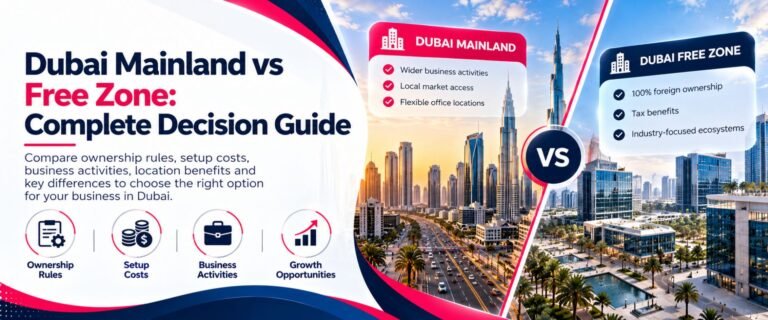
Mainland DET vs Free Zone: The Decision That Defines Your Business Model
This is the most consequential decision a trading company investor makes, and it has direct commercial implications that go far beyond initial cost differences.
| Factor | Mainland (DET) | Free Zone |
| Direct UAE mainland sales | Yes — unrestricted | No — needs distributor or dual entity |
| Government contracts | Eligible | Not eligible |
| Foreign ownership (2026) | 100% | 100% |
| Physical Ejari office | Mandatory | Flexi-desk or physical available |
| Flexi-desk accepted | No — dedicated tenancy only | Yes in most free zones |
| Minimum paid-up capital | None mandated by DET | None in most zones |
| Import/re-export focus | Can do both | Ideal for re-export model |
| Best for | Local UAE customer base | International trade/re-export |
| First-year cost range | AED 28,000 to 40,000+ | AED 12,000 to 50,000 (zone dependent) |
The Mainland Route: Direct Market Access, Physical Office Required
A Dubai mainland trading company registered with DET can sell directly to any buyer in the UAE, including retail stores, supermarkets, hospitality groups, and individual consumers, without restriction. It can bid on government contracts, which are often substantial for commodity supply. It has no limitation on where it can set up office or warehouse facilities across Dubai.
The critical physical requirement that most guides understate: a mainland general trading company requires a physical, Ejari-registered tenancy contract. Flexi-desk arrangements and virtual office contracts do not satisfy the DET’s requirement for a general trading license on the mainland. The logic is that a business handling physical goods needs a verifiable commercial address. The minimum office size acceptable is modest, and shared office suites with a dedicated desk and contract qualify, but the tenancy must be in the company’s name and registered through Ejari.
Under the 2021 UAE commercial law reforms, 100% foreign ownership of mainland trading companies is now available for most activities. The old requirement for a UAE national partner holding a 51% share has been removed. This eliminates an annual local service agent fee that was previously mandatory for foreign investors, which is a significant cost reduction compared to pre-2021 mainland structures.
The Free Zone Route: Tax Benefits, Re-Export Strength, Mainland Limitation
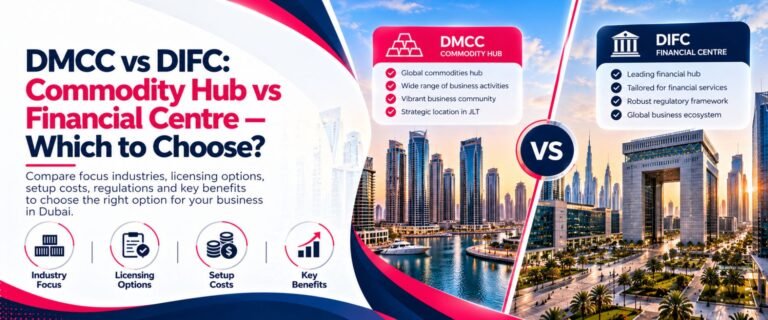
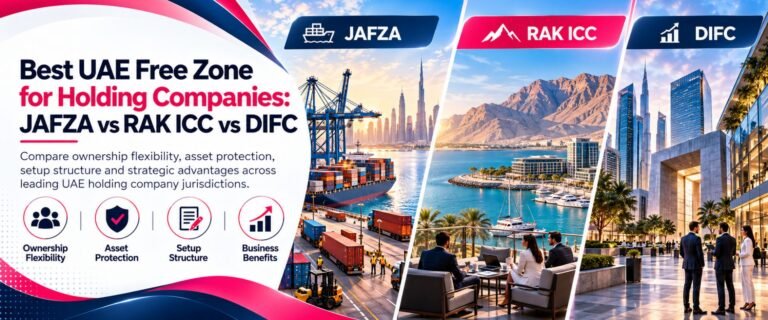
A Dubai free zone trading company offers 100% foreign ownership, import/export duty benefits on goods within the free zone, and in some cases lower initial licensing costs. Free zones particularly suited for general trading include DMCC (Dubai Multi Commodities Centre), IFZA, JAFZA (Jebel Ali Free Zone) for its port connectivity, and Dubai South for its aviation and logistics advantages.
The trade-off is direct UAE mainland sales. A free zone general trading company cannot sell directly to UAE mainland businesses or consumers without appointing a licensed mainland distributor or establishing a separate mainland entity. If your trading model is primarily international — importing goods, storing them in the free zone, and re-exporting to regional markets — the free zone structure is cost-effective and operationally well-suited. If your model requires direct UAE retail or wholesale distribution, the mainland route gives you the access that a free zone cannot.
The DET Cost Structure: Why the Real Number Is Higher Than Most Guides State
Most articles on general trading license costs cite the base DET license fee of AED 12,500 to AED 15,000 and stop there. The actual government cost is higher because the DET charges a separate general trading activity fee of approximately AED 15,000 in addition to the base license fee. These are two distinct government charges, and combining them puts the government fee component alone at approximately AED 27,000 to AED 30,000 on the mainland before office rental is added.
| Cost Component | Estimated Amount (AED) |
| DET Base License Fee (Mainland) | 12,500 to 15,000 |
| DET General Trading Activity Fee | Approx. 15,000 |
| Trade Name Reservation | 620 |
| Initial Approval Fee | 120 |
| Commercial Office Lease (Ejari) — per year | 20,000 to 80,000 depending on location |
| Ejari Registration | 200 to 500 |
| Memorandum of Association (notarised) | 1,500 to 3,000 |
| Establishment Card (MOHRE) | 1,500 to 2,000 |
| Visa per Person (investor/employee) | 4,000 to 6,000 |
| Total First-Year Estimate (Mainland, without office rent) | AED 28,000 to AED 40,000 |
| Free Zone General Trading License (IFZA/DMCC — varies) | AED 12,000 to AED 25,000 per year |
On the question of paid-up capital: there is no minimum paid-up capital requirement imposed by the DET for most general trading LLCs. However, when you open a corporate bank account, UAE banks typically request a capital declaration in the MOA. A figure of AED 50,000 to AED 300,000 in the MOA is the standard range that facilitates smooth bank account opening without raising due diligence questions. This capital is declared, not deposited into a blocked account, so it does not represent an actual cash outflow beyond the document preparation.
Step-by-Step: Starting a General Trading Company in Dubai
- Define your product scope and check the DET activity list to confirm that all goods you plan to trade fall within the general trading category or identify which ones require additional approvals.
- Choose your structure: mainland LLC through DET or a free zone authority. Base this on whether your primary customers are UAE-based or internationally focused.
- Submit three trade name options to DET. Names must comply with UAE naming conventions — no use of ‘international’ or ‘group’ without meeting specific criteria. Approval typically comes within 1 to 2 business days.
- Receive initial approval from DET confirming your proposed trading activity is permissible. This allows you to proceed with leasing premises.
- Secure a commercial office space with an Ejari-registered tenancy contract in your company’s name. For mainland trading, virtual offices and flexi-desks do not qualify.
- Prepare and notarise the Memorandum of Association (MOA) confirming shareholder structure, share capital, and business activities. If you have a corporate shareholder, the process involves additional documentation.
- Submit the complete application to DET with all documents and approvals. Pay the license fee and activity fee. DET issues the commercial trade license.
- Apply for an establishment card through MOHRE, open your corporate bank account, and begin the investor and employee visa process through our PRO services team.
Non-UAE residents can complete most of this process remotely with a power of attorney. The only stages requiring physical presence in Dubai are visa stamping and bank account opening biometrics. Many international trading investors complete the company setup and MOA preparation from their home country and make a single visit to Dubai for the final steps.
After Your License: Customs Registration and Warehouse Requirements
A trading license authorises you to trade. Actually moving goods requires two additional registrations that new traders sometimes overlook. If you plan to import or export, you need to register as a Dubai Customs trader through the Dubai Customs portal. This gives you an importer code and is required on all customs declarations. Details are available on the Dubai Customs official portal.
If you plan to stock goods physically, your storage facility must meet Dubai Municipality hygiene and safety standards. Temperature-controlled goods have additional requirements. For general dry goods, standard commercial warehouse space is straightforward. If you are importing food or pharmaceutical products, Dubai Municipality food safety approvals apply at the warehouse level as well as at the product registration level.
Once your trading company is established and revenue grows, keep in mind that UAE VAT registration becomes mandatory when annual turnover exceeds AED 375,000. Our VAT consultants can advise on when to register and manage the FTA process.
Where to Get Setup Support
The mainland general trading license application involves DET, Ejari, MOHRE, and potentially Dubai Customs — all running in sequence. Errors in trade name compliance, incorrect activity classification, or missing MOA provisions create delays that push your trading launch back by weeks. Dubai International Advisory Consultants manages the full setup process for trading companies, from trade name reservation and initial approval through to license issuance, bank account facilitation, and visa coordination. Visit the business setup in Dubai page or explore our dedicated general trading license service for a full overview of how the team supports trading investors.
Conclusion
A general trading license in Dubai gives you the commercial flexibility to trade multiple unrelated product categories under one entity, access Dubai’s world-class logistics infrastructure, and serve either the UAE domestic market or international re-export routes depending on whether you choose mainland or free zone. The real first-year cost on the mainland is AED 28,000 to AED 40,000 when you add the DET activity fee to the base license fee — this is higher than most single-number quotes suggest. Flexi-desks do not qualify for mainland general trading; a dedicated Ejari tenancy is mandatory. Cars, alcohol, weapons, and medical products are outside the general trading scope and need specialist licenses. With the right jurisdiction choice, correct activity classification, and a physical office from day one, the setup process takes 1 to 2 weeks for the license itself.
People Also Ask: Trading Company Dubai FAQs
What is a general trading license in Dubai?
A general trading license is a commercial permit issued by the DET (mainland) or a free zone authority that allows one company to import, export, distribute, and sell multiple unrelated product categories under a single license. It is the most flexible commercial license for multi-commodity trading businesses.
How much does a general trading license cost in Dubai?
The total first-year cost for a mainland general trading company in Dubai typically ranges from AED 28,000 to AED 40,000 in government fees alone, comprising a base DET license fee of AED 12,500 to AED 15,000 plus a separate DET activity fee of approximately AED 15,000, plus trade name registration and initial approval fees. Office rental is additional and varies by location.
Do I need a physical office for a general trading license in Dubai?
Yes for mainland DET companies. A dedicated, Ejari-registered commercial tenancy contract in the company’s name is mandatory. Flexi-desk arrangements and virtual offices do not qualify for a mainland general trading license. Free zone trading companies can use flexi-desk arrangements offered by the respective free zone authority.
Can a free zone trading company sell directly to UAE customers?
No. A free zone general trading company cannot sell directly to UAE mainland customers without appointing a licensed mainland distributor or establishing a separate mainland entity. Free zone licenses are ideal for businesses focused on international trade and re-export that do not need direct UAE retail or wholesale access.
What products cannot be traded under a general trading license?
Cars and motor vehicles, alcohol and beverages, weapons and ammunition, and medical devices or pharmaceuticals cannot be traded under a general trading license. These require specialist licenses. Food products, construction materials, and pharmaceuticals may need additional government approvals even if they can be included in certain trading activities.
Is there a minimum capital requirement for a general trading company in Dubai?
The DET does not impose a minimum paid-up capital requirement for most general trading LLCs. However, when opening a corporate bank account, UAE banks typically look for a capital declaration in the MOA. A figure of AED 50,000 to AED 300,000 is the standard range that facilitates smooth bank onboarding without compliance complications.
Can a foreigner own 100% of a general trading company in Dubai?
Yes. Under the 2021 UAE commercial law reforms, foreign investors can own 100% of mainland general trading companies in Dubai for most commercial activities. The old requirement for a UAE national partner or sponsor has been removed, eliminating the annual local service agent fee that was previously a mandatory cost.
How long does it take to get a general trading license in Dubai?
With complete documentation and a ready Ejari-registered office, the DET issues a mainland general trading license within approximately 5 to 10 working days. Trade name approval takes 1 to 2 days. Free zone trading licenses can sometimes be issued faster, within 3 to 7 working days. Total setup including visas and bank account opening takes 3 to 6 weeks.
About the Author
Adil Ahmad is a business setup specialist and content strategist at Dubai International Advisory Consultants. He specialises in commercial licensing, trading company formation, and mainland vs free zone structuring decisions for investors entering the Dubai market. His content reflects direct knowledge of DET activity classification, UAE trade regulations, and the practical commercial considerations that determine the right structure for import-export and distribution businesses.