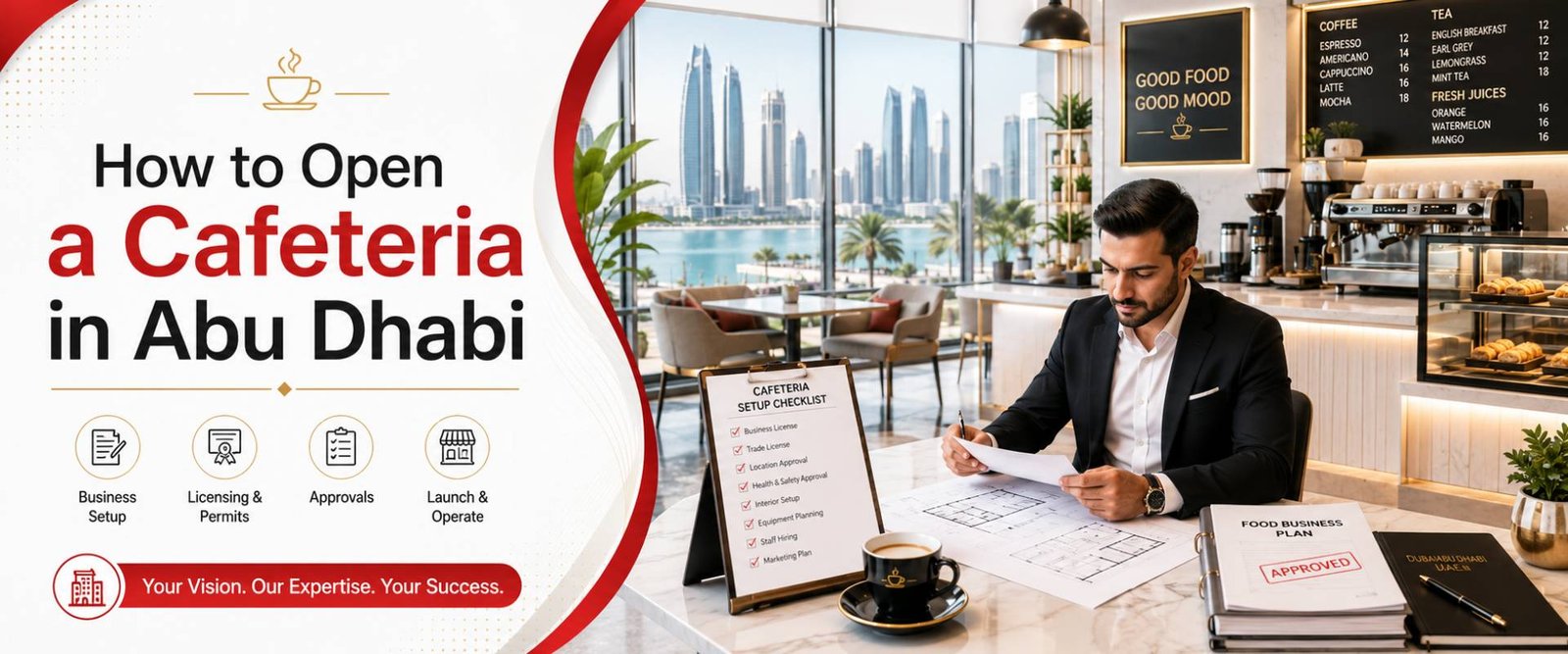
| Trade License | Food Permit | Min. Space | Setup Timeline |
| ADDED (Abu Dhabi DED) | Abu Dhabi Municipality | 30 sqm minimum | 8 to 14 weeks |
If you have tried researching how to open a cafeteria in Abu Dhabi, you have probably discovered that the answer involves more than one government department. That is because food and beverage businesses in the UAE capital operate under a dual-approval system: a trade license from ADDED (the Abu Dhabi Department of Economic Development) and a food establishment permit from Abu Dhabi Municipality (ADM). Both are non-negotiable. Both have their own timelines, fees, and inspection requirements. And getting one without the other leaves your cafeteria legally unable to serve a single customer.
This guide gives you the honest, practical breakdown: what each approval covers, how they interact, what ADM actually inspects, what your premises must look like, how much everything costs, and the common mistakes that delay new cafeteria owners by weeks. Whether you are opening a small coffee and sandwich spot, a full-service cafeteria in an office tower, or a school canteen, the regulatory path is the same.
DIAC’s business setup team handles the full ADDED and ADM process for food and beverage clients across Abu Dhabi. Overview of all UAE F&B setup options at our UAE business setup.
The ADDED and ADM Approval: Understanding Why Two Bodies Are Involved
Most aspiring cafeteria owners in Abu Dhabi are surprised to discover that the Abu Dhabi Department of Economic Development and the Abu Dhabi Municipality are two entirely separate authorities with no automatic connection between their processes. One licenses your business entity. The other licenses your food premises. You need both and you have to manage both timelines simultaneously.
ADDED: Your Business Entity License
ADDED (the Abu Dhabi Department of Economic Development) issues the commercial trade license that makes your company a legal entity in Abu Dhabi. Your ADDED license specifies the activity: restaurant and cafeteria, coffee shop, food and beverage establishment, or more specific sub-categories depending on your offering. ADDED also handles your company structure, shareholding, visa allocation, and annual renewal. Apply through the ADDED official business portal.
What ADDED does not cover: it does not inspect your kitchen, it does not verify your food handling procedures, and it does not care how your food is stored. That is ADM’s job.
Abu Dhabi Municipality: Your Food Premises License
The Abu Dhabi Municipality (ADM) regulates all food establishments in Abu Dhabi through its Food Control Sector. The ADM food establishment permit is your authorisation to actually prepare and serve food to the public. ADM inspects your physical premises, your kitchen equipment, your food storage arrangements, your staff health certificates, and your general hygiene before issuing the permit. The ADM permit is renewed annually and is subject to periodic unannounced inspections.
| The sequence that matters: Most food business consultants recommend starting the ADDED trade license application first (it is faster), then running the ADM food establishment permit application in parallel once you have your initial ADDED approval letter. The two processes are independent: you do not need ADDED to be fully completed before ADM will begin reviewing your premises. Running them in parallel saves four to six weeks. |
Choosing Your Abu Dhabi Cafeteria Location: What ADM and ADDED Both Care About
Your premises decision is the single most consequential commercial and regulatory choice in your cafeteria setup. Location determines your customer base, your rent burden, and whether your space will pass ADM inspection. Many cafeteria operators sign a lease before checking ADM’s space requirements, then discover their unit does not qualify. Do not do this.
ADM Minimum Premises Requirements
- Floor area: minimum 30 square metres for a basic cafeteria; larger units required if you plan table seating beyond 20 covers
- Separate kitchen area: the food preparation zone must be physically separated from the customer service area, either by a wall, counter partition, or clear delineation
- Ventilation and extraction: commercial kitchen exhaust requirements must be met; the landlord or fit-out contractor needs to confirm the building services can support this
- Hand-washing station: at least one dedicated hand-washing sink in the food preparation area, separate from dishwashing
- Grease trap: required for any premises with cooking; size depends on menu type and throughput; must be approved by drainage authority
- Cold storage: refrigeration capacity appropriate for your menu and anticipated daily volume
- Separate staff toilet from customer toilet (required above certain seating capacity thresholds)
- Pest control evidence: an active pest control contract with an ADM-approved provider must be in place before the inspection
Location Considerations by Business Type
| Cafeteria Type | Best Abu Dhabi Locations | Primary Customer | Key Regulatory Note |
| Office cafeteria or canteen | Business Bay AD, Al Maryah Island, Corniche Road towers | Corporate employees; fixed lunchtime volumes | May require additional building management approval alongside ADM |
| Street or mall cafeteria | Khalidiyah Mall, Abu Dhabi Mall, Marina Mall, high-street commercial | Walk-in mixed demographic | Mall management approval required before ADDED and ADM submissions |
| School canteen | Near residential schools in Khalifa City, Mohammed Bin Zayed City | Students and staff | ADEK (Abu Dhabi Education Council) additional approval for school-linked food operations |
| Residential community cafe | Al Reem Island, Al Reef, Yas Island communities | Residents; loyal local customer base | Check permitted F&B use in development’s master plan before committing |
| Industrial area cafeteria | Mussafah, ICAD, Khalifa Industrial Zone | Blue-collar workforce; high breakfast and lunch volume | Lower rent; high volume; simpler menu viable |
Fitting Out Your Abu Dhabi Cafeteria to Pass ADM Inspection
The ADM inspection is where most first-time cafeteria operators encounter delays. The most common reasons for a failed inspection are not major structural problems: they are easily preventable fit-out oversights that an experienced contractor would catch in advance.
What ADM Inspectors Look For
- Wall and floor finishes: All surfaces in food preparation areas must be smooth, non-porous, easy to clean, and light in colour. Rough concrete, raw brick, or porous tiles are not acceptable in kitchen zones
- Ceiling height and finish: Minimum 2.5 metres in kitchen areas; washable, non-absorbent ceiling material required; no exposed pipes or electrical conduits in food areas
- Equipment placement: All kitchen equipment must be positioned to allow cleaning underneath and around; no gaps between equipment units where food debris can accumulate
- Food contact surface materials: Only stainless steel or approved food-grade materials for preparation surfaces, shelving in cold storage, and food display equipment
- Handwashing facilities: Hot and cold running water, soap dispenser, and single-use paper towels or hand dryer at every handwashing point; no shared sink arrangements between handwashing and food preparation
- Waste management: Covered bins for food waste; outdoor waste storage area that is sealed and pest-proof; daily waste removal from kitchen; ADM-approved waste collection service contract
- Temperature monitoring: Calibrated thermometers visible in all cold storage units; temperature log sheets accessible for inspector review
| Hire an ADM-experienced fit-out contractor: The difference between a first-time pass and a failed inspection often comes down to the contractor. An experienced Abu Dhabi F&B fit-out contractor knows the ADM checklist and builds compliance into the design. Ask specifically for ADM-approved project references before engaging a contractor. |
Staff Requirements: Health Cards, Food Handler Certificates, and Visas
Every person who handles food in your Abu Dhabi cafeteria must hold a valid Abu Dhabi health card and complete an accredited food handler training course. This is not negotiable and it is checked during ADM inspections and at routine visits. Employing unqualified food handlers is one of the most common reasons for ADM closure orders against operating cafeterias.
Food Handler Health Cards
All food handling staff must obtain a health card issued by the Abu Dhabi Public Health Center (ADPHC). The health card requires a medical fitness examination and is typically valid for one to two years. Apply through the ADPHC health card portal. The card must be renewed before expiry; lapsed health cards during an ADM inspection will result in a violation notice.
Food Handler Training Certificate
In addition to the health card, all food handlers in Abu Dhabi must complete an ADM-approved food safety training course. Courses are offered by ADM-accredited training providers and typically take one to two days. The certificate is displayed at the premises and presented to inspectors on request. This applies to everyone who touches food: kitchen staff, counter service staff, and even cashiers who package food items.
Visa Allocation for Cafeteria Staff
Your ADDED trade license generates your visa quota based on the size of your licensed premises. A cafeteria of 30 to 80 square metres typically supports six to twelve employment visas. The exact formula follows Abu Dhabi’s standard allocation model. If your cafeteria requires more staff than your initial visa quota allows, upsizing your premises registration or securing additional visa quota through a formally declared expansion is the route. Our PRO services team handles visa processing for Abu Dhabi cafeteria businesses.
Realistic Cafeteria Setup Costs in Abu Dhabi
Cost ranges in most guides are too wide to be useful. Below are three practical scenarios reflecting real Abu Dhabi market conditions, so you can identify which bracket your concept falls into.
| Cost Component | Basic (30-50 sqm) | Mid-Size (50-100 sqm) | Full-Service (100+ sqm) |
| ADDED Trade License (annual) | AED 8,000 – 12,000 | AED 10,000 – 16,000 | AED 14,000 – 22,000 |
| ADM Food Establishment Permit (annual) | AED 1,500 – 3,000 | AED 2,500 – 5,000 | AED 4,000 – 8,000 |
| ADM Application and Inspection Fees | AED 500 – 1,500 | AED 1,000 – 2,500 | AED 1,500 – 4,000 |
| Premises Fit-Out (kitchen + front of house) | AED 60,000 – 150,000 | AED 150,000 – 350,000 | AED 350,000 – 700,000+ |
| Kitchen Equipment | AED 25,000 – 60,000 | AED 60,000 – 150,000 | AED 150,000 – 350,000+ |
| Annual Rent (Abu Dhabi average) | AED 50,000 – 100,000 | AED 100,000 – 250,000 | AED 250,000 – 600,000+ |
| Staff Health Cards (per person) | AED 300 – 500 each | AED 300 – 500 each | AED 300 – 500 each |
| Employment Visas (per person) | AED 3,500 – 5,000 | AED 3,500 – 5,000 | AED 3,500 – 5,000 |
| Food Hygiene Pest Control (annual) | AED 1,500 – 3,000 | AED 2,500 – 5,000 | AED 4,000 – 8,000+ |
| Opening Stock (first month) | AED 5,000 – 15,000 | AED 15,000 – 40,000 | AED 40,000 – 100,000+ |
| Realistic First-Year Total | AED 180,000 – 380,000 | AED 380,000 – 850,000 | AED 850,000 – 2,000,000+ |
| The cost item most people underestimate: Fit-out is consistently the biggest variable and the most underestimated cost item for first-time cafeteria owners. The gap between a basic-standard fit-out and an ADM-compliant one can be AED 30,000 to AED 80,000 in kitchen specification alone. Get two or three quotes from ADM-experienced contractors, not generic fit-out companies, before committing to a budget. |
The Registration Journey: From Concept to First Customer
The cafeteria registration process in Abu Dhabi has eight stages. The total timeline runs eight to fourteen weeks for a first-time operator with complete documentation and a premises that passes ADM inspection on the first attempt. Delays most commonly occur at the fit-out stage and at the first ADM inspection.
- Confirm your business concept and premises type: sit-down cafeteria, takeaway only, or combined. This determines your ADDED activity code and your ADM permit category before anything else is submitted.
- Shortlist premises and conduct a pre-lease ADM suitability check. Visit potential locations with your fit-out contractor and verify that the space can accommodate ADM’s ventilation, drainage, and area requirements before signing.
- Submit ADDED trade name reservation and initial activity approval. Processing takes three to seven working days for a clean application.
- Sign your commercial lease and complete Ejari registration through the Abu Dhabi Housing Authority system.
- Engage a fit-out contractor with ADM-approved cafeteria references and begin the fit-out. This stage typically takes four to eight weeks and is your critical path.
- Submit ADM food establishment permit application with floor plan, equipment list, and fit-out specifications. ADM reviews the application in parallel with your fit-out completion.
- Obtain Abu Dhabi Civil Defence fire safety certificate for the fitted-out premises. This requires a separate inspection by the Civil Defence authority.
- ADM conducts the premises inspection once fit-out is complete. A passing inspection leads to food establishment permit issuance within five to ten working days.
- Complete ADDED trade license with ADM permit attached. Obtain establishment card and process staff health cards, food handler certificates, and employment visas.
- Open for business with all licenses displayed at the premises as required by ADM and ADDED regulations.
| What competitors’ guides miss: Steps 2, 7, and 9 are consistently absent from generic business setup guides. The pre-lease ADM check (Step 2) saves thousands in rent on unqualified premises. The Civil Defence certificate (Step 7) is a separate process that adds one to three weeks to timelines. The establishment card (Step 9) is required before employment visas can be processed, and many new operators discover this gap too late. |
Opening a Cafeteria in Abu Dhabi vs Dubai: Key Practical Differences
If you are deciding between Abu Dhabi and Dubai for your cafeteria business, the operational differences matter beyond just the permit bodies. Our Dubai vs Abu Dhabi business setup comparison covers the full structural comparison, but for food businesses specifically:
| Factor | Abu Dhabi | Dubai |
| Trade license authority | ADDED (Abu Dhabi DED) | DET (Department of Economy and Tourism) |
| Food permit authority | Abu Dhabi Municipality (ADM) | Dubai Municipality (DM) |
| Food safety framework | ADM Food Control Sector | DM Food Safety Department |
| Health card issuer | Abu Dhabi Public Health Center (ADPHC) | Dubai Health Authority (DHA) / Preventive Medicine |
| Minimum kitchen size (typical) | 30 sqm | No fixed minimum but DM space standards apply per capacity |
| Average rent vs Dubai | 15 to 30% lower in comparable areas | Higher; especially in tourist and marina districts |
| Tourism-driven footfall | Lower; more resident-dependent business | Higher; strong tourist seasonal uplift |
| Government sector cafeteria contracts | Large opportunity; Abu Dhabi government campus cafeterias | Smaller government campus base |
| Food handler training provider network | ADM-approved providers; smaller network | DM-approved providers; wider network |
Questions People Actually Ask Before Opening a Cafeteria in Abu Dhabi
Can I open a cafeteria in Abu Dhabi as a foreigner with 100% ownership?
Yes. Food and beverage businesses including cafeterias are among the commercial activities fully open to 100% foreign ownership in Abu Dhabi under the 2021 UAE FDI reforms. You do not need a UAE national partner or local service agent to own a cafeteria on the Abu Dhabi mainland. In Abu Dhabi free zones such as Khalifa Industrial Zone (KIZAD) or twofour54, 100% foreign ownership has always been permitted. Confirm the current approved activity list with ADDED at the time of your application. See our company registration in Abu Dhabi free zone guide for the free zone route.
How long does it take to open a cafeteria in Abu Dhabi?
From initial application to opening day, the realistic timeline is eight to fourteen weeks. The fit-out stage is almost always the longest: a basic cafeteria fit-out takes four to six weeks, a larger full-service fit-out takes six to ten weeks. ADM inspection happens after fit-out completion, adding one to three weeks depending on inspection scheduling and whether any remediation is needed. Running ADDED and ADM applications in parallel (not sequentially) is the fastest approach and saves four to six weeks versus a sequential submission.
Do all cafeteria staff need food handler certificates in Abu Dhabi?
Yes. Every person who handles food in your Abu Dhabi cafeteria must hold both a valid Abu Dhabi health card from ADPHC and an ADM-approved food handler training certificate. This applies to kitchen staff, counter service staff, and any employee who packages, prepares, or serves food. The health card requires a medical fitness examination and has an expiry date. ADM inspectors check card validity dates during inspections and operational visits. Lapsed cards result in violation notices.
What is the difference between a cafeteria license and a restaurant license in Abu Dhabi?
The distinction in Abu Dhabi is primarily in the scale and service style registered with ADDED. A cafeteria license typically covers self-service or counter-service food operations, while a restaurant license covers full table-service dining with broader menu scope. The ADM food establishment permit requirements are similar for both but restaurants face higher minimum area standards and more detailed kitchen-to-seating ratio requirements. For a small to medium food and beverage operation serving breakfast, sandwiches, hot drinks, and light meals, the cafeteria license is the appropriate and less complex route.
Does my Abu Dhabi cafeteria need a separate food delivery license?
If you plan to offer delivery services alongside your in-premises operation, you do not need a separate license for delivery if you are delivering your own menu items using your own staff. What changes is your ADM food establishment permit scope, which should include delivery-ready food packaging and temperature maintenance standards for transported items. If you want to list on third-party delivery platforms (Talabat, Deliveroo, Careem Food), those platforms will require your active ADDED trade license and ADM food establishment permit for onboarding. No additional government license is required for delivery in Abu Dhabi beyond these two.
What happens if my cafeteria fails an ADM inspection?
A failed ADM inspection results in a written notice listing the specific deficiencies and a defined remediation period. The deficiency list is specific: each item has a corrective action required and a deadline. Minor violations (labelling, temperature log gaps, cleaning schedule documentation) are usually given 15 to 30 days for correction. Structural issues (inadequate ventilation, non-compliant surfaces, missing grease trap) require re-inspection after the remediation work is complete. If you address all items and request a re-inspection promptly, the delay is typically two to four additional weeks. If deficiencies recur at re-inspection, more serious enforcement action follows.
Is there a minimum investment requirement to open a cafeteria in Abu Dhabi?
There is no formal minimum investment threshold set by ADDED or ADM for a cafeteria business. The practical minimum investment is determined by your premises size, fit-out standard, and fleet of kitchen equipment. A basic 30 to 50 square metre cafeteria in Abu Dhabi requires a realistic first-year investment of AED 180,000 to AED 380,000 including licensing, fit-out, equipment, rent, and initial staffing. Attempting to cut significantly below this figure typically results in a premises or fit-out that does not meet ADM standards, creating longer delays and higher corrective costs than a compliant setup from the start. For a personalised estimate, contact a DIAC consultant at diac.ae.
Before You Sign a Lease, Talk to Us FirstThe most expensive mistakes in cafeteria setup happen before the license applications are even submitted: signing a premises lease that fails ADM requirements, choosing the wrong activity code, or underestimating the fit-out timeline. DIAC’s team advises Abu Dhabi food and beverage investors at the planning stage, not just the paperwork stage. Free consultation at diac.ae or contact us directly to discuss your cafeteria concept and get a realistic cost and timeline estimate before you commit to a location. |
About the Author
Adil Ahmad is a business setup consultant at DIAC with specific experience in food and beverage business formation across Abu Dhabi and Dubai, including cafeterias, restaurants, cloud kitchens, and catering businesses. He advises investors on ADDED licensing, ADM food establishment permits, fit-out compliance, and ongoing regulatory support for UAE F&B operators.