| Article Summary
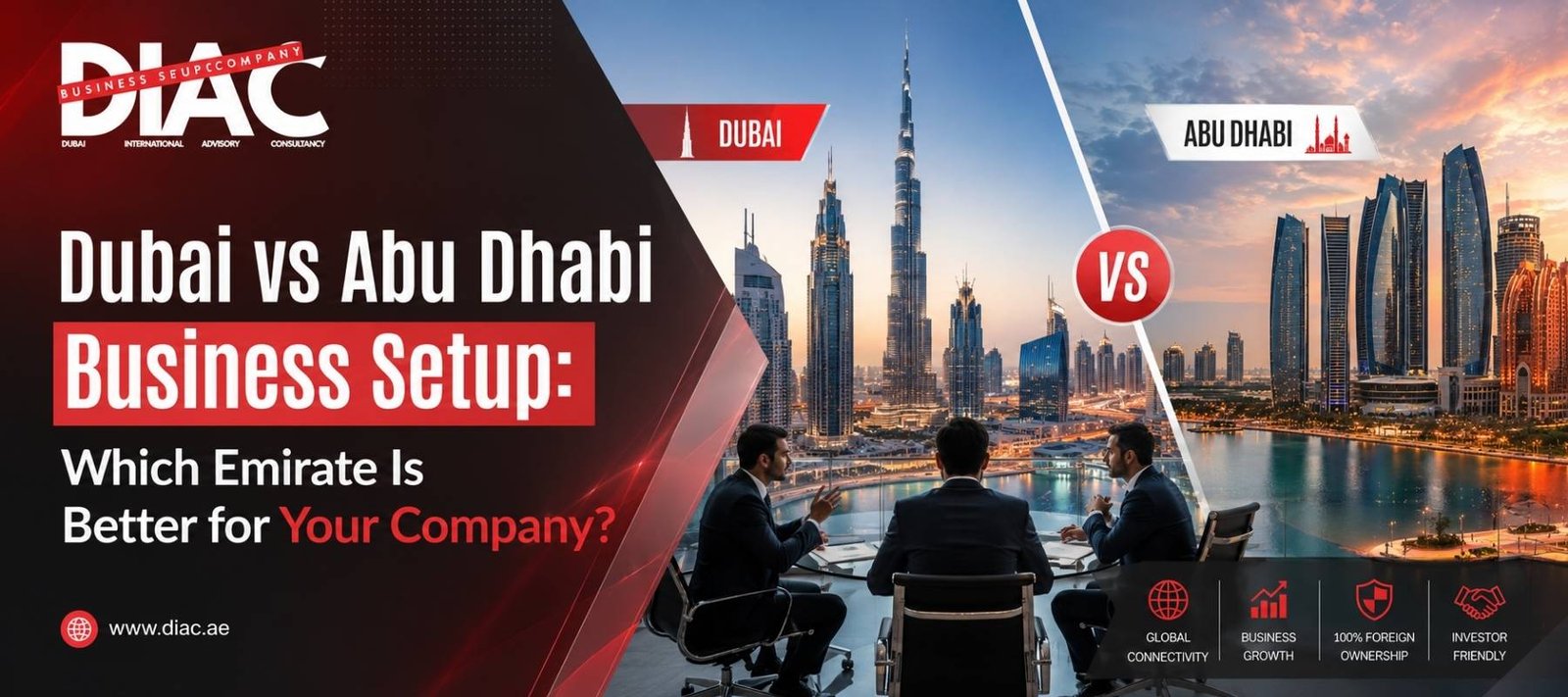
Dubai and Abu Dhabi are both world-class destinations for company formation, but they serve different business profiles. Dubai leads in commerce, logistics, fintech, and tourism. Abu Dhabi dominates energy, government contracts, and sovereign finance. This guide compares free zones, mainland formation costs, visa routes, industry clusters, and setup timelines so you can choose the right emirate for your specific business. |
It is one of the most common questions in UAE business setup: should I register my company in Dubai or in Abu Dhabi? Both emirates are open to foreign investment, both offer free zones and mainland options, and both deliver world-class infrastructure and a zero percent personal income tax environment. But the comparison ends there.
Dubai and Abu Dhabi have distinct economic profiles, regulatory environments, market access advantages, and cost structures. The right choice depends entirely on your industry, your target clients, your growth plans, and your budget. This guide gives you a direct, honest comparison across every factor that matters.
Dubai International Advisory Consultants (DIAC) assists businesses in setting up across both emirates. Whichever direction you choose, our consultants are available to manage the full registration and licensing process. Start at diac.ae for an overview of all UAE business setup services.
Dubai vs Abu Dhabi: The Business Landscape
Before comparing costs and processes, it is worth understanding what each emirate does best commercially. Choosing the wrong emirate for your industry is one of the most costly mistakes an investor can make, because it affects your access to clients, talent, and contracts.
Dubai: Commerce, Connectivity, and Global Business
Dubai is the UAE’s commercial capital and one of the top ten global cities for international business. It is home to over 30 free zones, the world’s busiest international airport (Dubai International), and the region’s largest port (Jebel Ali). More Fortune 500 companies have their Middle East headquarters in Dubai than in any other city in the region.
Dubai’s strongest sectors:
- Trade, import/export, and general commerce
- Financial services, fintech, and digital banking (DIFC is a global financial hub)
- Hospitality, tourism, and retail
- Logistics, shipping, and supply chain management
- Technology, e-commerce, and media
- Real estate and construction
- Professional services: legal, consulting, marketing, HR
Abu Dhabi: Government, Energy, and Institutional Finance
Abu Dhabi is the UAE’s capital and controls over 90 percent of the country’s oil reserves. It is home to sovereign wealth funds including ADIA and Mubadala, major government ministries, and the UAE’s largest financial institutions. Abu Dhabi is not a purely government economy: its diversification agenda (Ghadan 21 and beyond) has driven significant growth in manufacturing, renewable energy, healthcare, and advanced technology.
Abu Dhabi’s strongest sectors:
- Oil and gas, petrochemicals, and downstream energy
- Renewable energy and cleantech (Masdar City is a global clean energy hub)
- Government supply chain and public sector contracts
- Institutional finance, private wealth management, and sovereign investment
- Aerospace and defence manufacturing (Tawazun, EDGE Group supply chain)
- Healthcare and medical research
- Heavy industry and manufacturing (KIZAD is a major industrial zone)
| Quick verdict: If your clients are private sector companies, consumers, or international businesses, Dubai is almost always the better starting point. If your clients are government entities, energy companies, or institutional investors, Abu Dhabi gives you direct access to the decision-makers. |
Free Zones: Dubai vs Abu Dhabi Options Compared
Both emirates offer a wide range of free zones, but the number, variety, and cost profiles differ significantly. Dubai has more free zones and more competition between them, which generally means more flexibility and lower costs for standard setups.
Dubai Free Zones
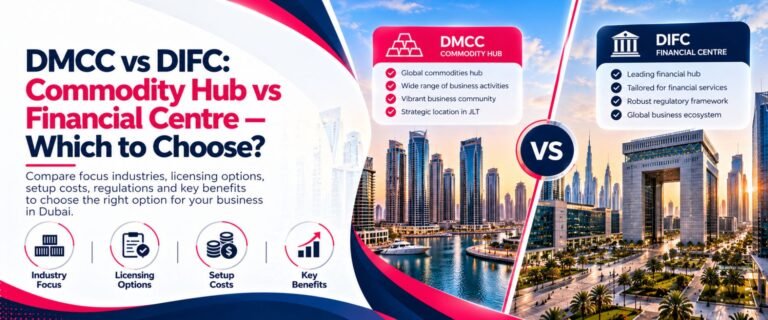
Dubai has over 30 active free zones catering to specific industries and business types. Key zones include DMCC (commodities and trading), DIFC (financial services), IFZA (SMEs and general business), JAFZA (logistics and manufacturing), DAFZA (aviation), and Dubai Silicon Oasis (technology). Costs range from around AED 12,000 per year for an IFZA flexi-desk package to AED 50,000 and above for DIFC setups. For more detail, visit our Dubai free zone company formation guide.
Abu Dhabi Free Zones
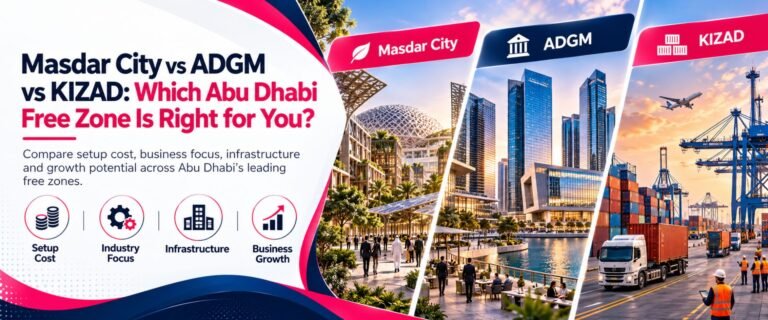
Abu Dhabi’s free zone landscape is more concentrated than Dubai’s but includes some highly specialised zones. Key options include ADGM (financial services and professional firms), KIZAD (Khalifa Industrial Zone Abu Dhabi, for manufacturing and logistics), Masdar City (cleantech and sustainability businesses), twofour54 (media and entertainment), and Abu Dhabi Airport Free Zone (ADAFZ). Our dedicated guides on company registration in Abu Dhabi free zone cover each zone in detail.
| Criteria | Dubai Free Zones | Abu Dhabi Free Zones |
| Number of zones | 30+ | 10+ |
| Lowest-cost entry | IFZA from AED 12,000/yr | KIZAD from AED 15,000/yr (approx) |
| Premium financial zone | DIFC | ADGM |
| Best for manufacturing | JAFZA | KIZAD |
| Best for cleantech | Dubai Science Park | Masdar City |
| Best for media | Dubai Media City | twofour54 |
| Visa allocation | Flexible; varies by package | Some zones require higher minimums |
| Market access | UAE mainland requires NOC/distributor | UAE mainland requires NOC/distributor |
Mainland Setup: DED Dubai vs ADDED Abu Dhabi
For businesses that need unrestricted access to the UAE domestic market, sell directly to local customers, or want to bid on government contracts, mainland formation is the right route. The two relevant mainland authorities are the Department of Economy and Tourism (DET, formerly DED) in Dubai and the Abu Dhabi Department of Economic Development (ADDED) in Abu Dhabi.
Dubai Mainland (DET)
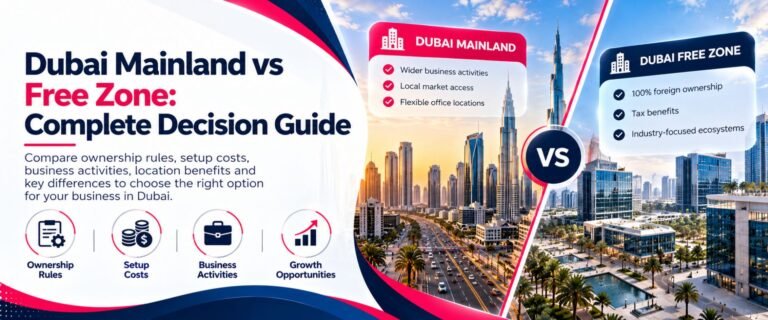
The Dubai mainland licensing process through DET is well-established, largely digital, and supported by a wide ecosystem of business setup consultants, shared office providers, and government service centres. Since 2021, the majority of commercial activities on Dubai mainland are open to 100 percent foreign ownership. Our guide to mainland company formation in Dubai walks through every step.
Dubai mainland advantages:
- Full access to UAE’s largest domestic consumer and business market
- No restriction on number of visa applications relative to free zone packages
- Can trade directly with any UAE entity, including government departments
- Large network of business service providers, accountants, and legal firms
- Flexible office options from flexi-desk to full commercial fit-out
Abu Dhabi Mainland (ADDED)
Abu Dhabi mainland formation through ADDED follows a similar structure to Dubai’s DET process but with some important differences in fee scales, approved activity lists, and the pace of digital transformation. Abu Dhabi mainland is the correct route for businesses targeting government ministries, semi-government entities, or the large Abu Dhabi corporate base. Visit the ADDED official portal for current activity lists and fee schedules.
Abu Dhabi mainland advantages:
- Direct access to Abu Dhabi government and semi-government contract procurement
- Lower commercial real estate costs than comparable Dubai locations
- Strong demand in healthcare, construction, and industrial supply sectors
- Growing startup ecosystem supported by Hub71 and Abu Dhabi investment authorities
- Fewer competing businesses in many professional service categories
Cost: Setting Up in Dubai vs Abu Dhabi
Cost is frequently the deciding factor for SMEs and startups choosing between the two emirates. The honest picture is more nuanced than most comparison articles suggest: Dubai is not always more expensive, and Abu Dhabi is not always cheaper. It depends heavily on the zone, the office type, and the visa count required.
| Cost Factor | Dubai | Abu Dhabi | Verdict |
| Free zone entry (lowest tier) | AED 12,000 – 15,000/yr | AED 14,000 – 18,000/yr | Dubai edge |
| Mainland license | AED 10,000 – 20,000/yr | AED 8,000 – 16,000/yr | Abu Dhabi slight edge |
| Office rent (flexi-desk) | AED 8,000 – 20,000/yr | AED 6,000 – 14,000/yr | Abu Dhabi edge |
| Office rent (fitted office) | AED 60,000 – 200,000+/yr | AED 40,000 – 130,000+/yr | Abu Dhabi edge |
| Residential rent | Higher: premium locations | Lower overall | Abu Dhabi edge |
| Premium zones (DIFC/ADGM) | AED 50,000 – 120,000+/yr | AED 40,000 – 100,000+/yr | ADGM slight edge |
| Talent availability | Larger pool, higher salaries | Smaller pool, lower salaries | Depends on role |
| Client market size | Larger private sector | Larger government sector | Depends on your market |
| Cost reality check: Abu Dhabi offers genuine real estate and operating cost advantages for businesses that do not depend on Dubai’s specific client base or market. However, for businesses targeting Dubai’s commerce and tourism sectors, a Dubai setup is necessary regardless of cost comparisons. |
Industry Clusters: Dubai (Finance, Logistics) vs Abu Dhabi (Energy, Government)
Industry clustering matters enormously in the UAE. Being in the wrong emirate for your sector means you are physically and contractually distant from your most important clients and partners. Here is how the two emirates break down by sector.
Sectors Where Dubai Wins
- Financial services and fintech: DIFC hosts over 5,000 companies including the world’s leading banks, asset managers, and fintech firms. For financial services, DIFC is unrivalled in the region.
- Logistics and supply chain: JAFZA and DP World’s Jebel Ali Port handle over 14 million TEUs annually. Dubai is the logistics gateway for the entire region.
- Hospitality and tourism: Dubai receives over 17 million international visitors annually. Hospitality-linked businesses (F&B, events, retail, travel) are concentrated here.
- E-commerce and digital media: Dubai Internet City, Dubai Media City, and Dubai Silicon Oasis are the region’s anchor zones for tech and digital businesses.
- Trading and import/export: Dubai handles around 70 percent of UAE non-oil foreign trade. For trading businesses, Dubai mainland or DMCC/JAFZA are the natural bases.
Sectors Where Abu Dhabi Wins
- Energy and oil and gas: ADNOC, the Abu Dhabi National Energy Company, and the full energy supply chain is concentrated in Abu Dhabi. Energy sector suppliers and consultants must have an Abu Dhabi presence.
- Government supply and procurement: UAE federal ministries and Abu Dhabi government departments require vendors to hold an Abu Dhabi mainland or approved-zone license. Federal contracts are registered in Abu Dhabi.
- Renewable energy and cleantech: Masdar City in Abu Dhabi is the world’s first purpose-built sustainable city and the home of IRENA (International Renewable Energy Agency). Cleantech investors and researchers cluster here.
- Industrial manufacturing and heavy industry: KIZAD (Khalifa Industrial Zone) offers direct port access and industrial land parcels at a scale Dubai cannot match. For manufacturers needing large footprints and port connectivity, KIZAD is the best option in the UAE.
- Private wealth management and family office structures: ADGM is increasingly the preferred jurisdiction for family offices, private wealth structures, and fund management, particularly for Abu Dhabi and Gulf-based families with sovereign fund relationships.
Visas and Residency: Dubai vs Abu Dhabi Routes
Visa allocation is a key practical consideration for business owners planning to relocate to the UAE or bring staff from overseas. Both emirates operate under the same UAE federal visa framework, but there are some structural differences in how free zones and mainland companies handle visa quotas.
| Visa Factor | Dubai | Abu Dhabi |
| Mainland visa allocation | Based on office size (typically 1 visa per 9 sqm) | Similar formula; confirm with ADDED |
| Free zone visa allocation | Included in packages (1 to 6 typical for SME packages) | Varies by zone; some require higher minimums |
| Investor/partner visa | 3-year renewable; tied to company license | 3-year renewable; tied to company license |
| Golden Visa eligibility | AED 2M property or qualifying investment/skill | AED 2M property or qualifying investment/skill |
| Remote work visa (virtual) | Dubai Virtual Working Programme available | Abu Dhabi offers similar schemes |
| Freelance visa option | Available through DMCC, IFZA, and others | Available through twofour54 and select zones |
| Family visa sponsorship | Permitted for license holders earning AED 4,000+ | Same federal rules apply |
One frequently overlooked difference: some Abu Dhabi free zones set higher minimum annual fees for packages that include multiple visas, whereas Dubai zones like IFZA offer packages with three or six visas at very competitive price points. If your setup is visa-heavy (you need to bring five or more staff from overseas quickly), do a side-by-side package comparison before choosing a zone.
Which Emirate Is Right for Your Business Type?
Rather than a general verdict, the most useful guidance is specific to your business type. Here is a decision framework based on the most common investor profiles DIAC works with.
| Your Business Type | Recommended Emirate | Recommended Structure | Key Reason |
| Trading and import/export SME | Dubai | Dubai mainland or DMCC/IFZA | Access to Jebel Ali port, 70% of UAE trade |
| Fintech or digital finance startup | Dubai | DIFC or ADGM (if Abu Dhabi clients) | DIFC regulatory sandbox and investor base |
| Energy sector supplier or consultant | Abu Dhabi | Abu Dhabi mainland or KIZAD | ADNOC and energy supply chain proximity |
| Government contractor | Abu Dhabi | Abu Dhabi mainland (ADDED) | Federal ministries require Abu Dhabi license |
| Manufacturing business | Abu Dhabi | KIZAD | Industrial land, port access, lower cost |
| Cleantech or sustainability startup | Abu Dhabi | Masdar City | IRENA, Masdar ecosystem, grant access |
| International law firm | Dubai or Abu Dhabi | DIFC or ADGM | Depends on client base geography |
| Hospitality or F&B business | Dubai | Dubai mainland | Tourism volume, consumer footfall |
| Media, creative, or tech startup | Dubai | Dubai Media City, DSO, or IFZA | Talent pool and digital ecosystem |
| Family office or private wealth | Abu Dhabi | ADGM | Sovereign wealth relationships |
If your business spans multiple industries or you plan to serve clients in both Dubai and Abu Dhabi, the most practical approach is often to establish your primary entity in whichever emirate hosts your largest client base, then add a branch or representative office in the second emirate as you scale. DIAC can advise on dual-emirate structures through our UAE business setup services.
Frequently Asked Questions
Is Dubai or Abu Dhabi better for a small business or startup?
For most SMEs and startups, Dubai is the stronger starting point. The volume and diversity of the private sector client base is larger, the free zone ecosystem is more competitive (which keeps setup costs lower), and the talent pool is deeper. Abu Dhabi is better for startups targeting the energy or government sectors specifically, or for cleantech businesses that want to leverage the Masdar City ecosystem.
Can I set up a company in Dubai and operate in Abu Dhabi?
Yes, but with limitations. A Dubai mainland company can operate across the UAE, including in Abu Dhabi. However, to win certain Abu Dhabi government contracts or to be listed as an approved vendor in Abu Dhabi government procurement systems, you may need an Abu Dhabi mainland trade license or an Abu Dhabi-based branch registration. A Dubai free zone company cannot operate on the UAE mainland (including Abu Dhabi) without appointing a mainland distributor or establishing a separate mainland entity.
Which emirate has lower business setup costs?
Abu Dhabi generally offers lower commercial real estate costs and slightly lower office rental rates than comparable Dubai locations. However, Dubai’s free zone ecosystem is more competitive, with a larger number of zones competing for business, which has driven down entry-level package prices. For the lowest possible setup cost on a flexi-desk or virtual office basis, Dubai zones like IFZA are often hard to beat. For physical office space and mainland operations, Abu Dhabi has a cost advantage.
Does it matter which emirate I choose for UAE Golden Visa eligibility?
No. The UAE Golden Visa is a federal scheme and the eligibility criteria are the same regardless of which emirate your company or investment is registered in. You can qualify through a property investment, a qualifying business investment, or a skilled professional route from either Dubai or Abu Dhabi. The visa itself is issued by the Federal Authority for Identity, Citizenship, Customs and Port Security (ICP) regardless of emirate.
What is ADGM and how does it compare to DIFC?
ADGM (Abu Dhabi Global Market) is Abu Dhabi’s international financial centre, located on Al Maryah Island. Like DIFC in Dubai, it operates under English common law with its own independent courts and regulatory authority. ADGM is particularly strong for private wealth management, family offices, fund structures, and businesses serving Abu Dhabi’s institutional investment community. DIFC in Dubai is larger, has a broader range of financial services firms, and is more established as a global financial centre. For most international financial firms entering the UAE, DIFC is the first choice; Abu Dhabi-focused firms often prefer ADGM or use both. Our guide on company registration in Abu Dhabi free zone includes an ADGM section.
Can a company be registered in both Dubai and Abu Dhabi?
Yes. Businesses routinely operate in both emirates through one of three structures: a UAE mainland company (which can operate across all emirates), two separate legal entities (one in each emirate), or a primary entity with a branch registration in the second emirate. Branch registrations are typically faster and less expensive than forming a new entity, and are the most common route for businesses expanding from one emirate into the other.
Which emirate is better for e-commerce businesses?
Dubai is significantly better for e-commerce. Dubai’s logistics infrastructure, the proximity to Jebel Ali Port, the large consumer base, and the presence of fulfilment partners and last-mile delivery networks make it the natural base for any business selling physical goods online. Dubai also has a more developed e-commerce regulatory environment through DET and the Dubai CommerCity free zone, which is purpose-built for cross-border e-commerce. Abu Dhabi is catching up, but for e-commerce specifically, Dubai is the clear choice.
Is Abu Dhabi more conservative as a business environment than Dubai?
Abu Dhabi is more formal and more relationship-driven in its business culture than Dubai, particularly when dealing with government entities. Decision-making cycles tend to be longer and the emphasis on trust and long-term relationships is higher. This is not a disadvantage but requires patience and investment in relationship-building. Dubai’s private sector culture is faster-paced, more transactional, and more comfortable with short-term engagements. Neither is better or worse; they reflect the different nature of the client bases in each emirate.
Not Sure Which Emirate Is Right for You?DIAC’s business setup consultants work across both Dubai and Abu Dhabi. Whether you need a Dubai mainland company, an Abu Dhabi free zone registration, a DIFC entity, or a dual-emirate structure, we handle the full process from entity selection through to license issuance, visa processing, and banking introduction. Start your UAE company formation at diac.ae or book a free consultation with our team today. |
About the Author
Adil Ahmad is a senior business setup consultant at DIAC with extensive experience advising investors on company formation, free zone selection, and mainland licensing across Dubai and Abu Dhabi. He has guided startups, SMEs, and multinational corporations through UAE market entry strategies, dual-emirate structures, and ongoing compliance.