| Summary
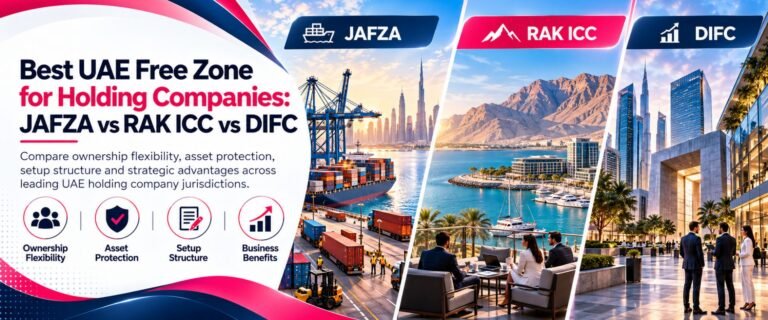
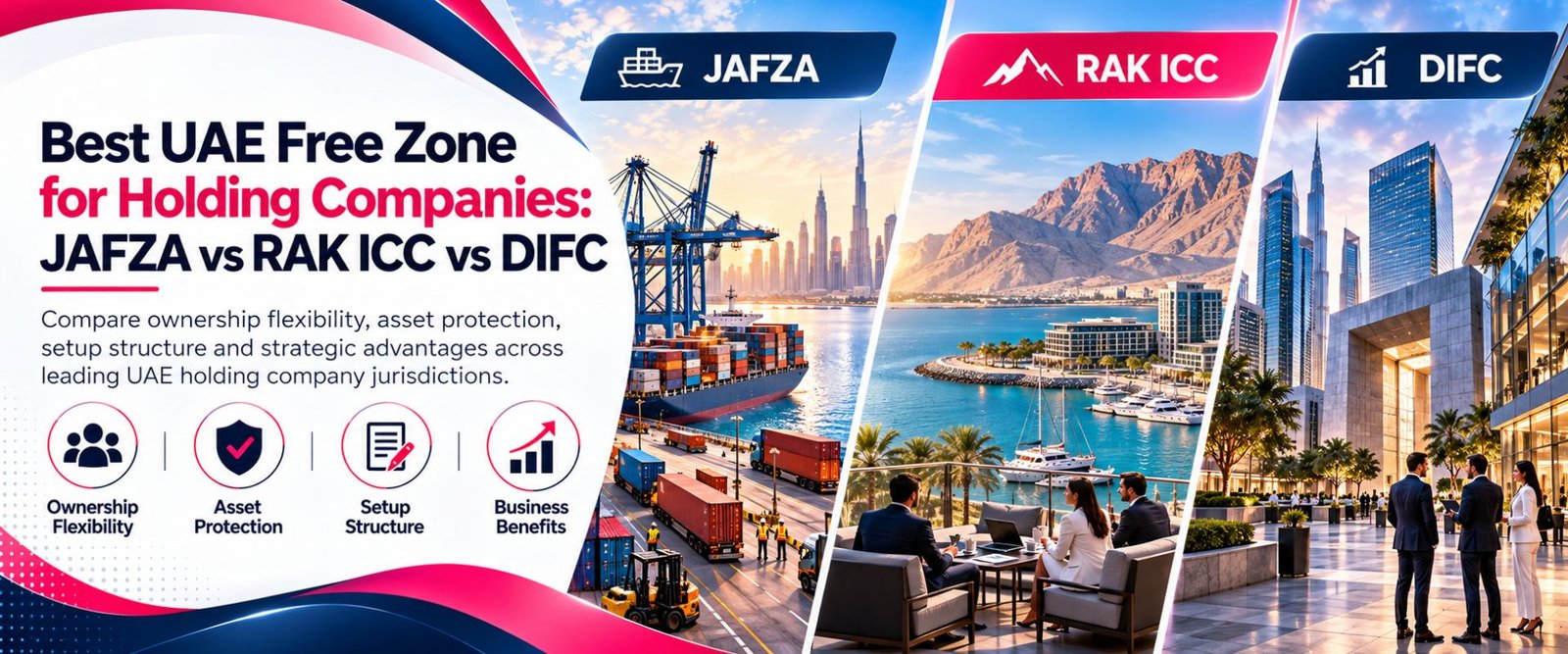
Choosing the right UAE jurisdiction for a holding company depends on what you are holding, not just the cost. RAK ICC is the lowest-cost option for holding shares, IP, and overseas assets. JAFZA Offshore is the only UAE structure that can hold Dubai freehold real estate directly. DIFC and ADGM serve premium holding needs: fund structures, family offices, and succession planning under English common law. This guide compares all three in plain terms. |
A UAE holding company is one of the most tax-efficient structures available to international entrepreneurs, family businesses, and investors. But the right jurisdiction matters enormously. The three names that come up most often in any holding company conversation are RAK ICC, JAFZA Offshore, and DIFC or ADGM for premium structures. Each one is built for a different purpose, and choosing the wrong one creates problems that are costly to fix.
This guide focuses specifically on the holding company question: which UAE free zone or offshore jurisdiction is the best home for a structure whose primary job is to hold assets, shares, IP, or real estate. If you want to understand how UAE holding companies work in general, our guide to offshore company formation in Dubai covers the broader offshore landscape.
What Makes a Good UAE Holding Company Jurisdiction?
Not every UAE free zone is designed to function as a holding structure. Most free zones issue trading or services licences: they are designed for operational businesses, not passive holding vehicles. The jurisdictions that work well for holding have four specific characteristics.
Four Criteria for a Good Holding Jurisdiction
- Asset protection: the structure separates the owner from the held asset, reducing personal liability and protecting wealth from business risks.
- Tax efficiency: no corporate tax on passive income (dividends, capital gains, interest, royalties) arising from qualifying offshore or free zone activity.
- Privacy: shareholders and beneficial owners are not publicly visible in an open registry accessible by third parties.
- Bankability: the holding entity can open a bank account in its own name in the UAE or internationally, so it can receive dividends, rental income, and sale proceeds cleanly.
The three jurisdictions covered in this guide each score differently on these four criteria, which is what makes them suited to different use cases. We also note where UAE Foundations (a separate structure available in DIFC, ADGM, and RAK) are relevant to the holding conversation.
What a Holding Company Cannot Do
A UAE holding company is a passive vehicle. It is not designed to conduct operations, employ staff, bill clients, or maintain commercial activities. If your structure needs to do those things alongside holding, you need a separate operational entity. Many clients run a dual structure: an offshore holding company (RAK ICC or JAFZA) owns shares in an operational free zone or mainland company that handles the day-to-day business.
For a detailed comparison of offshore options specifically, our RAK ICC vs JAFZA Offshore comparison guide covers those two jurisdictions in more depth.
At a Glance: UAE Holding Jurisdictions Compared
Before going into the detail on each option, here is the full comparison:
UAE Holding Company Jurisdictions: Full Comparison
| Factor | RAK ICC | JAFZA Offshore | DIFC / ADGM |
| Structure Type | Offshore IBC | Offshore company | Foundation, LLP, Ltd, SPV |
| Legal Framework | RAK ICC regulations (BVI-inspired) | JAFZA offshore regulations | English common law (DFSA / FSRA) |
| Annual Cost (approx) | AED 3,000 – 7,000 | AED 9,000 – 15,000 | USD 15,000 – 50,000+ |
| Can Hold UAE Real Estate | No | Yes (DLD-approved zones only) | Yes (via SPV/subsidiary) |
| Can Hold Shares/IP/Assets | Yes | Yes | Yes |
| Bank Account (own name) | Difficult (limited options) | Yes (UAE banks accept JAFZA) | Yes (full banking access) |
| Shareholders Register | Private (not public) | Private (not public) | Subject to ADGM/DIFC rules |
| Directors Required | 1 minimum | 2 minimum | 1 (varies by structure) |
| Audit Requirement | Not mandatory | Not mandatory | Mandatory (ADGM/DIFC) |
| UAE Presence Required | No physical presence needed | UAE visit required for setup | Physical office required |
| Best For | Offshore holding, IP, shares | Dubai real estate holding | Fund structuring, trusts, succession |
| Corporate Tax | 0% (no taxable income as offshore) | 0% (no taxable income as offshore) | 0% (Qualifying FZ Person) |
| Setup Timeline | 3 – 5 working days | 5 – 10 working days | 2 – 8 weeks (varies by structure) |
Source: RAK ICC, JAFZA, DIFC Authority, ADGM Registration Authority (indicative rates; verify before setup).
RAK ICC: The Most Cost-Effective UAE Holding Company Option
RAK ICC (Ras Al Khaimah International Corporate Centre) is the UAE’s most widely used offshore jurisdiction for holding structures. It is modelled on the British Virgin Islands (BVI) corporate framework and has become the default choice for entrepreneurs, international investors, and corporate groups who want a simple, low-cost UAE offshore vehicle to hold shares, IP, or other passive assets.
What RAK ICC Is Best For
- Holding shares in UAE free zone or mainland operating companies
- Holding international company shares and consolidating group ownership
- Intellectual property holding: patents, trademarks, copyrights, brand assets
- Investment portfolio holding: stocks, funds, private equity positions
- Shareholder agreements and joint venture structuring
- Clients who want the benefits of a UAE offshore company without the cost of JAFZA offshore company formation or DIFC
RAK ICC Key Advantages
- Cheapest UAE holding structure: annual costs from AED 3,000 to AED 7,000 all-in for a basic IBC.
- No physical presence required: a registered agent in RAK handles all formalities; you do not need to visit or maintain an office.
- Single director permitted: unlike JAFZA (which requires 2 directors), RAK ICC needs only 1.
- Fastest setup: 3 to 5 working days in most cases; fully remote process from anywhere in the world.
- No audit required: RAK ICC companies are not required to produce or file audited accounts unless their own shareholders require it.
- Private register: there is no public-facing shareholders register; beneficial ownership is not visible externally.
RAK ICC Limitations
- Cannot hold UAE real estate directly: RAK ICC is not approved by the Dubai Land Department (DLD) for direct real estate ownership. This is the single biggest limitation.
- Bank account challenges: UAE banks are cautious about opening accounts for RAK ICC companies. International banking (Mauritius, Singapore, EU) is often easier but adds cost.
- No visa issuance: as a pure offshore structure, RAK ICC cannot sponsor UAE residence visas.
- No UAE trade licence activities: the company cannot invoice UAE clients directly or conduct trade from the UAE.
For most straightforward group holding, IP holding, and international share consolidation purposes, RAK ICC is the right answer. The cost difference versus JAFZA (AED 5,000 to AED 10,000 per year vs AED 12,000 to AED 20,000) is significant if the real estate holding angle is not relevant to your situation.
JAFZA Offshore: The Only UAE Structure That Can Hold UAE Real Estate
JAFZA Offshore (Jebel Ali Free Zone Offshore) is operated by DP World and holds a unique distinction in the UAE: it is the only offshore company structure approved by the Dubai Land Department (DLD) to directly own freehold real estate in DLD-approved zones. If you are acquiring Dubai property and want to hold it through an offshore structure for privacy, estate planning, or tax efficiency, JAFZA Offshore is the structure you need.
What JAFZA Offshore Is Best For
- Dubai real estate holding: villas, apartments, commercial units in Palm Jumeirah, Downtown Dubai, Dubai Marina, and other DLD-approved zones.
- Holding company that also owns a UAE mainland or free zone operating business
- Clients who need a UAE banking relationship in the holding entity name (UAE banks accept JAFZA)
- International investors who want a UAE-registered holding entity with bank account access
- Group structures where JAFZA Offshore owns shares in an offshore company in Dubai or mainland UAE entity
JAFZA Offshore Key Advantages
- DLD-approved real estate ownership: the only offshore vehicle the UAE’s land registry accepts for direct freehold property ownership.
- UAE bank account: UAE banks (including major local and international banks operating in Dubai) accept JAFZA Offshore as an account-holding entity.
- No audit requirement: like RAK ICC, JAFZA Offshore does not require annual audited financial statements.
- Reputable Jebel Ali address: JAFZA is one of the world’s largest free zones and its offshore structure carries strong international credibility.
- Corporate structure flexibility: JAFZA Offshore can hold shares in other UAE entities and international companies alongside real estate.
JAFZA Offshore Limitations
- Requires a UAE visit to complete setup: unlike RAK ICC (fully remote), JAFZA requires at least one director to visit the UAE in person during the setup process.
- Two directors required: a minimum of two directors must be appointed, which adds complexity for solo operators.
- Higher cost than RAK ICC: annual costs run from AED 9,000 to AED 15,000, approximately double the RAK ICC equivalent.
- Only DLD-approved zones: JAFZA can hold freehold property in DLD-approved areas (Palm Jumeirah, Downtown, Marina, JBR, etc.) but not in all UAE property markets.
DIFC and ADGM: Premium Holding Under English Common Law
DIFC and ADGM are UAE financial centres that operate under English common law. Both offer holding structures that go beyond simple asset ownership: they provide legally robust, internationally recognised frameworks for family offices, multi-generational wealth management, fund structures, and succession planning. They are the right choice when the size of the assets being held, or the complexity of the ownership structure, justifies the premium cost.
Structures Available in DIFC and ADGM
- DIFC / ADGM Company (Ltd): a standard holding company structure. Can hold shares, assets, IP, and real estate through subsidiaries.
- DIFC / ADGM Foundation: a non-trust equivalent for wealth preservation and succession planning. The beneficiaries receive distributions from the Foundation rather than owning shares directly.
- DIFC / ADGM SPV (Special Purpose Vehicle): a ring-fenced entity used to hold a specific asset (a property, a joint venture stake, a loan) while isolating risk from the broader group.
- DIFC / ADGM LLP: a limited liability partnership used for professional services and investment management structures.
When DIFC or ADGM Is the Right Choice
- Family offices managing USD 5 million or more in assets requiring succession planning structures
- Fund managers and asset managers who need regulated status under DFSA (DIFC) or FSRA (ADGM) (see our guide to starting a private equity firm in Dubai)
- International holding companies whose investors require English law contracts and DIFC / ADGM Court jurisdiction
- Estate planning structures where assets need to pass cleanly across generations without probate in multiple jurisdictions
- Large real estate portfolios where an ADGM SPV holds each property separately for liability isolation
DIFC / ADGM Limitations
- Highest cost: physical office required; annual fees in USD; year one costs typically USD 30,000 to USD 100,000+
- Mandatory audit: all entities must produce and file audited financial statements annually.
- Physical presence: a registered office in DIFC or ADGM towers is required, not just a registered agent.
- Overkill for simple structures: the compliance and cost burden is not justified unless the holding purpose demands English law or regulated status.
Holding Company Cost Comparison: RAK ICC vs JAFZA vs DIFC
Cost Comparison: UAE Holding Company Structures (Year 1, Approximate)
| Cost Item | RAK ICC | JAFZA Offshore | DIFC / ADGM |
| Incorporation fee | AED 2,500 – 4,000 | AED 5,000 – 8,000 | USD 3,000 – 8,000 |
| Annual licence renewal | AED 2,500 – 4,500 | AED 6,000 – 10,000 | USD 10,000 – 30,000+ |
| Registered agent (annual) | AED 1,500 – 2,500 | AED 2,000 – 3,500 | Not required |
| Office / flexi-desk | Not required | Not required | USD 15,000 – 80,000+/yr |
| Investor visa (each) | N/A (offshore) | N/A (offshore) | USD 1,000 – 2,500 |
| Annual audit | Not required | Not required | Required (USD 2,000 – 6,000+) |
| Year 1 Total (approx) | AED 5,000 – 10,000 | AED 12,000 – 20,000 | USD 30,000 – 100,000+ |
DIFC/ADGM fees are USD-denominated. RAK ICC and JAFZA fees are AED-denominated. Offshore companies (RAK ICC, JAFZA) do not require visas or physical offices.
The cost table above shows why RAK ICC dominates pure holding use cases: for a structure whose only job is to hold shares or IP, paying AED 5,000 to AED 10,000 per year versus AED 12,000 to AED 20,000 (JAFZA) or USD 30,000 to USD 100,000+ (DIFC/ADGM) is a significant ongoing saving. The cost premium of JAFZA and DIFC/ADGM is only justified when the specific features of those jurisdictions are actually needed.
Which UAE Holding Structure Is Right for You?
Three simple rules cover the vast majority of holding company decisions in the UAE:
| The Three Rules for UAE Holding Company Selection
• Holding Dubai real estate? Use JAFZA Offshore. No other offshore structure can do this. • Holding shares, IP, or overseas assets at the lowest cost? Use RAK ICC. It is the most cost-efficient UAE holding structure available. • Succession planning, fund structuring, or English law required? Use DIFC or ADGM Foundation or Company. The cost is justified by the legal framework. |
For more complex situations, the decision table below covers the most common holding scenarios:
Which UAE Holding Structure Fits Your Situation?
| Holding Objective | Best Structure | Key Reason |
| Hold shares in UAE / overseas companies | RAK ICC | Lowest cost; BVI-equivalent structure; simple administration |
| Hold IP, patents, royalty-generating assets | RAK ICC | No corporate tax on offshore passive income; minimal compliance |
| Hold Dubai real estate (freehold) | JAFZA Offshore | Only UAE offshore structure approved by DLD for freehold ownership |
| Hold Abu Dhabi real estate | ADGM SPV | ADGM structures recognised by Abu Dhabi land departments |
| Family office / multi-generational wealth | DIFC/ADGM Foundation | English law succession, trust-equivalent; recognised globally |
| Fund management / investment vehicle | DIFC / ADGM | FSRA/DFSA regulated; international investor credibility |
| Holding company + active UAE business | JAFZA Offshore + mainland co. | JAFZA offshore owns the mainland entity shares |
| UBO privacy / confidentiality | RAK ICC | No public shareholders register; private ownership records |
| Estate planning / generational transfer | DIFC/ADGM Foundation | Wills and inheritance planning under English common law |
UBO Register: What Changed in the UAEThe UAE introduced a Ultimate Beneficial Owner (UBO) register requirement for all UAE entities, including offshore companies. RAK ICC, JAFZA Offshore, DIFC, and ADGM entities must all register their UBO information with their respective registrar. While this information is not publicly accessible, it is available to UAE regulators and law enforcement. True anonymous ownership is no longer an accurate description of any UAE entity. Work with a licensed business setup consultant to ensure UBO filings are completed correctly and on time. |
FAQs: UAE Free Zone Holding Companies
Can a RAK ICC company open a UAE bank account?
This is one of the most common questions about RAK ICC, and the honest answer is: it is difficult but not impossible. A small number of UAE banks accept RAK ICC companies for account opening, but most prefer JAFZA Offshore or DIFC/ADGM entities. International banking options (Mauritius, Singapore, or EU-licensed banks) are generally more accessible for RAK ICC companies. If UAE bank account access is important, JAFZA Offshore is a stronger structure. For help with corporate bank account opening in Dubai, our consultants advise on the most bankable structure for your specific situation.
Is a DIFC Foundation the same as a trust?
No, but it serves a similar purpose. A DIFC Foundation is a separate legal entity that holds and manages assets for the benefit of named beneficiaries according to a charter and by-laws. Unlike a trust, a Foundation owns its own assets rather than having a trustee hold them. For succession planning, a Foundation is often preferred because the legal structure is easier for beneficiaries in civil law countries (such as the GCC, India, or Europe) to understand and enforce. ADGM offers a similar Foundation structure.
Can I hold a mainland UAE company through a RAK ICC offshore entity?
Yes. A RAK ICC offshore company can hold shares in a UAE mainland company (LLC or branch). This is a common group structure: the RAK ICC entity owns the UAE mainland company, providing a layer of privacy and asset protection above the operational entity. For the mainland entity itself, see our guide to mainland company formation in Dubai.
Do offshore holding companies pay UAE corporate tax?
Offshore companies (RAK ICC and JAFZA Offshore) are generally outside the UAE corporate tax net because they have no taxable presence in the UAE and derive no UAE-sourced income from active business activities. Passive income (dividends from subsidiaries, capital gains from share sales) received by an offshore holding entity is generally not subject to UAE corporate tax. However, the rules depend on the specific income type and the entity’s activities. For the latest guidance, consult the UAE Federal Tax Authority or a licensed UAE tax advisor.
What is the difference between JAFZA Offshore and an offshore company in the Cayman Islands or BVI?
The main difference is jurisdiction. JAFZA Offshore is a UAE entity, which gives it specific advantages in the UAE: DLD-approved real estate holding, UAE bank account access, and recognition by UAE courts. BVI and Cayman Islands entities are international offshore jurisdictions that work well for international holding but carry no special UAE advantages. A BVI entity cannot hold Dubai freehold real estate in its own name; a JAFZA Offshore entity can.
Can a holding company hold a UAE property and rent it out?
Yes. A JAFZA Offshore company that holds a UAE property can receive rental income from that property. The income flows to the offshore entity’s bank account. Under current UAE corporate tax rules, qualifying offshore entities with no active UAE business are generally outside the corporate tax scope for this type of passive rental income, but rules evolve and professional advice should be taken. For questions about property-related business structures, see our guide to offshore company formation in Jebel Ali.
Can I use a RAK ICC company for estate planning?
RAK ICC companies can be used as part of an estate planning structure, but they are not the most robust option for complex multi-generational wealth management. For serious estate planning, a DIFC or ADGM Foundation offers more structured beneficiary protections under English law. RAK also offers its own Foundation structure (RAK International Corporate Centre Foundation) for those who want an estate planning vehicle without the cost of DIFC or ADGM. See our guide on UAE Foundation structures for more detail.
Ready to Set Up a UAE Holding Company?Whether you need a RAK ICC holding company for share or IP holding, a JAFZA Offshore entity to own Dubai real estate, or a DIFC or ADGM Foundation for family wealth and succession planning, DIAC’s consultants handle the full setup process including jurisdiction selection, incorporation, registered agent, and bank account introduction. Start with our guide to offshore company formation in Dubai or contact us for a free consultation. |