| Summary
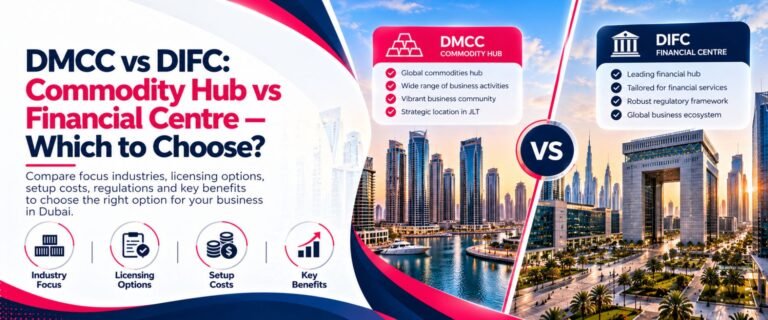
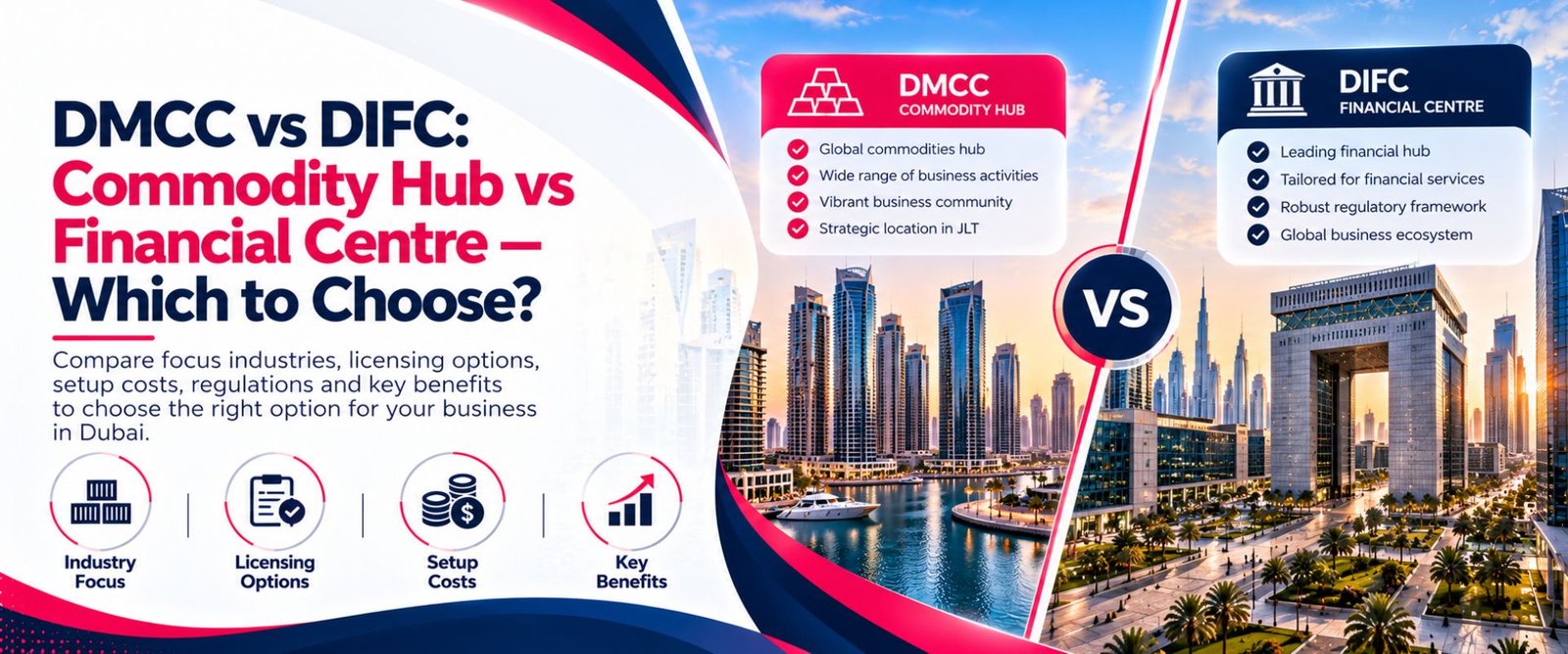
DMCC and DIFC are two of Dubai’s most prominent free zones, but they serve very different business profiles. DMCC is the world’s number-one free zone for commodity trading, precious metals, and crypto. DIFC is the UAE’s sole DFSA-regulated financial centre, the right address for funds, fintech, and investment firms needing a fully licensed framework. This guide maps which zone fits which business, with costs and a direct recommendation for eleven business types. |
Two of Dubai’s best-known free zones sit within a few kilometres of each other in the south-western part of the city, but they operate very differently. DMCC (Dubai Multi Commodities Centre) in Jumeirah Lakes Towers has grown into the world’s most populous free zone, with more than 24,000 registered companies. DIFC (Dubai International Financial Centre) in the heart of the financial district is smaller in company count but carries the weight of a fully independent regulatory framework under the Dubai Financial Services Authority (DFSA).
The question is not which is better overall. It is which is right for your business type. Get it wrong and you either pay for regulatory infrastructure you do not need (DIFC) or find yourself unable to offer the regulated financial products your investors expect (DMCC). This guide draws a clear line between the two.
If you are evaluating other Dubai free zones as well, see our full guide to business setup in Dubai free zones for a broader comparison. For the DIFC vs ADGM question specifically, our DIFC vs ADGM comparison covers the two leading common-law financial centres in the UAE.
DMCC vs DIFC: The Core Difference
The single most important difference is regulatory structure. DMCC is not a financial regulator. It is a trade and commodities authority. Companies in DMCC can trade commodities, run technology businesses, manage physical assets, and operate across dozens of commercial categories, all under the standard DMCC authority framework. But if your business involves managing client investments, running a fund, or offering financial advice or insurance in a regulated sense, DMCC cannot provide the licence you need.
DIFC has the DFSA. The Dubai Financial Services Authority is a full financial regulator operating under English common law, recognised by regulators in the UK, EU, and internationally. A DFSA licence is what asset managers, fund administrators, insurance brokers, and regulated fintech companies need when they want to operate from the UAE with credibility for institutional clients and international investors.
The decision rule that simplifies this entire comparison:
| Commodity trading or physical goods exchange: DMCC. Regulated financial service or investment product: DIFC. |
If your business straddles both, you are not alone. Many Dubai-based firms hold a DMCC entity for their trading arm and a DIFC entity for their advisory or fund management operation. The dual-entity model is common and is worth the additional cost when the business genuinely serves two distinct regulatory contexts.
Here is a full side-by-side for the key criteria:
| Factor | DMCC | DIFC |
| Authority | DMCC Authority | DIFC Authority (DFSA for regulated) |
| Legal Framework | UAE federal law + DMCC regs | English common law (independent) |
| Corporate Tax | 0% on qualifying income | 0% on qualifying income |
| Regulator for Finance | No DFSA; not FSA-equivalent | DFSA: full financial regulator |
| Primary Sector Fit | Commodities, trading, crypto | Financial services, fintech, funds |
| Licence Fee (typical) | AED 18,000 – 30,000/yr | AED 40,000 – 100,000+/yr |
| Office Requirement | Flexi-desk available | Flexi-desk available (limited) |
| Visa Allocation | Package-based; scalable | Package-based; scalable |
| Member Count | 24,000+ companies (2024) | 6,000+ companies |
| Banking Access | All major UAE banks | All major UAE banks; DIFC banks |
| Tradeflow Access | Yes – commodity financing platform | No |
| Dispute Resolution | DMCC arbitration / UAE courts | DIFC Courts (common law) |
DMCC: The World’s Number-One Free Zone for Commodity Trading
What Makes DMCC the Global Commodity Hub
DMCC was established in 2002 with a specific mandate: make Dubai the global hub for commodity trade. It has executed on that mandate to a degree that no other free zone in the world has matched for commodities. As of the latest rankings from the Global Free Zones of the Year survey (fDi Intelligence), DMCC has held the top position for more than a decade.
The zone’s infrastructure is built around physical commodity trade. The DMCC Tradeflow platform is a commodity financing and inventory management system that lets members use commodities as collateral for working capital. This is infrastructure that is unique to DMCC and does not exist in DIFC or any other UAE free zone.
Commodity Categories in DMCC
DMCC licences span a wide range of physical commodity categories:
- Precious metals: Gold, silver, platinum, and diamonds. DMCC hosts the Dubai Gold and Commodities Exchange (DGCX) and is the primary address for UAE-based bullion trading companies.
- Agricultural commodities: Tea, coffee, sugar, rice, and other soft commodities. The DMCC Tea and Coffee Centre is a physical facility dedicated to these trade flows.
- Energy: Oil, gas, and petrochemical trading companies use DMCC as their UAE base, with DGCX providing futures contracts for oil and gas benchmarks.
- Crypto and virtual assets: DMCC was the first UAE free zone to offer a virtual asset licence, attracting numerous crypto exchanges and blockchain companies. The DMCC Crypto Centre is now one of the largest crypto business communities in the region
DMCC for Non-Commodity Businesses
DMCC is not exclusively for commodity traders. It is also a very popular option for technology companies, consulting firms, and general trading businesses that value its large member ecosystem, strong banking reputation, and relatively competitive pricing compared to DIFC. The JLT district has a well-developed residential and commercial infrastructure that makes it attractive for companies that want their staff to live and work in the same area.
For more detail on setting up in DMCC specifically, see our guide to DMCC free zone company formation.
DIFC: The UAE’s Premier Regulated Financial Centre
The DFSA Advantage
DIFC’s primary draw is the Dubai Financial Services Authority (DFSA), a Tier 1 financial regulator operating under English common law. The DFSA licence categories cover: fund management, investment banking, insurance and reinsurance, credit and mortgage services, financial advisory, regulated fintech, and money services. If you are offering any of these services professionally and need to accept client money or manage client assets, DFSA authorisation is what gives you legitimacy with institutional counterparties.
DIFC operates under its own legal system, with DIFC Courts handling disputes. The courts follow English common law and their judgments are enforceable in over 160 countries under the New York Convention. For international asset managers and investment firms structuring cross-border transactions, this legal infrastructure is a material advantage. It is one of the reasons why DIFC is the preferred address for private equity firms, family offices, and global banks establishing UAE operations.
For a detailed look at DIFC specifically, our guide to DIFC company formation and licensing covers the DFSA categories and the setup process in full.
DIFC Fintech Hive and the Innovation Testing Licence
DIFC runs the FinTech Hive, the UAE’s most established fintech accelerator. For regulated fintech companies, the Innovation Testing Licence (ITL) allows companies to test a regulated product in a controlled environment before obtaining a full DFSA licence. This is a meaningful entry point for startups building payment products, robo-advisers, or digital lending platforms, and it has no equivalent in DMCC.
If your business involves crypto in a regulated context (a crypto fund, a digital asset custody service, or a regulated exchange with institutional clients), DIFC’s DFSA virtual asset framework may be more appropriate than DMCC’s crypto licence, depending on what your investors and clients require. See our DIFC crypto licence guide for the distinctions.
Cost Comparison: DMCC vs DIFC Annual Fees
DIFC is materially more expensive than DMCC, and the gap is wider than it first appears because DIFC costs include DFSA authorisation fees on top of the base licence. Here is a realistic breakdown:
| Cost Item | DMCC (typical) | DIFC (typical) |
| Licence / Registration Fee | AED 18,000 – 30,000 | AED 40,000 – 80,000+ |
| DFSA Authorisation (if req.) | Not applicable | AED 35,000 – 100,000+ |
| Flexi-Desk Package | AED 10,000 – 18,000/yr | AED 25,000 – 45,000/yr |
| Dedicated Office | AED 60,000 – 180,000/yr | AED 100,000 – 400,000+/yr |
| Visa (per person) | AED 3,500 – 5,000 | AED 4,000 – 6,000 |
| Annual Renewal | AED 12,000 – 22,000 | AED 30,000 – 60,000+ |
| Typical Year-1 Total | AED 35,000 – 80,000 | AED 80,000 – 200,000+ |
The cost gap for regulated financial activities is significant. A DMCC entity costs AED 35,000 to AED 80,000 in year one for most standard configurations. A DIFC entity with DFSA authorisation can easily reach AED 120,000 to AED 200,000 in year one before office costs. For businesses that genuinely need DFSA regulation, this is the cost of market access. For businesses that do not need it, the premium is pure overhead.
DIFC office space is also significantly more expensive than JLT. A dedicated office in DIFC Gate Avenue or the Gate Building commands some of the highest commercial rents in Dubai. Many DIFC companies use the flexi-desk and hot-desk options, but the floor on total annual cost remains higher than DMCC.
Regulation: DMCC Authority vs DFSA for Regulated Activities
This is the section most comparison articles skip, and it is the most important factor for anyone in or adjacent to financial services.
What DMCC Can and Cannot Regulate
DMCC Authority is the governing body for all DMCC companies. It manages licensing, compliance, and the zone’s operational rules. It is not, however, a financial services regulator in the sense that the DFSA, ADGM’s FSRA, or the UK FCA are. A DMCC company can carry out commodity trading, physical asset management, and a broad range of commercial activities without needing any additional financial regulation.
But a DMCC company cannot offer regulated financial services such as managing a pooled investment vehicle, accepting client funds for investment, providing licensed investment advice, or running an insurance operation. These activities require a licence from the UAE Securities and Commodities Authority (SCA), the UAE Central Bank, the DFSA, or the FSRA, none of which are available through DMCC.
What DFSA Covers
The DFSA issues licences for financial services within the DIFC. These are the main categories:
- Managing Assets: discretionary portfolio management for third parties
- Managing a Collective Investment Fund: managing an open or closed-ended fund
- Arranging Credit or Deals in Investments: intermediary services for investment products
- Insurance Business: underwriting and reinsurance
- Providing Financial Advice: formal investment advisory
- Operating a Crowdfunding Platform: equity or lending crowdfunding
- Innovation Testing Licence: supervised testing for emerging fintech products
Companies in DIFC that do not need DFSA authorisation (professional services, technology firms, retail businesses in the Gate Village) can operate on a standard DIFC commercial licence without going through the DFSA. The DFSA layer is only for entities conducting regulated activities. This distinction is often missed: not every DIFC company is DFSA-regulated.
Who Should Choose DMCC vs DIFC?
Apply the decision framework to your specific business type using this table:
| Business Type | DMCC | DIFC |
| Commodity trader (metals, agri, energy) | Primary choice | Not applicable |
| Physical gold / precious metals dealer | Primary choice | Not applicable |
| Coffee or tea trading company | Primary choice | Not applicable |
| Crypto / virtual asset exchange | Primary choice | Secondary (via DFSA) |
| Hedge fund / asset management | Secondary only | Primary choice |
| Family office (wealth management) | Possible but limited | Primary choice |
| Fintech startup (regulated product) | Not applicable | Primary choice |
| Insurance / reinsurance broker | Not applicable | Primary choice |
| Trading company (general goods) | Primary choice | Not typical |
| Professional services (legal, consulting) | Good option | Good option |
| Technology startup (non-regulated) | Good option | Good option (ecosystem) |
The Dual-Entity ModelA significant number of Dubai financial services groups operate both a DMCC entity and a DIFC entity. The structure is common in commodity finance: the DMCC entity handles the physical trading and commodity-backed financing via Tradeflow, while the DIFC entity holds the DFSA licence for the fund or investment advisory arm. If your business genuinely spans physical commodity trade and regulated investment management, the dual-entity structure is the right answer rather than a compromise. DIAC can advise on how to structure this efficiently from a cost and compliance perspective. |
DMCC vs DIFC vs ADGM: The Three-Way Question
Many businesses comparing DMCC and DIFC are also considering ADGM (Abu Dhabi Global Market). ADGM, like DIFC, operates under English common law and has its own financial regulator (FSRA). For regulated financial services, DIFC and ADGM are the two genuine alternatives; DMCC is not the competitor in that tier.
The practical difference between DIFC and ADGM comes down to geography (Dubai vs Abu Dhabi), client base (Dubai-centric firms vs Abu Dhabi/government-linked capital), and regulatory emphasis (DIFC is stronger for banking and insurance; ADGM has a strong family office and alternative investments reputation). For the full comparison, see our DIFC vs ADGM guide.
For holding companies comparing these zones, our guide to the best UAE free zone for holding companies covers JAFZA, RAK ICC, and DIFC with a specific holding company lens.
Frequently Asked Questions
Can a DMCC company offer financial services?
Not regulated financial services. A DMCC company can carry out commodity trading, physical asset management, technology services, and general commercial activities. But it cannot manage pooled investment funds, accept client money for investment, provide licensed financial advice, or run insurance operations. These require a DFSA licence (DIFC), an FSRA licence (ADGM), or a UAE SCA or Central Bank licence. If your business involves any of these regulated activities, DIFC or ADGM is the correct address.
Is DMCC good for cryptocurrency companies?
Yes, particularly for crypto exchanges, blockchain infrastructure companies, and virtual asset trading businesses. DMCC was the first UAE free zone to introduce a virtual asset licence and now hosts hundreds of crypto companies in its DMCC Crypto Centre. For regulated crypto products that require institutional investor credibility, such as a crypto fund or a licensed custody service, DIFC’s DFSA virtual asset framework is also available. The choice depends on whether your crypto business is primarily a trading operation (DMCC) or a regulated financial product (DIFC).
How much does a DIFC company cost compared to DMCC?
A standard DMCC company with a flexi-desk and two visas costs approximately AED 35,000 to AED 50,000 in year one. A DIFC company without DFSA authorisation costs approximately AED 70,000 to AED 100,000 in year one. A DIFC company with DFSA authorisation can exceed AED 150,000 to AED 200,000 in year one, depending on the licence category and the office arrangement. The premium for DIFC reflects the regulatory infrastructure, the DIFC Courts framework, and the Gate Village address.
Can I register in both DMCC and DIFC?
Yes. The dual-entity model is common among commodity finance and investment management businesses in Dubai. The typical structure is a DMCC entity for the trading arm and a DIFC entity for the regulated advisory or fund management business. Both entities can share directors and shareholders. The additional cost is worth it when the business genuinely needs both the commodity trading infrastructure of DMCC and the DFSA licence of DIFC.
Is DIFC the only place in the UAE to get a fund management licence?
No. ADGM in Abu Dhabi also offers fund management licensing through its Financial Services Regulatory Authority (FSRA). Both DIFC and ADGM are recognised international financial centres with common-law frameworks. The UAE Securities and Commodities Authority (SCA) also issues fund manager licences for onshore UAE funds, though these operate under a different framework. For most international fund managers establishing a UAE presence, DIFC and ADGM are the primary options, and the choice between them often comes down to geography and existing client relationships.
What is the DMCC Tradeflow platform?
DMCC Tradeflow is a commodity financing and inventory management platform that allows DMCC member companies to use physical commodities as collateral for working capital financing. It is integrated with the DMCC’s commodity vaulting and storage infrastructure and is widely used by commodity traders and financial institutions to structure commodity-backed transactions. There is no equivalent platform in DIFC or any other UAE free zone. It is one of the genuinely unique features of DMCC for physical commodity businesses.
Does DIFC require a physical office?
Not necessarily. DIFC offers flexi-desk and hot-desk options within the DIFC Authority’s co-working facilities, and some DFSA licence categories can be held with a flexi-desk. However, the available flexi-desk inventory in DIFC is more limited than in DMCC, and many DIFC companies opt for dedicated offices because the DFSA’s substance requirements (adequate people, premises, and systems in the DIFC) are easier to demonstrate with a proper office. For non-DFSA DIFC entities, flexi-desk is a practical and common arrangement.
DMCC or DIFC? Talk to a Specialist First.DIAC works with commodity traders, asset managers, and fintech companies setting up in both DMCC and DIFC. We help you choose the right zone, structure your entity correctly, and navigate the licensing process from start to finish. See our Dubai free zone business setup guide, explore our DMCC formation guide and our DIFC company formation guide, or contact us for a free consultation. |