| Summary
Dubai mainland gives you unrestricted access to the UAE market and the ability to operate anywhere in the country. A Dubai free zone gives you lower setup costs, full foreign ownership, and potential corporate tax advantages on qualifying income. Neither is universally better: the right choice depends entirely on where your clients are, what your business does, and how much the cost difference matters to you at this stage. This guide covers every factor. |
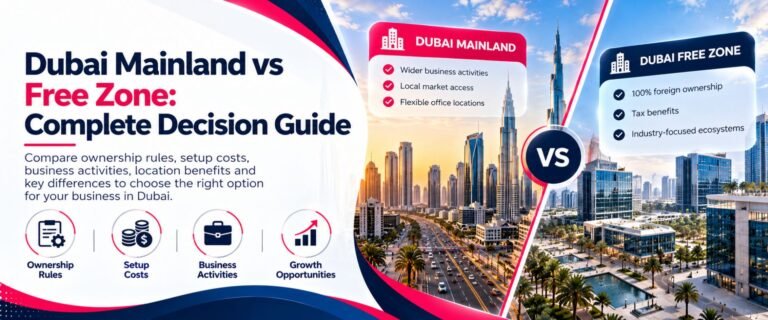
Every new business in Dubai faces the same early decision: mainland or free zone? It is the first question most consultants ask, and it has a bigger impact on your business model than almost any other structural choice. The answer is rarely obvious, and it changed significantly after the 2021 ownership reforms that opened mainland Dubai to 100% foreign ownership in most sectors.
This guide takes the question seriously. We go through every material difference between a Dubai mainland company (licensed by the Department of Economy and Tourism, formerly DED) and a Dubai free zone company, including the corporate tax implications that have shifted the calculation for many business owners since the UAE introduced a 9% corporate tax framework. We also cover the dual-structure approach that many established businesses use to get the best of both worlds.
If you want to skip straight to registering, our mainland company formation in Dubai guide covers the DED process, and our business setup in Dubai free zone guide covers the free zone options. Read this first if you have not made the call yet.
Dubai Mainland in the Current Environment: What Has Changed?
The case for mainland used to be more complicated than it is today. Before the ownership reforms rolled out in late 2021, most mainland activities required a UAE national to hold a 51% stake in the business. That single rule drove huge numbers of businesses into free zones, even when mainland would have been a better operational fit.
100% Foreign Ownership Now Available in Most Sectors
Under the current framework, the UAE Commercial Companies Law allows 100% foreign ownership of mainland companies in the majority of commercial, industrial, and professional activities. A small list of strategic sectors (such as oil and gas exploration, utilities, and certain defence-related activities) still require Emirati participation, but this does not affect the vast majority of businesses considering Dubai.
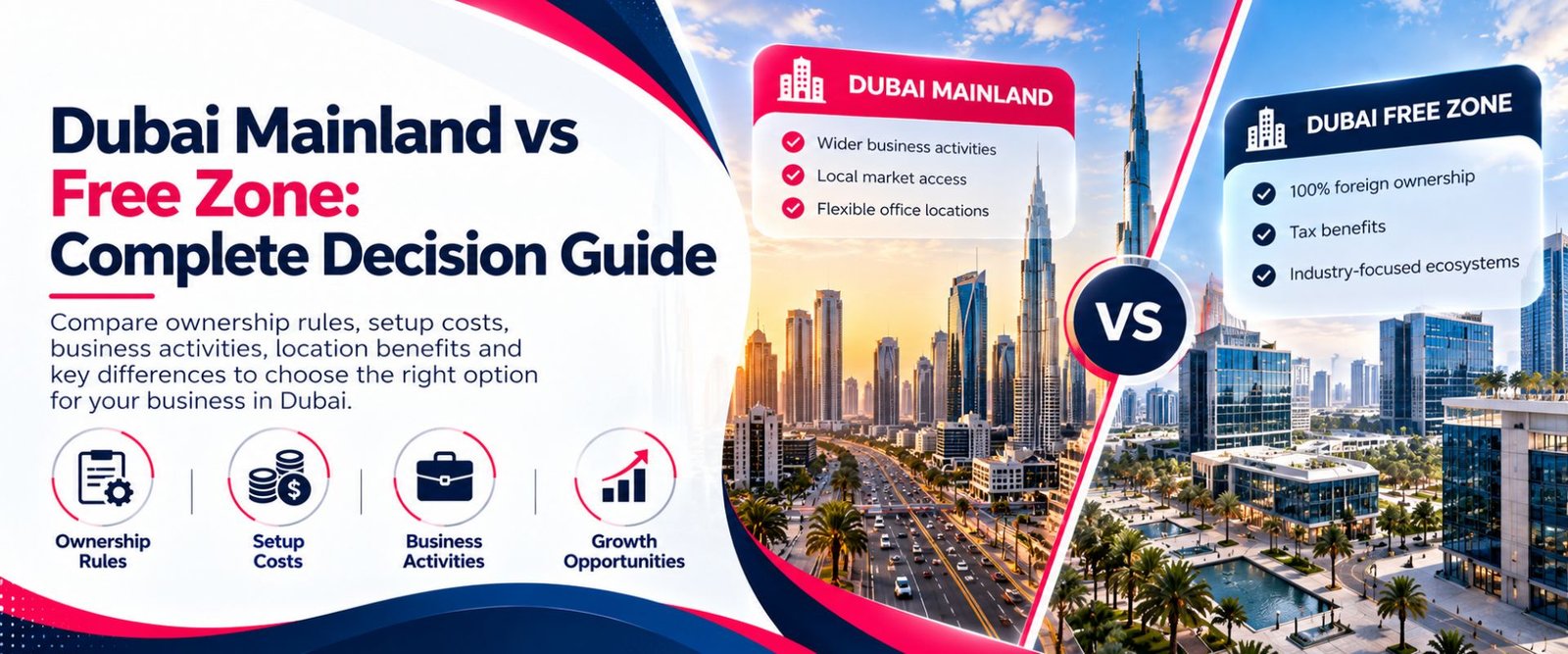
The practical result is that the ownership argument for free zone is largely gone. Both mainland and free zone now offer 100% foreign ownership in most cases. The decision returns to what it should always have been: where are your clients and what does your business actually need?
Corporate Tax on Mainland Businesses
The UAE introduced a 9% corporate tax on business profits above AED 375,000 in the financial year starting June 2023. Mainland Dubai companies are subject to this tax if their taxable income exceeds the AED 375,000 threshold. The Small Business Relief provision allows businesses with revenue up to AED 3 million to elect simplified tax treatment, but this is a transitional measure, not a permanent exemption.
This change matters for the mainland vs free zone comparison because free zone companies that qualify as Qualifying Free Zone Persons (QFZP) pay 0% corporate tax on qualifying income. For a profitable consulting, technology, or service business, the tax saving can be significant enough to justify the free zone structure even if it means some operational constraints on mainland market access.
What Has Not Changed on Mainland
- Physical office lease (Ejari registration) is still required for a mainland trade licence
- Visa allocation is still tied to office size: roughly 1 visa per 9 square metres of leased space
- Government tenders, construction contracts, and most regulated activities still require a mainland licence
- Retail, F&B, and physical services businesses still need mainland licences for their premises
Dubai Free Zone in the Current Environment: Updated Ownership and Tax Rules
Free zones in Dubai have not stood still either. The period since the corporate tax introduction has clarified what free zone companies can and cannot do while retaining their tax advantages.
The QFZP Test: What It Means for Your Business
A free zone company qualifies for the 0% rate only if it passes the Qualifying Free Zone Person (QFZP) test set by the UAE Federal Tax Authority. The key conditions are:
- The company must have adequate economic substance in the free zone (real employees, activities, expenditure)
- Qualifying income must come from transactions with other free zone persons or from international sources
- Income from UAE mainland customers generally does not qualify for the 0% rate
- Non-qualifying income is taxed at 9%, and if non-qualifying income exceeds a threshold, the company loses the 0% benefit entirely for that year
The practical implication: a free zone company that primarily serves international clients or other free zone businesses can realistically access the 0% rate. A free zone company that generates most of its revenue from mainland UAE clients may find that the tax advantage is smaller than assumed. For current rules, the UAE Federal Tax Authority website publishes the most up-to-date guidance.
Free Zone Cost and Flexibility Updates
Competition between Dubai’s free zones has intensified, and many zones now offer more transparent and competitive pricing than in previous years. Key free zones for service and trading businesses include DMCC, IFZA, Meydan, Dubai South, DAFZA, and RAKEZ (technically RAK-based but widely used by Dubai-resident business owners). Some free zones have launched freelancer licence options for individuals who want a compliant UAE business structure without a full company setup.
For a broader view of what free zones offer and how to choose between them, see our business setup in Dubai free zone guide which covers individual zone comparisons.
10 Key Decision Factors: Mainland vs Free Zone Side-by-Side
Here is the full side-by-side comparison across the factors that drive most mainland vs free zone decisions.
Dubai Mainland vs Free Zone: 10 Key Decision Factors
| Decision Factor | Dubai Mainland (DED) | Dubai Free Zone |
| UAE Market Access | Unrestricted: sell to any UAE customer, retail or wholesale | Restricted: must use distributor or mainland branch for direct UAE sales |
| Foreign Ownership | 100% in most sectors (post-2021 reform); some strategic sectors require local partner | 100% always |
| Office Requirement | Physical office required (DED mandates lease proof) | Flexi-desk available in many zones; physical office not always required |
| Trade Licence Cost | AED 10,000 – 20,000 (varies by activity and authority) | AED 5,000 – 25,000+ (varies widely by zone and package) |
| Corporate Tax (CT) | 9% on taxable profits above AED 375,000; Small Business Relief up to AED 3M | 0% on qualifying income; must meet QFZP substance tests |
| Visa Allocation | Based on office size; usually 1-6 per 9 sq m of space | Package-based or space-based depending on zone |
| Government Contracts | Can bid for UAE government and semi-government tenders directly | Generally cannot bid for government contracts directly |
| Import / Export Duties | 5% customs duty on most imports to UAE mainland | Duty-free import and re-export from free zone |
| Banking | Full UAE banking access; banks prefer DED companies | UAE banking available; some zones easier than others |
| Setup Speed | 5 – 15 working days typically | 3 – 7 working days in most zones |
Sources: Dubai DED, UAE Federal Tax Authority, DMCC, IFZA, RAKEZ (indicative figures; confirm current rates before setup).
Industry-by-Industry Recommendation
The right answer changes completely depending on what your business actually does. Here is the breakdown by sector:
Industry-by-Industry Recommendation: Mainland vs Free Zone
| Industry / Business Type | Recommended | Key Reason |
| Restaurant / F&B | Mainland | Requires DED/DM licence, physical premises; free zone cannot operate directly |
| Retail shop (physical) | Mainland | Retail requires DED trade licence and mall/street lease; free zone retail not possible in most zones |
| Digital marketing agency | Free Zone | Client services delivered remotely; lower cost; most zones allow this activity |
| Consulting / advisory | Free Zone | No physical retail needed; free zone QFZP rate advantageous if income qualifies |
| E-commerce / online retail | Free Zone | Import and ship from free zone warehouse; no need for mainland unless selling in local stores |
| Construction / contracting | Mainland | Requires DED + RERA / DM approval; must work on UAE mainland sites |
| Import and distribution | Mainland | Must sell to mainland retailers and wholesalers; free zone distributor role adds cost layer |
| IT / SaaS / software | Free Zone | International clients; no physical retail; QFZP-eligible income in many cases |
| Medical / healthcare | Mainland (DHA) | DHA licence required for most healthcare activities; free zone healthcare very limited |
| Real estate brokerage | Mainland | RERA licence and DED required; must be UAE mainland registered |
| Manufacturing (physical goods) | Free Zone or mainland based on distribution | Free zone for export; mainland licence needed for UAE retail distribution |
| General trading | Mainland | Widest product list; unrestricted UAE market access; no distributor needed |
The pattern is clear: physical-presence businesses belong on mainland. Remote-service businesses and international traders belong in a free zone. The grey area is the general services or consulting business that also wants to serve local UAE clients, which is where the dual structure (below) becomes relevant.
Mainland + Free Zone Branch: The Best of Both Worlds?
A significant number of businesses in Dubai operate both a mainland entity and a free zone entity. This is not as unusual or complicated as it sounds, and for businesses that genuinely need both UAE market access and tax-efficient international revenue streams, it is often the right long-term answer.
How the Dual Structure Works
The typical structure has a free zone company (the parent or holding entity) owning a mainland company or branch in Dubai. The free zone company handles international revenue and holds the group’s IP or shares. The mainland company handles local UAE client work, government contracts, or physical retail. Each entity is licensed and taxed independently.
Alternatively, a mainland company can open a free zone branch, which allows it to invoice international clients through the free zone address while keeping the mainland licence active for local work. The branch does not get a separate free zone licence but operates under the parent company’s mainland trade licence.
When the Dual Structure Makes Sense
- Your business has both UAE-based clients (mainstream) and international or free zone clients (qualifying income)
- You want to tender for government contracts (mainland) while also holding IP or shares in the free zone
- You are scaling a business that started in a free zone and now needs direct mainland market access
- You are in a sector like advertising agency licensing in Dubai where some clients are UAE mainland businesses and others are international
The Cost of Running Two Entities
Running both a mainland and a free zone entity adds cost: two trade licences, two sets of accounting, two corporate tax returns. Year one total costs for a dual structure typically range from AED 60,000 to AED 120,000 depending on the zones and office choices. This is only justified when the commercial benefit (mainland access plus tax advantage) is clear and quantifiable.
For help modelling whether a dual structure makes sense for your specific revenue split, DIAC’s consultants can work through the numbers with you.
Cost Comparison: DED Mainland vs Top Dubai Free Zones
Here is a realistic cost comparison for a typical small business (1 investor visa, no employees, basic office setup):
Dubai Mainland vs Top Free Zone Cost Comparison (Year 1, Approximate AED)
| Cost Item | Dubai Mainland (DED) | Dubai Free Zone (e.g. DMCC, IFZA, Meydan) |
| Trade Licence (annual) | AED 10,000 – 20,000 | AED 5,500 – 20,000 (zone-dependent) |
| Initial Registration / DED fees | AED 3,000 – 8,000 | AED 2,500 – 6,000 |
| Office Lease (annual) | AED 25,000 – 80,000+ | AED 0 (flexi-desk) to AED 50,000+ |
| Ejari / Tenancy Registration | AED 220 per contract | Not required (FZ handles) |
| Investor Visa (each) | AED 3,500 – 5,500 | AED 3,000 – 5,000 |
| Medical / Emirates ID | AED 500 – 800/person | AED 500 – 800/person |
| Corporate Tax Filing | Required; AED 2,000 – 5,000/yr | Required; AED 1,500 – 4,000/yr |
| Total Year 1 (1 visa, flexi-desk FZ) | AED 42,000 – 80,000+ | AED 12,000 – 30,000 (flexi-desk) |
Costs are approximate and vary by licence activity, authority fees, and office choice. Get a current quote before committing to either structure.
The cost table shows why free zones dominate for solo operators and early-stage businesses: the flexi-desk option in a free zone can bring year one total costs below AED 15,000 to AED 20,000, compared to AED 40,000 to AED 80,000 for a mainland setup with a physical office. For businesses that genuinely need a physical location on the mainland, that premium is unavoidable. For businesses that work remotely or serve clients at their client’s premises, the free zone cost saving is real and significant.
Corporate Tax Impact: Mainland vs Free Zone at Different Revenue LevelsMainland company at AED 1 million taxable profit: pays 9% CT on AED 625,000 above the AED 375,000 threshold = AED 56,250 in CT per year. Free zone QFZP at AED 1 million qualifying income: pays 0% CT on qualifying income = AED 0 in CT per year (provided QFZP conditions are met). Free zone company with AED 500,000 mainland income and AED 500,000 qualifying income: the mainland income portion is taxed at 9% and, if it exceeds the non-qualifying income threshold, the company may lose the 0% benefit entirely for that year. Careful income structuring is essential. Consult a UAE licensed tax advisor before making the mainland vs free zone decision purely on CT grounds. |
FAQs: Dubai Mainland vs Free Zone
Can a free zone company sell to UAE mainland customers?
Yes, but with restrictions. A free zone company can sell products to mainland UAE customers through an approved mainland distributor or agent. It can also provide services remotely to mainland clients. What it cannot do is open a retail shop, maintain a physical office, or employ staff on the UAE mainland under the free zone licence. For businesses that need direct mainland access, a mainland company formation in Dubai or a mainland branch is required.
Is a Dubai mainland company better for banking?
In general, yes. UAE banks have historically been more comfortable opening and maintaining business accounts for DED mainland companies because they have a physical address, an office lease (Ejari), and a clear local market presence. Free zone companies can and do open UAE bank accounts, but the process can be slower and some banks apply more scrutiny. The gap has narrowed as banks have become more familiar with free zone structures, but if banking ease is a priority, mainland has an edge. For more guidance, see our guide to corporate bank account opening in Dubai.
Do I need a local sponsor for a mainland company any more?
No, in most sectors. Since the 2021 commercial companies law reforms, 100% foreign ownership is available for most mainland business activities without requiring a UAE national sponsor or local service agent. A small number of restricted or strategic activities still require Emirati participation. Check the UAE Ministry of Economy’s negative list or speak with a business setup consultant to confirm whether your specific activity is affected.
Which is faster to set up: mainland or free zone?
Free zone setup is generally faster: most free zones in Dubai can complete the incorporation and issue a trade licence within 3 to 7 working days once documents are in order, and some offer same-day virtual licences. Mainland DED registration typically takes 5 to 15 working days, with additional time needed if external approvals (from DHA, KHDA, DM, or other authorities) are required for regulated activities. For businesses that need to start quickly, a business setup in Dubai free zone is usually the faster route.
Can I convert a free zone company to a mainland company?
Direct conversion is not usually possible: you cannot transfer a free zone licence directly to a mainland DED licence. The standard approach is to set up a new mainland entity while keeping the free zone entity active (or winding it down once the mainland entity is operational). Some businesses use the transition period to run both structures in parallel. For help managing this type of business restructuring, DIAC’s consultants handle both the new mainland registration and the free zone closure process.
Is a free zone licence valid across the UAE or only in Dubai?
A Dubai free zone licence allows you to operate within the free zone itself and to conduct business internationally. It does not automatically give you the right to operate commercially across the UAE mainland. If you have a Dubai free zone company and want to expand to Abu Dhabi mainland, Sharjah, or other emirates, you need either a mainland licence in each emirate or a branch of your free zone entity. Some activities are licenced federally and apply across all emirates.
What is the cheapest legal business structure in Dubai?
The cheapest compliant business structure in Dubai is typically a free zone freelancer licence or a low-cost free zone package from zones like Meydan, RAKEZ, or IFZA, where year one all-in costs (licence plus visa) can be AED 12,000 to AED 20,000. A mainland DED sole establishment (sole proprietorship) is also possible but typically costs more due to the mandatory physical office requirement. For the most current options, see our business setup in Dubai free zone guide.
Not Sure Which Structure Is Right for You?DIAC’s consultants work through the mainland vs free zone decision with you based on your specific business activity, target clients, visa needs, and budget. We cover both structures and help you avoid the expensive mistake of choosing the wrong one at the start. See our mainland company formation in Dubai guide, our Dubai free zone business setup guide, or contact us for a free consultation. |