| Summary
Dubai free zones offer unmatched global brand recognition, lower entry costs, and strong commerce, finance, media, and tech ecosystems. Abu Dhabi free zones provide world-class financial regulation through ADGM, clean-energy leadership through Masdar City, industrial scale through KIZAD, and easier access to Abu Dhabi government contracts. The right choice depends on your sector, budget, and growth ambition — both emirates offer 0% corporate tax, 100% foreign ownership, and a pathway to UAE residency. |
Core Differences: Abu Dhabi Free Zone vs Dubai Free Zone
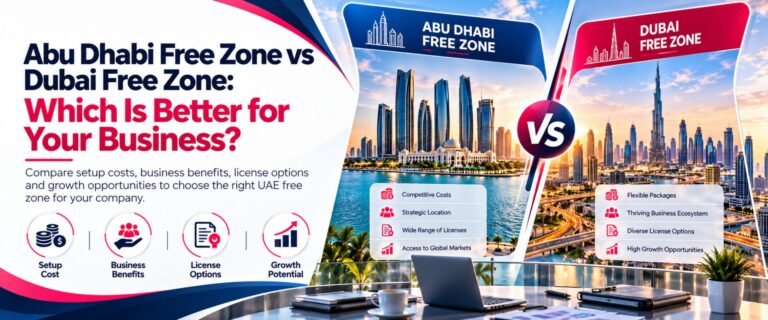
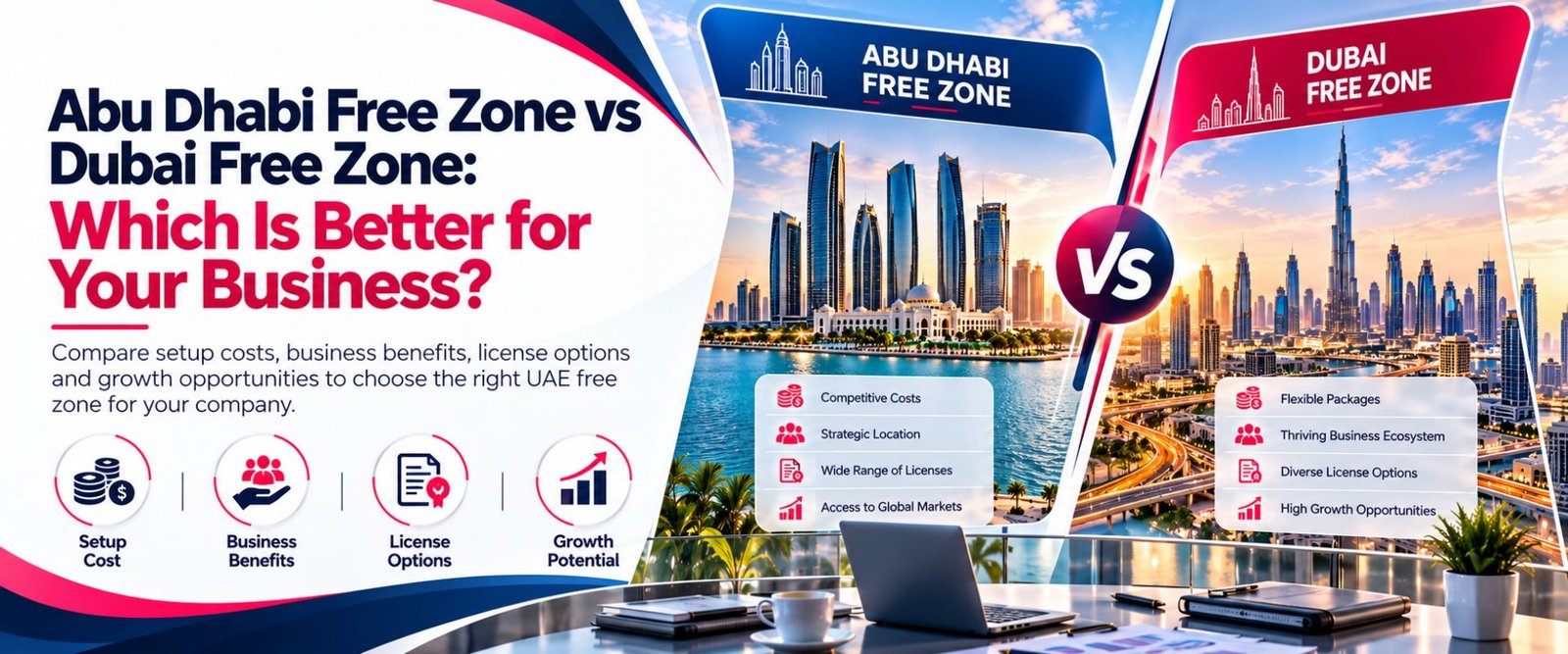
Choosing between a Dubai free zone and an Abu Dhabi free zone is not simply a question of location — it determines the regulatory authority overseeing your company, the network of clients and partners available to you, and the sector ecosystem you plug into. Both emirates are part of the UAE and both offer free zone structures with 100% foreign ownership, 0% personal income tax, and full profit repatriation. The differences lie in specialisation, cost profile, and strategic positioning.
Dubai is the UAE’s commercial powerhouse. With over 30 free zones and a critical mass of multinational headquarters, Dubai free zones attract global trading, financial services, media, and technology companies. DIAC helps businesses set up across the UAE, including in both Dubai and Abu Dhabi, which means you can compare zones objectively rather than being guided by a single emirate’s promoters.
Abu Dhabi is the UAE’s capital and wealthiest emirate. Its free zones are smaller in number but highly specialised. ADGM is one of the world’s leading financial centres. Masdar City is a global hub for clean energy and sustainability technology. KIZAD connects industrial companies to Khalifa Port, the Arab world’s first semi-automated container port.
Here is a side-by-side overview:
| Factor | Dubai Free Zone | Abu Dhabi Free Zone | Verdict |
| Setup Cost (Entry) | AED 10,000 – 20,000 | AED 12,000 – 30,000 | Dubai (budget FZs) |
| Prestige / Address | Global brand recognition | Strong (ADGM = world-class) | Tied (sector-dependent) |
| Financial Regulation | DIFC (global standard) | ADGM (equivalent to DIFC) | Tied |
| Clean Energy / Tech | Various FZs | Masdar City specialises | Abu Dhabi |
| Industrial / Logistics | JAFZA, DAFZA | KIZAD (port-linked) | Tied |
| Media & Creative | Dubai Media City, d3 | twofour54 | Dubai (volume) |
| 100% Foreign Ownership | Yes (all FZs) | Yes (all FZs) | Tied |
| Corporate Tax (FZ) | 0% (qualifying) | 0% (qualifying) | Tied |
| Banking Access | Many options in Dubai | Growing (ADCB, FAB, ENBD) | Dubai (ease) |
| Visa Allowance | Depends on office package | Depends on office package | Similar |
| Gov. Contracts | Strong in Dubai | Easier for AD projects | Abu Dhabi |
Source: Free zone authority websites and company formation data. Costs are estimates; obtain current quotes before committing.
Dubai Free Zones: What You Get
Dubai’s free zone ecosystem is the largest and most varied in the UAE. Whether you are a solo consultant, a commodity trader, a fintech startup, or a global media company, there is a purpose-built zone in Dubai. Here are the five most relevant:
DMCC — Dubai Multi Commodities Centre
DMCC is consistently ranked the world’s leading free zone by the Financial Times’ fDi magazine. Headquartered in the Jumeirah Lake Towers cluster, DMCC is the home of commodity trading, including gold, diamonds, tea, coffee, and agricultural goods. Companies that need commodity trading licences, access to commodity exchanges, or proximity to global supply-chain players tend to gravitate to DMCC. Licence fees are higher than budget zones (AED 18,000 and above), but the address carries weight in finance and commodities circles.
DIFC — Dubai International Financial Centre
DIFC operates under its own common-law legal system with an independent court and is regulated by the Dubai Financial Services Authority (DFSA). It is the preferred hub for banks, asset managers, private equity firms, law firms, and — more recently — crypto and fintech businesses licensed under VARA. DIFC is expensive: registered office space, compliance requirements, and licence fees are significantly higher than most free zones. But for financial services firms that need credibility with international counterparties, DIFC’s regulatory environment is a major selling point.
IFZA — International Free Zone Authority
IFZA, located in Dubai Silicon Oasis, is the most cost-effective gateway for startups, SMEs, and freelancers. Licence packages start below AED 13,000 and include one visa. The activities list is broad — covering consulting, trading, services, tech, and media — and the setup process is fast, often completed within five to seven working days. For entrepreneurs comparing costs across the UAE, IFZA free zone company formation is a natural first consideration.
Meydan Free Zone
Meydan is the budget option for companies that want a Dubai business address and basic UAE presence. Packages start below AED 12,000 and are popular with consultants and service companies that do most of their work outside the UAE but want a credible UAE entity. Meydan does not offer a physical office, so it is not suited for companies that need to meet clients on-premises.
DAFZA — Dubai Airport Free Zone Authority
DAFZA sits adjacent to Dubai International Airport and is ideal for aviation, logistics, perishables, and companies that need rapid air freight access. The zone is more expensive than IFZA or Meydan, but for logistics-intensive businesses, proximity to the airport is a tangible operational advantage.
Dubai free zones as a group suit companies that need an internationally recognised address, a large and established professional network, and a proven commercial ecosystem. The trade-off is cost: prime Dubai zones are among the most expensive in the region.
Abu Dhabi Free Zones: What You Get
Abu Dhabi has fewer free zones than Dubai but each is built around a specific national priority — financial services, clean energy, industrial production, or media. This specialisation means that if your business aligns with one of these pillars, an Abu Dhabi free zone may offer a better ecosystem than a generic Dubai alternative.
ADGM — Abu Dhabi Global Market
ADGM, located on Al Maryah Island, is Abu Dhabi’s answer to DIFC. It operates under English common law, has an independent court system, and is regulated by the Financial Services Regulatory Authority (FSRA). ADGM has grown rapidly as a hub for financial services businesses in Abu Dhabi, including hedge funds, family offices, private equity, and crypto companies. When it comes to regulatory sophistication, ADGM and DIFC are considered equals in the global financial community. ADGM also offers a private equity and fund management ecosystem that is increasingly competitive with DIFC.
Masdar City
Masdar City was designed from the ground up as a sustainable urban development and clean-technology hub. Companies working in renewable energy, energy efficiency, clean water, sustainable construction, and environmental services benefit from a purpose-built cluster of like-minded businesses, research institutions, and government-linked partners. Masdar City is the natural home for any company that wants to position itself in Abu Dhabi’s renewable energy agenda or access sovereign wealth fund-backed clean energy projects.
KIZAD — Khalifa Industrial Zone Abu Dhabi
KIZAD is one of the UAE’s largest industrial zones and is directly connected to Khalifa Port. It is designed for manufacturing, processing, logistics, and heavy industry. Companies that need large warehouse footprints, direct port access, and proximity to Abu Dhabi’s industrial supply chain will find KIZAD significantly cheaper per square metre than equivalent logistics zones in Dubai. KIZAD is not suited to services businesses or startups — it is a zone for companies that move physical goods at volume.
twofour54
twofour54 is Abu Dhabi’s media and entertainment free zone, located in the heart of the capital. It provides licences for broadcasting, film, digital media, gaming, music, and publishing. Studios, post-production houses, gaming companies, and content creators that want to target Abu Dhabi’s government-owned media sector often base themselves here. The zone is smaller than Dubai Media City but benefits from direct ties to Abu Dhabi government media contracts.
Abu Dhabi free zones as a group suit companies that are either in a specialist sector (finance, clean energy, industrial, media) or that specifically want to access Abu Dhabi government procurement. The Abu Dhabi free zone company registration process is generally straightforward and comparable in documentation requirements to Dubai free zones.
Cost Comparison: Abu Dhabi vs Dubai Free Zone
Cost is often the deciding factor, especially for startups and small businesses. The table below provides estimated first-year costs across the major free zones in both emirates. Costs include licence fees and basic visa quota; they exclude office rent (unless noted), professional fees, and government security deposits, which vary by visa count.
| Free Zone | Licence Fee (Est.) | Visa Quota | Approx. First Year |
| IFZA (Dubai) | AED 12,900 | 1 visa incl. | AED 13,000 – 16,000 |
| Meydan (Dubai) | AED 11,500 | 1 visa incl. | AED 12,000 – 15,000 |
| DMCC (Dubai) | AED 18,000+ | Per employee | AED 25,000 – 40,000 |
| DIFC (Dubai) | AED 30,000+ | Application-based | AED 40,000 – 80,000+ |
| Masdar City (AD) | AED 15,000+ | Per employee | AED 18,000 – 30,000 |
| twofour54 (AD) | AED 14,000+ | Per employee | AED 16,000 – 28,000 |
| KIZAD (AD) | AED 12,000+ | Per employee | AED 14,000 – 25,000 |
| ADGM (AD) | AED 35,000+ | Application-based | AED 50,000 – 100,000+ |
Note: All costs are estimates. Obtain current official quotes from each free zone authority before making a decision.
The headline conclusion: Dubai free zones offer the lowest entry-level costs through IFZA and Meydan, making them attractive for startups and sole practitioners. Abu Dhabi’s budget options (KIZAD, twofour54, Masdar) are competitive for sector-specific businesses but less flexible for general trading or consulting.
At the premium end, ADGM and DIFC are similarly expensive. The choice between them should be driven by regulatory requirements and client expectations, not cost. Companies needing a DFSA licence choose DIFC; those needing an FSRA licence choose ADGM.
Both emirates charge similar government fees for visas, Emirates ID cards, and medical testing. UAE-wide costs like health insurance and accounting are identical. The main variable is the licence fee and, if you need physical office space, the rent differential — Abu Dhabi office space is typically 20 to 30 per cent cheaper than equivalent space in central Dubai.
When evaluating total cost, consider the company formation process in Abu Dhabi mainland as a third option: Abu Dhabi mainland licences allow full access to local government tenders and can be cost-competitive with premium free zone licences for certain activities.
Which Sector Fits Which Free Zone?
The most important question in the Abu Dhabi vs Dubai free zone decision is not which emirate has the best overall offering — it is which zone fits your specific business activity. The sector match table below summarises the strongest alignment between business type and free zone location.
| Sector | Best Dubai Free Zone | Best Abu Dhabi Free Zone |
| Finance & Banking | DIFC | ADGM |
| Trading & Commodities | DMCC, JAFZA | KIZAD (industrial goods) |
| Technology & Startups | IFZA, Dubai Internet City | Masdar City, Hub71 |
| Media & Creative | Dubai Media City, d3 | twofour54 |
| Clean Energy | Multiple FZs | Masdar City (specialist) |
| Aviation & Logistics | DAFZA, JAFZA | KIZAD |
| Consulting & Professional | IFZA, Meydan, SPC | Masdar, twofour54, ADGM |
| Crypto & Fintech | DIFC (VARA licensed) | ADGM (FSRA regulated) |
A few patterns emerge from this analysis:
- Finance and crypto: DIFC and ADGM are direct competitors at the same level of regulatory quality. DIFC has a larger established network; ADGM is growing faster and has been particularly active in attracting family offices and digital asset firms.
- Trading and logistics: DMCC and JAFZA dominate in Dubai for commodities and general trading. KIZAD is the superior option for industrial goods that enter through Khalifa Port.
- Startups and SMEs: IFZA in Dubai is the most flexible and cost-effective option. Hub71 in Abu Dhabi is excellent for funded tech startups but has more selective entry criteria.
- Clean energy: Masdar City has no equivalent in Dubai. If sustainability and clean technology are central to your proposition, Masdar City is the clear choice regardless of the cost differential.
- Media: Dubai’s media free zones (Dubai Media City, d3) are larger and more established. twofour54 in Abu Dhabi is worth considering if Abu Dhabi government media relationships are central to your business model.
If your business does not fit neatly into any of these sectors — general consulting, management services, or professional services — Dubai’s IFZA or Meydan will typically offer the best value and flexibility. Both allow a broad activity list without the sector-specific restrictions that come with zones like ADGM or Masdar City.
For a personalised assessment of which zone fits your specific activity code and growth plan, DIAC’s team of formation specialists can compare options across both emirates without bias toward either.
Frequently Asked Questions
Can I set up a company in an Abu Dhabi free zone if I live in Dubai?
Yes. UAE free zone companies are not tied to your place of residence. You can be physically based in Dubai, run a business through an Abu Dhabi free zone, and travel between the two emirates freely. The registered address of your company will be in the Abu Dhabi free zone, but there is no requirement for you to live in Abu Dhabi.
Is ADGM better than DIFC?
Neither is definitively better — they are equivalent in regulatory quality and both operate under English common law. DIFC has a larger, more established financial services community and was founded earlier. ADGM is growing quickly and has been particularly active in attracting digital asset businesses, family offices, and fund managers. The practical choice often depends on where your target clients and counterparties are based: if they are in Dubai, DIFC is more convenient; if they are in Abu Dhabi or you target sovereign wealth fund relationships, ADGM may have an edge.
Is Masdar City vs IFZA a fair comparison?
Not directly — they serve different sectors. Masdar City is a specialist clean-energy hub in Abu Dhabi with a focused ecosystem. IFZA is a general-purpose Dubai free zone for startups, consultants, traders, and services businesses. If your company is in clean energy or sustainability, Masdar City is the specialist choice. If your business is in consulting, trading, or services, IFZA is typically more suitable and more cost-effective.
Can a Dubai free zone company bid for Abu Dhabi government contracts?
It can try, but Abu Dhabi government procurement processes generally prefer suppliers with a physical presence in Abu Dhabi — whether on the mainland or in an Abu Dhabi free zone. A Dubai free zone company may be at a disadvantage for Abu Dhabi government tenders. If access to Abu Dhabi government contracts is a core part of your revenue strategy, an Abu Dhabi free zone or mainland licence is worth considering.
Which free zone is cheapest for a solo consultant in the UAE?
IFZA and Meydan in Dubai are consistently among the cheapest options, with first-year all-in costs starting around AED 12,000 to 16,000 including one visa. In Abu Dhabi, KIZAD and twofour54 can be competitive for sector-specific activities. For pure consulting with no sector restriction, IFZA or Meydan will typically be the most affordable starting point.
Do Abu Dhabi free zone companies pay UAE corporate tax?
Abu Dhabi free zone companies are subject to the same UAE Corporate Tax framework as Dubai free zone companies. Companies that qualify as Qualifying Free Zone Persons (QFZPs) under the law are taxed at 0% on qualifying income. Non-qualifying income and income from UAE mainland sources is taxed at 9%. The rules are identical regardless of whether your free zone is in Dubai or Abu Dhabi.
How long does it take to set up a company in an Abu Dhabi free zone compared to a Dubai free zone?
Timeline varies by zone. IFZA in Dubai is among the fastest, with initial approvals in two to three working days and full licence issue in five to seven days. Abu Dhabi free zones like Masdar City and KIZAD typically take seven to fourteen working days. ADGM and DIFC both involve regulatory applications that can take several weeks for regulated activities. For non-regulated activities, timelines are broadly similar across both emirates.
Ready to Choose Your UAE Free Zone?Whether your business belongs in ADGM, IFZA, Masdar City, or DMCC, DIAC’s formation specialists compare all options — Dubai and Abu Dhabi, to find the right fit for your sector, budget, and visa needs. Get a free consultation at diac.ae or speak to a consultant about Abu Dhabi free zone company registration or Dubai free zone company setup today. |
| About the Author
Adil Ahmad is a UAE business formation specialist at DIAC with extensive experience guiding entrepreneurs, SMEs, and multinationals through free zone and mainland company registration across Dubai and Abu Dhabi. His focus is on helping clients find the right legal structure, jurisdiction, and licence type for their specific goals. |