| Summary
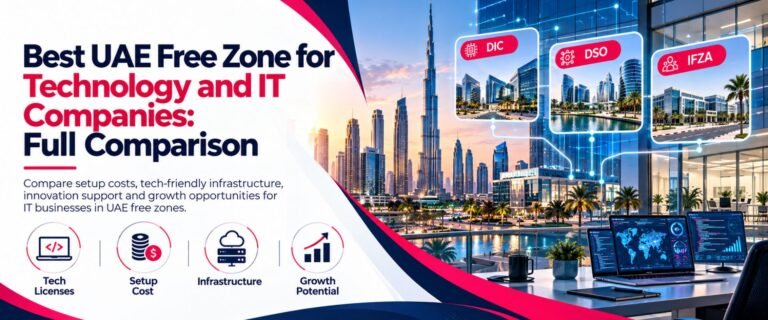
The UAE has over a dozen free zones competing for technology company registrations. Dubai Internet City and Dubai Silicon Oasis are the most established, IFZA offers the lowest cost Dubai-address setup from AED 12,900, DIFC suits fintech and cybersecurity, and Abu Dhabi Hub71 and ADGM are rising fast. This guide compares every major option with verified pricing, VAT status and tech-specific perks. |
UAE Tech Free Zones: Quick Comparison at a Glance
| Factor | DIC | DSOA | IFZA (DSO Area) | DIFC | RAKEZ | Hub71 (AD) |
| Licence Cost | Quote only | ~AED 12,000/yr | AED 12,900/yr | USD 1,500/yr | AED 14,010/yr | USD 1,500/yr |
| Year-1 All-In (1V) | AED 50,000+ | ~AED 28,000-33,000 | ~AED 21,450 | ~AED 44,000-47,000 | ~AED 26,000-28,500 | ~AED 16,500 |
| VAT Designated | No | No | No | No | No | No |
| Tech Incubator | No (enterprise) | Yes (Dtec/SANDBOX) | No | Yes (Innovation Hub) | No | Yes (Hub71 programme) |
| Dubai Address | Yes (DIC) | Yes (DSO) | Yes (Dubai Digital Park) | Yes (DIFC) | No (RAK) | No (Abu Dhabi) |
| Best For | Enterprise IT / MNCs | Hardware / IoT / startups | Cost-first IT startup | Fintech / cybersecurity | Tech manufacturing | Pre-seed / VC-backed |
Source: DIC, DSOA, IFZA, DIFC, RAKEZ, Hub71 published pricing. Government fees (establishment card, e-channel, Emirates ID, medical insurance) additional. Confirm current rates before committing.
The UAE is one of the world’s most active technology business destinations, with more than 8,000 tech companies registered across its free zones. Choosing the wrong free zone for your IT company is one of the most common and most costly mistakes tech founders make. The difference between a well-matched free zone and the wrong one can mean paying AED 15,000 more per year, holding the wrong activity on your licence, or being registered in a zone with no practical access to the UAE’s main tech ecosystem. DIAC consultants work with technology founders every week on exactly this decision. This guide covers every significant UAE tech free zone, with verified pricing, honest strengths and limitations, and a decision framework to help you choose the right one for your specific type of business.
If you are comparing free zone options for a non-tech business, see our guide to business setup in Dubai free zones for the full picture. For IT company licence types and activities, the how to start a fintech company in Dubai guide covers licence categories and permitted activities for technology businesses in detail.
What Technology Companies Need from a UAE Free Zone
Not all free zones are equal for technology businesses. A zone that works well for a trading company or a media consultancy may be a poor choice for a software development firm or a hardware startup. These are the six factors that matter most for tech companies specifically:
Activity Coverage
UAE free zone licences are activity-specific. A technology company licence needs to explicitly list your permitted activities: software development, IT consultancy, cybersecurity, cloud services, SaaS, data analytics, artificial intelligence, mobile application development, and so on. Some free zones (like DIFC) have specialist licence categories for fintech. Others (like IFZA) bundle up to three IT activities into one licence. Confirm your specific activity is permitted before committing.
Ecosystem and Networking Access
Dubai Internet City, Dubai Silicon Oasis and DIFC’s Innovation Hub each host large communities of tech companies. Being registered in the same zone as Google, Microsoft, Oracle (DIC) or alongside hundreds of early-stage startups (DSO’s Dtec co-working hub) has real business value. Zones outside this ecosystem offer lower costs but fewer networking benefits.
Physical Office vs Flexi-Desk
For IT companies requiring visa quotas of 3 or more, the distinction between a flexi-desk arrangement and a dedicated office becomes significant. Flexi-desk options at most free zones support up to 3 visas; larger teams need office space. DSO, DIC and DIFC all offer permanent office accommodation within the zone at market rates.
Corporate Tax Position for Tech Companies
| Important: UAE corporate tax (9%) applies to business income above AED 375,000. Free zone companies can claim Qualifying Free Zone Person (QFZP) status to access the 0% rate, but only on income from transactions with other free zone entities or qualifying overseas clients. Revenue from UAE mainland clients is taxed at 9% regardless of free zone registration. SaaS businesses with UAE-based subscribers and IT service companies with UAE mainland clients need to budget for this. Small Business Relief (0% on revenue below AED 3 million) applies until the end of the tax relief period. |
Visa Quota and Family Sponsorship
The number of residence visas your free zone licence supports determines how many employees and dependants you can sponsor. Most flexi-desk arrangements support 1-3 visas. If you plan to build a team of 5 or more in year one, confirm the visa quota your chosen package supports before registering.
Banking Access
UAE corporate bank account approval has become more rigorous. Tech companies registered in major free zones (DIC, DSO, IFZA, DIFC) generally have a smoother banking process than those registered in newer or lesser-known zones. DIFC-registered companies have direct access to DIFC’s own financial infrastructure. For tech companies expecting international wire transfers and multi-currency operations, IFZA and DIC have strong track records with major UAE banks.
Dubai Internet City (DIC): UAE’s Flagship Enterprise Tech Zone
What Dubai Internet City Is
Dubai Internet City is the UAE’s most established and most prestigious technology free zone, home to over 1,600 companies including Microsoft, Oracle, IBM, Cisco, Dell, HP, Lenovo and hundreds of regional tech businesses. Established in 2000 under TECOM Group, DIC is the address that signals enterprise credibility in the UAE tech market.
DIC is also the anchor zone of the broader TECOM cluster, which includes Dubai Media City (DMC), Dubai Knowledge Park (DKP), Dubai Science Park and Dubai Design District (d3). Being in DIC puts your company in the heart of the UAE’s largest tech and media business community.
DIC Licence and Permitted Activities
- Software development, IT consulting and managed services
- Cybersecurity, cloud computing and data centre operations
- Telecommunications, networking and infrastructure
- Digital marketing technology and analytics
- E-government solutions and smart city technology
- Fintech (non-licensed financial services), insurtech and proptech
DIC Costs and Limitations
DIC does not publish its licence costs online. Pricing is quote-based and varies significantly by company size, office space requirements and negotiated terms. Year-1 all-in costs for a DIC setup with a small dedicated office and one visa typically start from AED 50,000 and rise significantly with larger office space. DIC is not the right choice for a cost-first early-stage startup.
The primary limitation of DIC is cost: both the licence and the mandatory office space requirements make it one of the most expensive tech free zones in the UAE. DIC is most appropriate for established IT companies, MNCs opening regional offices, and tech businesses for whom a DIC address directly serves business development goals with enterprise UAE clients.
Dubai Silicon Oasis (DSOA): Government Tech Campus with Incubation
Dubai Silicon Oasis Authority (DSOA) is a government-owned integrated technology park covering 7.2 square kilometres in the Dubailand area of Dubai. Unlike most free zones, DSO is a live-work-play community designed specifically for technology companies, with residential apartments, retail, schools and a university campus within the zone itself.
DSOA’s Dtec and SANDBOX Ecosystem
The two flagship programmes that make DSO distinct are Dtec and SANDBOX:
- Dtec: The co-working and startup community hub within DSO. Dtec offers hot-desking, dedicated desks, private offices and event spaces, with a community of over 1,500 tech entrepreneurs and startups. Dtec membership gives access to mentorship, investor connections and partner events.
- SANDBOX: DSO’s formal early-stage incubator, focused specifically on AI, robotics, autonomous vehicles and deep tech. SANDBOX is application and selection based; costs are not published. Companies selected for SANDBOX receive structured mentorship, government access and investor introduction alongside their DSO licence.
DSO is particularly strong for hardware companies, IoT device manufacturers, robotics firms, and tech businesses that need physical lab or prototyping space — something that no other Dubai free zone provides in the same integrated way. The zone also has established links with Rochester Institute of Technology Dubai and Heriot-Watt University Dubai, making it a natural location for university-to-industry research commercialisation.
DSOA Costs
DSOA trade licences start from approximately AED 12,000 per year, with year-1 all-in costs (including establishment card, e-channel, Emirates ID and medical insurance with one residence visa) approximately AED 28,000 to AED 33,000 depending on the specific licence type and office arrangement. Dedicated lab or office space within the DSO campus is available at market rates and adds to the total.
IFZA (Dubai Silicon Oasis Area): Cheapest IT Company Setup with a Dubai Address
| IFZA and DSO: Understanding the Relationship
IFZA is an independent free zone authority that operates within Dubai Digital Park, a business park development within the broader Dubai Silicon Oasis master-planned district. IFZA and DSOA are separate legal entities: registering with IFZA gives you a Dubai Digital Park address (within the DSO area) but you are not a DSOA licensee and do not automatically access DSOA’s Dtec or SANDBOX programmes. The two zones are geographically adjacent and complementary, not the same. |
IFZA (International Free Zone Authority) is consistently the most cost-competitive option for IT companies that need a Dubai address. The IFZA free zone setup process is straightforward, the documentation requirements are lighter than at TECOM zones, and the all-in year-1 cost with one visa is approximately AED 21,450 — significantly less than DIC or DSOA for equivalent visa counts.
IFZA IT Company Licence Details
- Base licence cost: AED 12,900 per year (includes up to 3 activities on one licence)
- Year-1 all-in with 1 visa: approximately AED 21,450
- Visa quota: 1 visa with flexi-desk package; additional visas available with larger office arrangements
- Dubai address: Yes — Dubai Digital Park, Dubai Silicon Oasis Area
- VAT designated zone: No (note: VAT designated zone status is irrelevant for service-based IT companies in any case)
IFZA IT Licence Activities Covered
IFZA IT licences cover a wide range of technology activities:
- Software development and programming
- IT consultancy and managed IT services
- Mobile application development
- Cybersecurity services and data protection
- Cloud services, SaaS and PaaS solutions
- Artificial intelligence and machine learning services
- E-commerce technology and platform development
- Network infrastructure and telecommunications support
IFZA suits bootstrapped tech founders, IT consultants, software developers, SaaS startups and digital agencies who want a Dubai address, low setup cost and fast incorporation — typically 5-7 working days.
DIFC and DMCC: Fintech, Financial Tech and Commodity Tech
DIFC: The Fintech and Cybersecurity Specialist
The Dubai International Financial Centre (DIFC) is the UAE’s premium financial services free zone and is now one of the world’s top fintech ecosystems. For technology companies working in fintech, regtech, cybersecurity for the financial sector, insurtech or blockchain for financial applications, setting up in DIFC gives access to the highest concentration of financial services clients in the region.
DIFC Innovation Licence
DIFC’s Innovation Licence is specifically designed for early-stage tech startups, offering a heavily discounted entry into the DIFC ecosystem:
- Innovation Licence cost: USD 1,500 per year (approximately AED 5,500)
- Year-1 all-in with workspace and 1 visa: approximately USD 12,000 to 13,000 (AED 44,000 to 47,000)
- In-principle approval: 5 to 7 working days
- DIFC Innovation Hub access: co-working, events, regulatory sandbox (FinTech Hive)
- Regulatory sandbox: DFSA FinTech Hive allows testing of regulated financial products without a full DFSA licence
The DIFC Innovation Licence is an excellent option for fintech startups that want DIFC’s credibility and access to financial sector clients at a comparable entry cost to IFZA. The year-1 total is higher than IFZA, but the ecosystem access, regulatory sandbox and FinTech Hive membership justify the premium for fintech-specific businesses.
DMCC: Commodity Tech and Blockchain
DMCC (Dubai Multi Commodities Centre) is primarily a commodities trading free zone but has developed significant technology infrastructure relevant to specific IT use cases. DMCC’s Crypto Centre and digital assets hub make it the preferred zone for blockchain technology companies, cryptocurrency infrastructure businesses and commodity-linked fintech applications.
DMCC is not suitable as a general-purpose IT company home. Licence costs are higher (from AED 31,000 with a tech discount package). DMCC is the right choice only when your technology business is directly connected to commodities, digital assets or financial infrastructure — and you benefit from being in a regulated commodities ecosystem.
Dubai Design District (d3): Creative Tech, Gaming and Digital Media
Dubai Design District (d3) is part of the TECOM Group portfolio and is designed for creative, design, fashion and luxury brands. For technology companies, d3 Dubai is relevant specifically when the technology is creative-facing: game development studios, virtual reality and augmented reality companies, UI/UX design technology, creative AI tools, digital animation, immersive experience technology and design-led tech startups.
d3 pricing is not published online; licences are quote-based through the TECOM Group enquiry process. Year-1 costs are typically in the AED 30,000 to 45,000 range depending on office size. The zone is not cost-competitive with IFZA for a standard IT company, but the creative tech ecosystem, proximity to luxury and fashion clients, and d3’s growing reputation as a creative innovation hub make it the right choice for companies at the intersection of technology and creative industries.
d3 is not appropriate for: general software development, IT consultancy, enterprise SaaS, cybersecurity, cloud services or e-commerce technology businesses without a design or creative angle.
RAKEZ: Technology Manufacturing and Cost-Efficient IT Setup Outside Dubai
Ras Al Khaimah Economic Zone (RAKEZ) is one of the most cost-competitive free zones for technology companies that do not require a Dubai address. RAKEZ covers a wide range of technology activities and is notable for being one of the few UAE free zones with both professional (service) and industrial (manufacturing) licence categories — making it suitable for tech hardware companies, electronics manufacturers and IoT device producers.
RAKEZ Tech Licence Costs
- Base licence (government fees): AED 14,010 per year
- Year-1 all-in with 1 visa: approximately AED 26,000 to AED 28,500
- RAK address: Not a Dubai address; Ras Al Khaimah, UAE
- Industrial licences: available for tech hardware manufacturing and electronics assembly
- RAKEZ Amazon partnership: official Amazon UAE seller enablement partner
RAKEZ suits IT support companies, technology distributors, telecom equipment suppliers, IoT device manufacturers, and tech startups for whom a Dubai address is not a commercial requirement. For companies that operate primarily online or serve international clients, the RAK address is not a meaningful disadvantage and the lower cost is a genuine benefit.
Abu Dhabi Options: Hub71 and ADGM for High-Growth Tech Startups
Abu Dhabi has become a serious alternative to Dubai for technology company registration, particularly for venture-backed startups and fintech businesses. Two Abu Dhabi structures deserve attention:
Hub71: Abu Dhabi’s Startup Accelerator
Hub71 is Abu Dhabi’s flagship tech startup ecosystem, backed by Mubadala Investment Company, Microsoft and SoftBank. It operates as a curated accelerator programme within Abu Dhabi Global Market (ADGM) and is open to application by pre-seed, seed and Series A technology startups. Hub71 is not a standard free zone where any company can register — it is an application-based programme.
- ADGM licence cost for Hub71 startups: from USD 1,500 per year (approximately AED 5,500)
- Year-1 all-in: approximately USD 4,500 (AED 16,500) for the startup ADGM licence rate
- Hub71 benefits: subsidised office space, access to Mubadala and SoftBank investor networks, government procurement fast-track, visa support
- Best for: VC-seeking tech startups, AI companies, healthtech, cleantech and deep tech businesses that can qualify for the programme
ADGM: Financial-Linked Tech in Abu Dhabi
Abu Dhabi Global Market (ADGM) is Abu Dhabi’s international financial centre on Al Maryah Island. Like DIFC in Dubai, ADGM is the right choice for fintech, regtech, digital assets and financial infrastructure technology companies that want to work with Abu Dhabi’s sovereign funds, financial institutions and government entities. ADGM uses English common law and offers a FSRA (Financial Services Regulatory Authority) sandbox for licensed fintech testing.
Budget Tech Company Options: SPC Free Zone and Meydan
Two free zones offer tech company setups at lower costs than IFZA, though with different trade-offs:
SPC Free Zone: Cheapest UAE Tech Licence
- Base licence: AED 6,875 per year
- Year-1 all-in with 1 visa: approximately AED 14,325
- Location: Sharjah (not a Dubai address)
- Visa quota: up to unlimited visas (SPC is notable for no visa cap)
- Limitation: Not VAT designated. Sharjah address. Less recognized than Dubai free zones for enterprise client credibility.
Meydan Free Zone: Budget Dubai Address for Tech
- Base licence: from AED 12,500 per year
- Year-1 all-in with 1 visa: approximately AED 14,350 to 14,500
- Location: Meydan, Dubai (Dubai address)
- Limitation: Meydan is newer and less established than IFZA, DSOA or DIC for the tech sector; some banks are less familiar with Meydan free zone compared to longer-established zones.
Which UAE Tech Free Zone Is Right for You: Decision Guide
| Your Situation | Recommended Zone | Key Reason |
| Lowest cost, Dubai address, fast setup | IFZA or Meydan | AED 12,900 / AED 12,500 base; Dubai address; 5-7 day setup |
| Lowest cost overall (non-Dubai address) | SPC Free Zone | AED 6,875 base; unlimited visas; Sharjah address |
| Hardware, IoT, robotics, lab space needed | Dubai Silicon Oasis (DSOA) | Integrated tech campus; Dtec/SANDBOX ecosystem; lab access |
| Enterprise IT / MNC regional office | Dubai Internet City (DIC) | Most recognized tech address in UAE; major enterprise clients |
| Fintech, cybersecurity for finance sector | DIFC Innovation Licence | FinTech Hive sandbox; DFSA regulatory access; financial sector proximity |
| Blockchain, digital assets, crypto tech | DMCC Crypto Centre | Licensed digital asset framework; commodity tech ecosystem |
| Gaming, VR/AR, creative AI, digital media | Dubai Design District (d3) | Creative tech ecosystem; design and luxury brand proximity |
| Tech manufacturing / electronics / IoT hardware | RAKEZ (industrial licence) | Industrial licence available; cost-competitive; manufacturing facilities |
| VC-backed startup, AI/deep tech (Abu Dhabi) | Hub71 (ADGM) | Mubadala/SoftBank ecosystem; subsidised space; investor access |
| Fintech (Abu Dhabi clients / sovereign funds) | ADGM | Abu Dhabi financial centre; FSRA sandbox; sovereign fund access |
| IT freelancer / solo consultant | TECOM GoFreelance or Creative City | Freelance permit (not a company licence) is cheaper for solo operators |
Source: DIAC consultant analysis. Confirm with a UAE business setup consultant before committing to a free zone.
How to Set Up a Technology Company in a UAE Free Zone: Step-by-Step
The general process for free zone business setup in Dubai follows similar steps across most zones, with timeline varying by zone:
- Step 1: Choose your free zone and licence: Confirm your specific IT activities are permitted. Some zones require activity-specific forms.
- Step 2: Reserve your company name: Submit name choices for approval. Most zones approve within 1-2 business days.
- Step 3: Submit incorporation documents: Passport copies, visa page, No Objection Letter if currently employed in UAE, business plan (required by some zones).
- Step 4: Receive Initial Approval and pay fees: Initial approval typically takes 3-7 working days. Pay licence and establishment fees.
- Step 5: Collect your trade licence: Digital licence issued. Physical card may follow. Timeline: 5-15 working days depending on zone.
- Step 6: Apply for residence visa (if required): Entry permit, medical fitness test, Emirates ID registration, visa stamping.
- Step 7: Open a corporate bank account: Submit licence, MOA, passport, Emirates ID, proof of address and business activity description. Approval: 2-4 weeks with digital banks; 4-8 weeks with traditional banks.
Frequently Asked Questions: UAE Tech Free Zones
Which is the cheapest UAE free zone for an IT company?
SPC Free Zone in Sharjah is the most affordable at AED 6,875 per year with year-1 all-in costs of approximately AED 14,325 including one visa. For a Dubai address specifically, Meydan Free Zone (from AED 12,500 base, approximately AED 14,350 all-in) and IFZA (AED 12,900 base, approximately AED 21,450 all-in) are the most competitive options.
Is IFZA inside Dubai Silicon Oasis?
IFZA operates within Dubai Digital Park, a business park development located within the Dubai Silicon Oasis master-planned district. IFZA and DSOA (Dubai Silicon Oasis Authority) are separate free zone authorities; registering with IFZA gives you a Dubai Digital Park address in the DSO area, but you are not a DSOA licensee and do not automatically access DSOA’s Dtec or SANDBOX programmes. The two zones are geographically adjacent and complement each other well.
Do UAE free zone tech companies pay corporate tax?
UAE corporate tax at 9% applies to business income above AED 375,000. Free zone companies can claim Qualifying Free Zone Person (QFZP) status for a 0% rate on income from qualifying transactions with other free zone entities and overseas clients. However, revenue from UAE mainland clients is taxed at 9% regardless of free zone registration. IT service companies with UAE-based clients, SaaS businesses with UAE subscribers and tech companies with significant mainland revenue need to plan for this carefully. Small Business Relief (0% on revenue below AED 3 million) applies until the end of the current relief period.
What is the difference between Dubai Internet City and Dubai Silicon Oasis for tech companies?
Dubai Internet City (DIC) targets established technology companies, MNCs and enterprise-scale IT businesses. It is home to Microsoft, Oracle, IBM and similar names, and carries significant enterprise client credibility. It is expensive and not quote-based. Dubai Silicon Oasis (DSO) is a government-owned integrated tech campus focused on startups, hardware companies, IoT developers and early-stage tech businesses. DSO has the Dtec co-working hub and SANDBOX incubator. For a bootstrapped startup, DSO is more accessible; for an established IT business targeting enterprise UAE clients, DIC carries more prestige.
Can I set up a fintech company in a UAE free zone?
Yes, and the choice of free zone matters significantly. DIFC (Dubai International Financial Centre) is the most appropriate zone for fintech companies, offering the DFSA FinTech Hive regulatory sandbox, direct access to UAE and regional financial institutions, and the DIFC Innovation Licence at USD 1,500 per year. ADGM in Abu Dhabi offers a similar FSRA-regulated sandbox environment. Standard IT free zones like IFZA, DSOA or DIC do not offer regulated fintech sandbox access and are not suitable for fintech businesses requiring DFSA oversight.
Which UAE free zone is best for a software development startup?
For most software development startups, IFZA offers the best balance of cost, Dubai address and activity coverage. At AED 12,900 per year base with up to three activities on one licence, it covers software development, IT consultancy and mobile app development in a single licence. DSOA is a strong alternative if you want access to the Dtec startup community. DIC is appropriate only once the business is established and the DIC address has clear commercial value with enterprise clients.
Is Dubai Internet City or DIFC better for a cybersecurity company?
It depends on your clients. For cybersecurity companies working primarily with technology businesses, enterprise clients and government entities, DIC offers the most relevant industry network and enterprise credibility. For cybersecurity companies focused specifically on the financial sector (banks, insurance companies, asset managers), DIFC provides direct access to financial institution clients, the DFSA regulatory framework and the FinTech Hive innovation ecosystem. A cybersecurity company with mixed clients might register in IFZA or DSOA for cost efficiency and establish client relationships independently of their free zone address.
Not Sure Which UAE Tech Free Zone Is Right for You?DIAC’s consultants have helped hundreds of tech startups, IT companies and software businesses choose the right free zone and get set up correctly in the UAE. Get a free recommendation tailored to your tech activity and team size. |
| About the Author
Adil Ahmad is a UAE business setup consultant specialising in free zone selection for technology companies, IT startups, fintech businesses and software firms. He has guided tech founders through free zone selection, licence structuring and regulatory compliance across Dubai and Abu Dhabi. |