
The commercial brokerage license is one of the more nuanced license categories in Dubai’s business framework, and it is one where confusion about scope creates problems for investors before they even apply. Most guides on this topic conflate commercial brokerage with real estate brokerage or financial brokerage — which are fundamentally different license categories governed by entirely different authorities. Getting clarity on what a commercial brokerage license actually is in Dubai, and what it specifically allows, is the essential starting point.
Dubai’s economy is built on trade. As one of the world’s top re-export hubs — with Jebel Ali Port handling over 13 million TEUs annually — the city generates constant commercial activity between international suppliers and regional buyers. Skilled intermediaries who connect these parties, negotiate terms, and facilitate transactions across goods categories are a functional part of this ecosystem. The commercial brokerage license is the legal vehicle for this work. If you are planning to build a business as a goods intermediary and are looking for expert setup support from the start, our business setup consultants in Dubai team can guide the complete licensing process.
What Commercial Brokerage Means Under DET’s Definition
The Department of Economy and Tourism (DET) defines commercial brokerage activity as: a firm that engages in bringing together sellers and buyers involved in trade, in any domain other than brokerage in real estate, services, shares and bonds, and finance.
Two things about this definition carry significant practical weight:
First, the explicit exclusions. Commercial brokerage in Dubai’s licensing framework specifically excludes real estate, financial securities, services brokerage, and insurance. If you want to broker property transactions, you need a different license entirely — through the DLD and RERA. If you want to broker investment products or securities, that falls under the Securities and Commodities Authority (SCA) or the DFSA in DIFC. A commercial brokerage license does not authorise any of those activities. Mixing them up during the application results in the wrong license type being issued — which then creates problems during inspections and when opening bank accounts.
Second, the trading restriction. Commercial brokers under this license cannot trade on their own account. They act purely as intermediaries — connecting a seller and a buyer, facilitating the negotiation, and earning a commission when the transaction closes. They do not buy the goods themselves, hold stock, or sell to end customers from their own inventory. If you want to both intermediate and trade, you need a commercial trading license alongside the brokerage license or a general trading license that covers both activities.
The Four Types of Brokerage Licenses in Dubai: Which One Applies to You
Because ‘brokerage’ covers multiple industries in Dubai, each governed by a different regulatory authority, the table below clarifies which license applies to which type of brokerage business.
| Brokerage Type | Regulatory Authority | License Category |
| Commercial brokerage (goods intermediary) | DET (Department of Economy and Tourism) | Commercial trade license with brokerage activity |
| Real estate brokerage | DLD / RERA | RERA broker card + DET/DLD real estate license |
| Financial securities brokerage | SCA (Securities and Commodities Authority) or DFSA | Financial services license under SCA or DIFC |
| Insurance brokerage | Central Bank of UAE / Insurance Authority | Separate insurance broker license |
| Freight / logistics brokerage | DET + relevant transport authority | Commercial license with transport/freight activity |
This distinction matters practically for your bank account. UAE banks ask to see your trade license activity when you open a corporate account and request transactions. A commercial brokerage license for goods intermediary work does not cover brokerage income from securities or property transactions — those would be outside your licensed scope and raise compliance flags during banking due diligence.
Commercial Broker Activities in Dubai: The Full Goods Scope
The commercial broker license in Dubai covers a deliberately broad range of goods sectors. The permitted activities reflect Dubai’s role as a global trading and re-export hub — where facilitating cross-border transactions in commodities, industrial goods, consumer goods, and equipment is commercially significant. The table below lists the permitted activity categories under the commercial brokerage license.
| Commercial Broker Activity Category | Examples of Goods / Products Covered |
| Agricultural raw materials and semi-finished goods | Grain, pulses, oilseeds, cotton, raw textile materials |
| Fuels, ores, metals and industrial chemicals | Steel, copper, aluminium, petroleum products, fertilisers |
| Food, beverages and tobacco | Packaged food, dry goods, beverages — acting as intermediary only |
| Textiles, clothing, fur, footwear and leather goods | Fabric, garments, leather accessories |
| Timber and building materials | Lumber, cement, stone, construction supplies |
| Machinery and office equipment (including computers) | Industrial machinery, IT hardware, office equipment |
| Industrial equipment, ships and aircraft | Heavy equipment, marine vessels, aviation assets |
| Furniture, household goods and hardware | Furniture ranges, tools, household appliances |
| Wholesale auctioneering houses | Auction intermediaries facilitating sales of goods |
Within these goods categories, the commercial broker license accommodates a wide variety of business models: commodity intermediaries connecting raw material buyers and sellers (sugar, metals, pulses); procurement facilitators sourcing specific goods for large companies; B2B matchmakers linking different parts of the supply chain; corporate sourcing agents finding foreign suppliers for domestic buyers; and wholesale auctioneering houses facilitating goods sales in an auction format. All of these business models are covered by the commercial brokerage license when the underlying goods fall within the categories above.
Broker vs Brokerage: Understanding the Operational Distinction
The terms broker and brokerage are used interchangeably in casual conversation, but in the context of structuring your business in Dubai, they have a practical distinction worth understanding.
A broker is the individual professional who acts as the intermediary — the person with market knowledge, supplier relationships, and the ability to identify and connect the right buyer with the right seller. A broker typically has specialised expertise in their sector and earns commission per completed deal.
A brokerage is the company that employs brokers and provides the organisational infrastructure: the legal entity that holds the commercial brokerage license, enters into formal brokerage agreements with clients, manages commission flows, and ensures regulatory compliance. The brokerage is the licensed entity; the broker is the individual practitioner operating under it.
When you are setting up a commercial brokerage business in Dubai, you are establishing the brokerage entity — the company that will hold the DET commercial license and through which all brokerage transactions and agreements will be formalised. Individual brokers working within your company do not need their own personal licenses for goods brokerage, unlike in real estate where each agent holds a separate RERA broker card.
Key Legal and Compliance Obligations for Commercial Brokers in Dubai
Formal Brokerage Agreements
Every commercial brokerage transaction in Dubai should be governed by a formal written brokerage agreement that clearly states the commission rate or flat fee the broker earns from the transaction. This is not merely good business practice — it is essential for two practical reasons. First, it protects the broker’s right to payment if a client disputes the commission after the deal closes. Second, it provides the paper trail that UAE banks and the Federal Tax Authority require to understand the source of the company’s income. Commission income from undocumented brokerage arrangements creates banking compliance problems and corporate tax filing complications.
Transparency to Both Parties
Commercial brokers in Dubai are obligated to disclose their role as intermediaries to all parties in a transaction. This transparency requirement prevents conflicts of interest and ensures that both the buyer and seller understand they are dealing through an intermediary rather than a principal. Failure to disclose the brokerage role can expose the business to legal claims from either party if the transaction’s terms are later disputed.
AML, ESR, and Corporate Tax Compliance
Commercial brokerage companies in Dubai operate within the UAE’s Anti-Money Laundering (AML) framework. This requires maintaining Know Your Customer (KYC) records for all counterparties in transactions, particularly for high-value goods deals. Economic Substance Regulations (ESR) may apply if your brokerage earns passive income through holding or financing structures rather than active intermediary work — a compliance assessment should be done annually. From a VAT perspective, brokerage commissions earned from facilitating transactions are generally subject to 5% VAT. Corporate tax at 9% applies to annual taxable profits above AED 375,000. Our accounting services team manages VAT filing and corporate tax compliance for brokerage businesses.
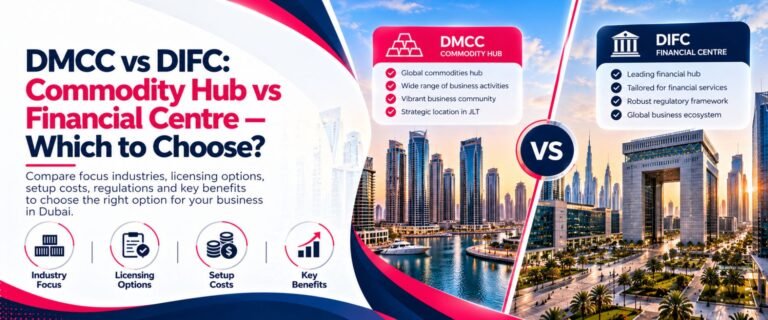
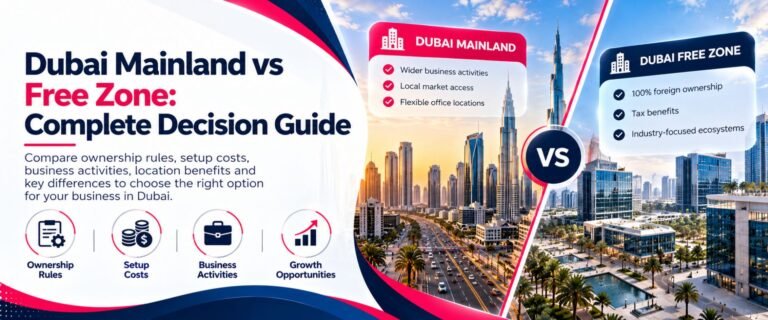
Mainland or Free Zone: The Right Choice for a Commercial Brokerage Business
For brokers whose clients are primarily UAE-based businesses — local manufacturers sourcing materials, UAE distributors seeking foreign suppliers, or domestic companies buying industrial equipment — the Dubai mainland commercial license from DET is the correct structure. Mainland companies can enter into brokerage agreements with any UAE entity without restriction and are eligible to supply to government sector buyers.
For brokers whose work is primarily international in scope — connecting overseas suppliers and buyers without involving UAE mainland counterparties directly — free zone commercial licenses from providers like IFZA or Meydan Free Zone are a cost-effective alternative. Free zone commercial brokerage licenses start from AED 12,500, which is meaningfully lower than the mainland equivalent. The standard free zone limitation applies: a free zone commercial brokerage company cannot directly enter into transactions with UAE mainland clients without a separate mainland permit or distributor arrangement.
How to Get a Commercial Brokerage License in Dubai
- Confirm that your planned business activities fall within the goods intermediary scope of the commercial brokerage license. If you are planning to broker real estate, securities, or insurance, you need a different license and authority.
- Choose your jurisdiction: mainland DET for UAE-based clients, or a free zone for primarily international operations.
- Select your legal structure: LLC for multiple shareholders, or Sole Establishment for a single-owner setup. Since 2021 reforms, foreigners can own 100% of mainland commercial brokerage companies.
- Reserve your trade name through the DET portal or free zone authority. The name must comply with UAE naming conventions.
- Obtain a Good Conduct Certificate (police clearance) from Dubai Police for each shareholder. This is required for all commercial license applications involving brokerage activities.
- Obtain initial approval from DET confirming the brokerage activity and legal structure are acceptable.
- Secure a commercial office with Ejari registration for mainland setups. A serviced office in a business centre qualifies. Submit the MOA or local service agent agreement as applicable.
- Submit the complete application package and pay the license fees. DET typically issues the commercial trade license within 5 to 10 working days of complete submission.
- Apply for investor and staff visas through our PRO services team, open a corporate bank account, and register for VAT and Corporate Tax through the Federal Tax Authority.
Commercial Brokerage License Cost in Dubai 2026
The table below gives a realistic cost picture for both mainland and free zone commercial brokerage setups.
| Cost Component | Estimated Amount (AED) |
| DET Commercial Trade License (mainland) | 15,000 to 25,000 |
| Trade Name Reservation | 620 to 1,000 |
| Initial Approval Certificate | Nominal DET fee |
| Commercial Office Rent (Ejari — mainland) | 30,000 to 80,000+ per year |
| Ejari Registration | 200 to 500 |
| Good Conduct Certificate (Dubai Police) | Approx. AED 200 to 300 per shareholder |
| Meydan Free Zone — commercial brokerage license | From AED 12,500 |
| IFZA Free Zone — commercial activity license | From AED 12,900 |
| Staff Visa per Employee | 4,000 to 6,000 |
| Total First-Year Estimate (mainland, single shareholder) | AED 40,000 to AED 70,000 |
| Total First-Year Estimate (free zone, basic) | AED 15,000 to AED 30,000 |
The AED 40,000 to AED 70,000 mainland first-year range reflects the commercial trade license fee, commercial office rent (the most variable component), and administrative costs. For brokers who primarily serve international clients and do not need a commercial Dubai address for deal-closing purposes, the free zone option at AED 15,000 to AED 30,000 is genuinely competitive. The Good Conduct Certificate is a relatively modest cost but is a mandatory document that must be obtained before submitting the final application — not after.
Getting Your Commercial Brokerage Business Set Up in Dubai
The most common setup error for commercial brokerage businesses is selecting an activity scope that either misclassifies the business (applying for general trading rather than brokerage, which affects how the business is treated for banking and compliance purposes) or misidentifies the license type (applying for a commercial brokerage license for what is actually a real estate or financial services brokerage business).
Dubai International Advisory Consultants supports commercial brokerage company formation in Dubai from activity classification and initial DET approval through to license issuance, commercial office setup, and visa processing. Whether you are establishing a commodity intermediary, a B2B matchmaking business, or a procurement facilitation company, the right activity and structure from the start determines how smoothly the business operates from day one. Visit the business setup consultants in Dubai page for a consultation.
Conclusion
A commercial brokerage license in Dubai covers goods-based intermediary businesses — connecting buyers and sellers of goods across sectors including agricultural raw materials, fuels and metals, food, machinery, textiles, and building materials. It explicitly excludes real estate, financial securities, insurance, and service brokerage — each of which requires a different license from a different regulatory authority. Commercial brokers cannot trade on their own account. All brokerage transactions must be governed by formal written agreements stating the commission rate or flat fee. Brokers must disclose their intermediary role to all parties. The license costs AED 15,000 to AED 25,000 on the mainland and from AED 12,500 in a free zone. First-year total costs including office run AED 40,000 to AED 70,000 on the mainland, or AED 15,000 to AED 30,000 in a free zone. AML, ESR, VAT, and corporate tax compliance obligations apply.
People Also Ask: Commercial Brokerage License Dubai FAQs
What is a commercial brokerage license in Dubai?
Under DET’s definition, a commercial brokerage license authorises a company to act as an intermediary between buyers and sellers of goods — connecting them, facilitating negotiations, and earning a commission when transactions close. It specifically covers goods categories including agricultural raw materials, fuels, metals, food, machinery, textiles, and building materials. It explicitly excludes real estate brokerage, financial securities brokerage, insurance brokerage, and services brokerage — each of which requires a separate license from a different authority.
What is the difference between commercial brokerage and real estate brokerage in Dubai?
Commercial brokerage (under a DET commercial license) covers goods-based intermediary work — buying, selling, and trading of physical goods categories on behalf of clients. Real estate brokerage is governed by the Dubai Land Department and RERA, requiring a RERA broker card and DLD-registered license. The two are separate regulatory categories with different authorities, different training requirements, and different license types. A commercial brokerage license does not authorise real estate transactions.
What activities are permitted under a commercial broker license in Dubai?
Permitted activities include acting as an intermediary in the sale and purchase of: agricultural raw materials and semi-finished goods; fuels, ores, metals, and industrial chemicals; food, beverages, and tobacco; textiles, clothing, and leather goods; timber and building materials; machinery and office equipment; industrial equipment; and furniture and household goods. Wholesale auctioneering houses also fall under this license. Business models covered include commodity intermediaries, B2B matchmakers, procurement facilitators, and corporate sourcing agents.
Can a commercial broker trade goods on their own account in Dubai?
No. A commercial broker under this license acts as an intermediary only and cannot trade on their own account. They connect buyers and sellers, facilitate negotiations, and earn a commission when the transaction closes. They do not buy the goods themselves, hold inventory, or sell to end customers from their own stock. If you want to both intermediate deals and trade goods directly, you would need a commercial trading license in addition to or instead of a pure brokerage license.
What documents are required for a commercial brokerage license in Dubai?
Standard required documents include: passport copies and residence visa copies of all shareholders and managers; passport-size photographs with a white background; a Good Conduct Certificate (police clearance) from Dubai Police for each shareholder; educational certificates; a detailed business plan for some application types; MOA or Local Service Agent agreement depending on legal structure; and commercial office lease and Ejari registration for mainland setups. Document requirements vary slightly by jurisdiction — DET for mainland, or the relevant free zone authority.
How much does a commercial brokerage license cost in Dubai?
A mainland commercial brokerage license from DET costs AED 15,000 to AED 25,000 in government fees. When commercial office rent is added, first-year total costs typically run AED 40,000 to AED 70,000 depending on office location and size. Free zone commercial brokerage licenses start from AED 12,500 at providers like Meydan Free Zone, with first-year total costs typically AED 15,000 to AED 30,000 for basic setups without a physical office requirement.
Is a Good Conduct Certificate required for a commercial brokerage license?
Yes. A Good Conduct Certificate (police clearance certificate) from Dubai Police is required for each shareholder in a commercial brokerage company application. The certificate confirms a clean criminal record and is a standard requirement for commercial license applications involving intermediary or brokerage activities in Dubai. The certificate costs approximately AED 200 to AED 300 and can be obtained through the Dubai Police online portal or service centres.
What compliance obligations apply to commercial brokers in Dubai?
Commercial brokers in Dubai must maintain formal written brokerage agreements for every transaction, clearly stating the commission rate or flat fee. They must disclose their intermediary role to all parties in a deal. AML (Anti-Money Laundering) compliance requires maintaining KYC records for all counterparties. ESR (Economic Substance Regulations) self-assessment must be conducted annually. VAT at 5% applies to brokerage commissions. Corporate tax at 9% applies to taxable profits above AED 375,000. Annual license renewal requires a valid Ejari lease, cleared government fines, and updated UBO declaration.
About the Author
Adil Ahmad is a business setup specialist and content strategist at Dubai International Advisory Consultants. He specialises in commercial and trading company formation in Dubai, with practical knowledge of DET commercial brokerage licensing, activity classification, and the compliance framework that governs goods-intermediary businesses operating in and through the UAE market.