Dubai’s fitness industry is one of the fastest-growing commercial sectors in the emirate. The market is valued at over AED 2.8 billion and expanding at 12.5% annually, driven by a health-conscious expatriate population, government wellness initiatives like the Dubai 30×30 Fitness Challenge, and a growing appetite for premium fitness experiences across every price point. For entrepreneurs with a fitness background or investors who understand the sector, opening a gym in Dubai represents a well-supported commercial opportunity with consistent membership demand.
What distinguishes the gym setup process from most other business license applications in Dubai is the involvement of the Dubai Sports Council (DSC) as a mandatory regulatory authority alongside DET and Dubai Municipality. The DSC does not just register your business — it reviews your gym type, training programmes, and staff qualifications as conditions of approval. Getting the DSC process right from the start shapes your entire timeline and determines how quickly you can open. With expert support from our business setup consultants in Dubai team, this process is navigated with clarity rather than guesswork.
The Three Authorities That Must Approve Your Gym
Most business license applications in Dubai involve DET and possibly one sector regulator. For gyms and fitness centers, three separate approvals are mandatory, and all three must be obtained before you can legally open:
- : Issues the commercial or professional trade license with the gym or fitness center activity
- : Mandatory approval for all fitness centers, covering gym concept, proposed training programmes, and trainer qualifications
- : Health, safety, and facility inspection of the physical premises
The Dubai Sports Council is the authority that catches most investors off guard. The DSC does not simply stamp an approval — it actively reviews your business. This includes the type of gym you are opening (full-service, ladies-only, boutique studio), the fitness programmes you plan to offer, and the qualifications of your training staff. If your trainers are not certified under REPs UAE (Register of Exercise Professionals UAE) or an equivalent recognized certification, your DSC approval will not be granted. Build your trainer qualification documentation before you apply to DSC, not after.
Gym Types in Dubai: What Each Requires
The type of gym you open determines which specific approvals, facility specifications, and trainer certifications apply. The table below maps each gym type to its key requirements.
| Gym Type | License Category | Key Additional Requirement |
| Full-service gym / fitness center | Commercial license (DET) + DSC approval | REPs UAE certified trainers; min 1,500-2,000 sq ft |
| Boutique fitness studio (CrossFit, HIIT, spinning) | Commercial license (DET) + DSC approval | Activity-specific DSC programme approval |
| Ladies-only gym | Commercial license (DET) + DSC approval | Gender-segregated facilities; female-only staff for training floor |
| Personal training studio | Commercial or professional license + DSC | Individual trainer REPs UAE Level 3 minimum |
| Yoga / Pilates / wellness studio | Professional license (DET) + DSC approval | Specialist instructor certification; DHA if clinical services offered |
| Dubai Sports City / Dubai Healthcare City | Free zone commercial license | Zone-specific approvals; DSC registration still required |
Full-Service Gym and Fitness Center
A full-service gym offering cardio equipment, weights, group classes, and personal training is the most common model and requires a Dubai mainland commercial license from DET with the fitness center or gym activity, DSC approval, and Dubai Municipality health and safety inspection. The standard minimum space requirement is 1,500 to 2,000 square feet for a standard fitness facility. In most cases, gym premises must be located on the ground floor — this is a specific operational requirement driven by safety and accessibility standards that applies in most commercial contexts.
Boutique Fitness Studios
CrossFit boxes, HIIT studios, spinning studios, and functional training spaces fall into the boutique category. DSC approval for boutique studios covers the specific programme type — a CrossFit facility has a different programme approval process than a cycle studio. The advantage is that boutique studios can operate in smaller spaces with more focused equipment lists, which reduces fit-out costs meaningfully compared to a full-service gym.
Ladies-Only Gyms
Female-only fitness facilities are in consistently strong demand in Dubai and across the UAE. They require standard DET and DSC approvals, plus specific implementation of gender segregation requirements. The training floor and all operational areas must be exclusively accessible to female members, and trainers working on the floor must be female. Signage, entrance arrangements, and facility layout must all support the gender-segregated model to satisfy DSC standards.
Yoga, Pilates and Wellness Studios
Holistic fitness studios operate under a professional license from DET (rather than commercial) and require DSC approval for the specific wellness activities offered. If any clinical services are incorporated — physiotherapy, nutrition counseling with a clinical component, or medical wellness assessments — Dubai Health Authority (DHA) involvement may be required in addition to DSC. Keeping the business scope clearly defined at the license activity stage prevents this complication.
Facility Requirements: What Dubai Authorities Inspect
Dubai Municipality inspects the physical premises before your gym license is finalised. The inspection covers health, safety, and operational compliance across several specific areas that every gym owner should prepare for before booking the inspection visit:
- Minimum space: 1,500 to 2,000 sq ft for standard gyms; boutique studios may qualify with less but must demonstrate adequate clearance between equipment
- Ground floor location: Required for most gym types; mezzanine or upper-floor setups require specific approval
- Ventilation and air conditioning: Commercial-standard HVAC capable of managing the heat and humidity generated by high-occupancy exercise sessions
- Commercial-grade equipment only: All gym equipment must be certified for commercial use and meet international safety standards; domestic-grade equipment fails inspection
- Emergency preparedness: First-aid kit and trained emergency response staff are mandatory; clear emergency exit routes and fire extinguishers must be in place
- Hygiene standards: Locker rooms, changing areas, and common areas must meet Dubai Municipality’s cleanliness standards; regular maintenance schedules must be documented
- Signage compliance: Non-smoking signs and, where applicable, gender segregation notices must be displayed prominently
In addition, a Civil Defence fire safety approval covering smoke detection, suppression systems, and emergency exit compliance must be obtained for your premises. This runs in parallel with the Dubai Municipality inspection and must be completed before the final license is issued.
Trainer Certifications: The DSC Requirement That Stops Many Gyms from Opening
The REPs UAE (Register of Exercise Professionals UAE) certification is the standard framework that Dubai Sports Council uses to assess trainer qualifications. For personal trainers operating in your gym, a minimum of Level 3 Diploma in Personal Training (or equivalent internationally recognized qualification) is required. All trainers must register with DSC for professional approval before your gym can receive its operational clearance.
This is the requirement that most often delays gym openings when it is not planned for early enough. If you plan to hire trainers from overseas, their qualification attestation and DSC registration process must be initiated well before your planned opening date. Running a gym with uncertified trainers on the floor is a compliance violation that DSC monitors through routine inspections and can result in fines or license suspension.
Public liability and professional indemnity insurance is also mandatory, not optional. This protects your business from claims arising from member injuries on your premises or trainer negligence during sessions. Most commercial gym landlords also require proof of insurance before signing a lease. Budget AED 10,000 to AED 50,000 per year for appropriate insurance cover depending on the size of your facility and the services offered.
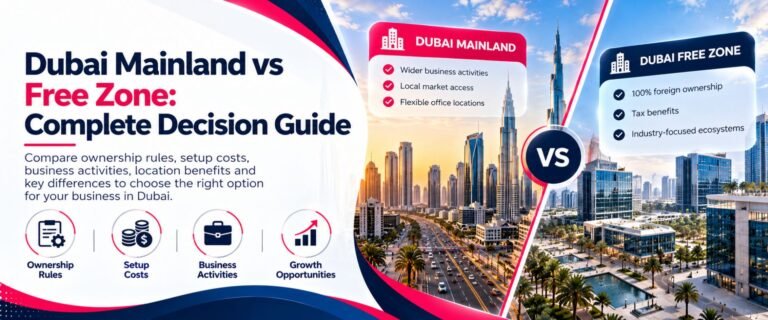
Mainland or Free Zone: Which Works Better for a Gym Business
For gyms whose members will walk through the door from surrounding residential or commercial areas, mainland DET licensing is the standard and recommended structure. It provides unrestricted access to the entire Dubai market, eligibility for corporate wellness contract bidding, and the ability to open multiple branches across the UAE under the same company structure.
Free zone options do exist — Dubai Sports City is specifically designed for sports and fitness businesses and offers integrated infrastructure, a fitness-conscious tenant community, and free zone benefits including 100% foreign ownership. Dubai Healthcare City (DHCC) is the appropriate zone for wellness centers that integrate clinical health services alongside fitness. In both cases, DSC registration is still required even for free zone gym businesses — the free zone license does not substitute for DSC approval.
For most entrepreneurs opening a standalone gym or boutique studio serving a residential or mixed-use area, mainland Dubai company formation gives you direct market access without the location restrictions that come with operating from a dedicated free zone. If your vision is specifically tied to the Sports City cluster or a clinical wellness concept, free zone setup is worth considering.
Steps to Open a Gym in Dubai
- Define your gym concept precisely: full-service, boutique, ladies-only, personal training studio, or wellness. The concept determines your DSC approval track and facility specifications.
- Choose your legal structure and jurisdiction. Since the 2021 ownership reforms, foreigners can own 100% of a mainland gym business for most fitness activities.
- Identify and recruit your trainer team. Confirm all trainers hold REPs UAE Level 3 minimum certifications before submitting the DSC application — DSC will request trainer credentials as part of the review.
- Reserve your trade name and obtain DET initial approval with the gym or fitness center activity listed precisely.
- Secure commercial premises: minimum 1,500 to 2,000 sq ft, ground floor where required, with adequate ventilation, HVAC, and layout for your concept. Register the tenancy contract through Ejari.
- Submit the DSC approval application, including your gym concept, programme details, trainer qualifications, and premises information. DSC reviews and approves the operational model, not just the business entity.
- Submit to Dubai Municipality for health, hygiene, and facility inspection. Carry out fit-out to specification before the inspection visit.
- Obtain Civil Defence fire safety approval for the premises in parallel with the municipality inspection.
- Secure public liability and professional indemnity insurance before opening.
- Submit the complete application to DET with all approvals. The DET trade license is issued once DSC, Dubai Municipality, and Civil Defence approvals are in hand. Apply for staff visas through our PRO services team.
Gym Setup Cost in Dubai 2026
The cost of opening a gym in Dubai varies significantly by scale, location, and concept. The table below covers the major cost components.
| Cost Component | Estimated Amount (AED) |
| DET Commercial Trade License (mainland) | 15,000 to 40,000 |
| Dubai Sports Council (DSC) Approval Fee | Variable by activity; contact DSC for current schedule |
| Trade Name Reservation | 620 to 1,000 |
| Dubai Municipality Health and Safety Approval | 2,000 to 5,000 |
| Civil Defence Fire Safety Approval | 2,000 to 5,000 |
| Commercial Premises Rent (per year) | 100,000 to 500,000+ depending on location and size |
| Ejari Registration | 200 to 500 |
| Gym Fit-Out and Interior | 100,000 to 500,000+ |
| Gym Equipment (commercial-grade) | 50,000 to 500,000+ depending on scale |
| Public Liability and Professional Indemnity Insurance | 10,000 to 50,000 per year |
| Staff Visa per Employee | 4,000 to 6,000 |
| REPs UAE Registration per Trainer | Certification cost + DSC registration fee |
| Total First-Year (small boutique gym) | AED 300,000 to AED 600,000 |
| Total First-Year (mid-size fitness center) | AED 600,000 to AED 1,200,000 |
| Total First-Year (premium full-service gym) | AED 1,500,000 to AED 3,000,000+ |
The fit-out and equipment costs are the largest variables. A boutique CrossFit or functional training studio with minimal equipment can be fitted out for AED 150,000 to AED 300,000. A mid-size full-service fitness center with cardio machines, a free weights area, functional training space, and group class studio typically requires AED 400,000 to AED 800,000 in equipment and fit-out alone, on top of license and premises costs. For ongoing compliance management, corporate tax registration, and financial reporting, our accounting services team supports gym businesses with the documentation that DSC and municipality follow-up audits require.
Getting Your Gym Open in Dubai the Right Way
The most consistent delay in gym setups is the DSC approval process — specifically when trainer certifications are not ready at the time of DSC application. Building the DSC-required documentation package in parallel with the DET initial approval, rather than sequentially, typically reduces the overall timeline from 12 weeks to 8 weeks. The second most common issue is a failed municipality inspection due to ventilation or equipment layout problems. Having the premises layout reviewed against Dubai Municipality specifications before committing to fit-out prevents expensive redesigns.
Dubai International Advisory Consultants supports gym and fitness center entrepreneurs through the complete setup process — from DET license activity selection and initial approval through to DSC submission coordination, Dubai Municipality inspection preparation, Civil Defence clearance, insurance guidance, and staff visa processing. Whether you are opening a boutique studio or a full-service fitness center, visit the business setup consultants in Dubai page to start your gym setup consultation.
Conclusion
Opening a gym in Dubai requires approvals from three authorities: DET for the trade license, Dubai Sports Council for the operational and trainer certification review, and Dubai Municipality for the facility inspection. The DSC approval is not a formality — it actively reviews your gym concept, programmes, and trainer qualifications. All trainers must hold REPs UAE Level 3 minimum certification and be registered with DSC. Facilities must be a minimum of 1,500 to 2,000 sq ft and located on the ground floor in most cases. All gym equipment must be commercial-grade certified. Civil Defence approval and public liability insurance are mandatory before opening. The full licensing timeline runs 8 to 12 weeks. First-year costs start from AED 300,000 for a small boutique gym and reach AED 1,200,000 or more for a mid-size fitness center.
People Also Ask: Gym Business Dubai FAQs
What licenses and approvals do I need to open a gym in Dubai?
You need three mandatory approvals: a commercial or professional trade license from the Department of Economy and Tourism (DET) with the gym or fitness center activity listed, an operational approval from the Dubai Sports Council (DSC) covering your gym concept, programmes, and trainer qualifications, and a facility inspection clearance from Dubai Municipality. Civil Defence fire safety approval for the premises is also required. All must be in place before you can legally open.
Is Dubai Sports Council approval required for all gyms?
Yes. Dubai Sports Council approval is mandatory for all fitness centers, gyms, boutique studios, and personal training facilities in Dubai. The DSC does not simply register the business — it reviews your gym type, proposed training programmes, and verifies that your trainers hold recognized certifications. DSC registration is required for the gym business even if you set up in a free zone. The DET trade license alone is not sufficient to operate a gym without DSC clearance.
What trainer certifications are required to open a gym in Dubai?
All personal trainers and fitness instructors working in your gym must hold certifications recognized under REPs UAE (Register of Exercise Professionals UAE) or an equivalent internationally recognized qualification. A minimum of Level 3 Diploma in Personal Training is required for personal trainers. All trainers must be registered with the Dubai Sports Council. If trainers are being hired from overseas, their qualification attestation and DSC registration must be initiated well before the planned opening date.
What are the facility requirements for a gym in Dubai?
A standard gym or fitness center in Dubai requires a minimum space of 1,500 to 2,000 square feet. Most gyms must be located on the ground floor. Facilities must have commercial-standard ventilation and air conditioning, commercial-grade certified equipment only (no domestic appliances), adequate locker rooms, clear emergency exits, first-aid equipment, and fire safety systems approved by Civil Defence. Dubai Municipality inspects all these areas before issuing the final approval.
How much does it cost to open a gym in Dubai?
The gym license cost in Dubai ranges from AED 15,000 to AED 40,000 for the DET trade license. Total first-year investment including premises, fit-out, and equipment starts from approximately AED 300,000 for a small boutique gym, AED 600,000 to AED 1,200,000 for a mid-size fitness center, and AED 1,500,000 to AED 3,000,000 or more for a premium full-service gym. Monthly operational costs including rent, staff, and utilities typically run AED 80,000 to AED 250,000 depending on size and location.
Can a foreigner own 100% of a gym in Dubai?
Yes. Since the 2021 UAE commercial law reforms, foreign investors can own 100% of a gym or fitness center on the Dubai mainland for most approved fitness activities. No UAE national equity partner is required. Free zones have always permitted 100% foreign ownership. For certain specific activities that may still require a local service agent for administrative purposes, the agent holds no equity and has no management role.
How long does it take to get a gym license in Dubai?
The full process from initial DET approval to license issuance typically takes 8 to 12 weeks for a gym in Dubai. This includes the DET initial approval, DSC application and review, Dubai Municipality facility inspection, and Civil Defence approval. The DSC review is often the longest step, particularly when trainer certification documentation requires attestation. Working with a business setup consultant who manages all three approval tracks simultaneously reduces the timeline to the lower end of this range.
Is a ladies-only gym treated differently from a mixed gym in Dubai?
Yes. Ladies-only gyms require the same DET and DSC approvals as mixed gyms but must also implement specific gender segregation requirements: the training floor and all operational areas must be exclusively accessible to female members, training staff on the floor must be female, and the facility layout and signage must clearly support the gender-segregated model. These requirements are reviewed as part of the DSC approval process for female-only fitness facilities.
About the Author
Adil Ahmad is a business setup specialist and content strategist at Dubai International Advisory Consultants. He specialises in commercial business formation in Dubai, with practical knowledge of DET fitness licensing, Dubai Sports Council approval requirements, and the regulatory framework that governs gym and fitness center setup across mainland Dubai and free zones.