By Adil Ahmad, Senior Business Setup Consultant, Dubai International Advisory Consultants
Summary
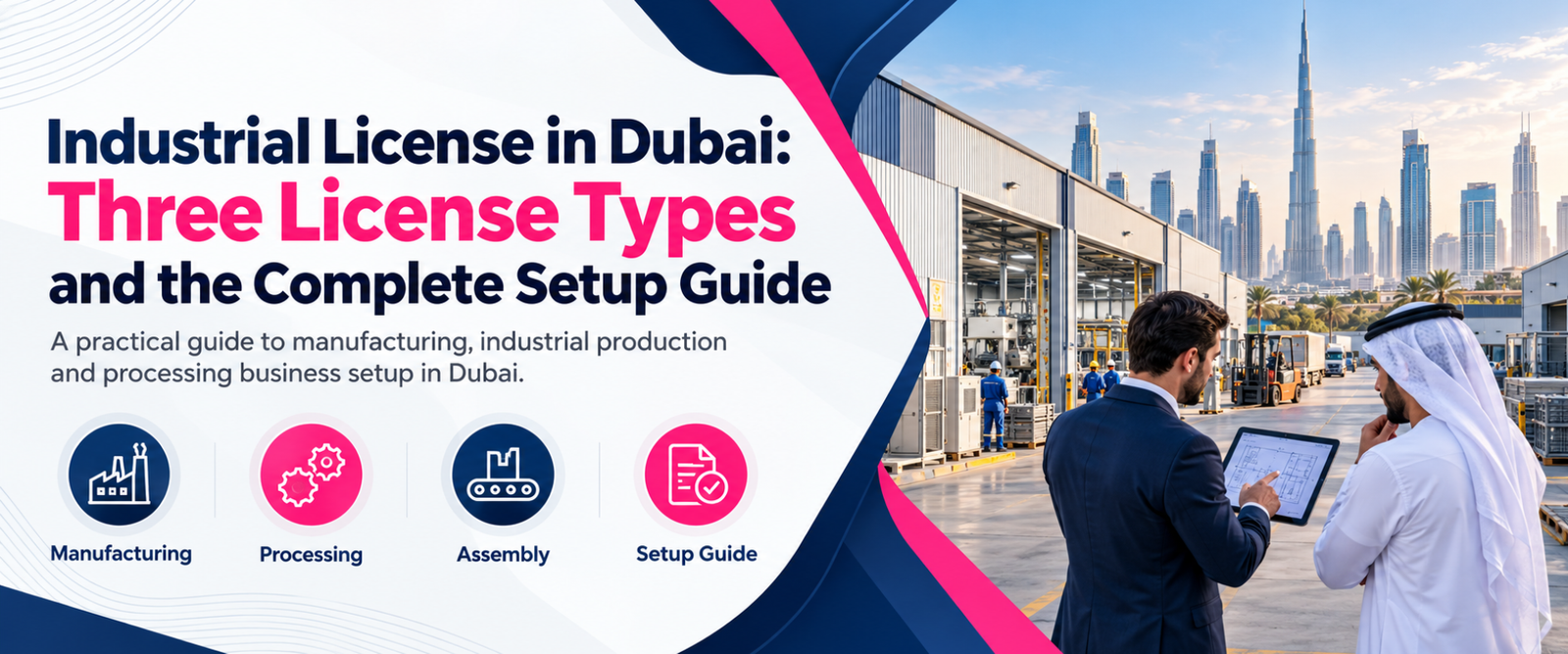
An industrial license in Dubai lets you manufacture, assemble, process or package goods. You get it from the DET on the mainland or from a free zone such as JAFZA or Dubai Industrial City, then add Dubai Municipality, Civil Defence and DEWA approvals for your facility. Registering with MoIAT unlocks customs duty exemptions on machinery and raw materials. Most setups take six to ten weeks.
Industrial License in Dubai at a Glance
| Item | What you need |
|---|---|
| Licence | DET industrial licence (mainland) or free zone manufacturing licence |
| Facility approvals | Dubai Municipality, Dubai Civil Defence, DEWA, environment |
| Federal registration | MoIAT Industrial Production License for customs exemptions |
| Main law | Federal Decree-Law No. 25 of 2022 on regulating industry |
| Foreign ownership | 100% for most manufacturing activities |
| Typical timeline | 6 to 10 weeks with complete documents |
What an Industrial License in Dubai Covers
An industrial license is for businesses that turn inputs into products. It covers:
- Manufacturing finished goods from raw materials
- Assembling products from components
- Processing, refining or treating materials
- Packaging and labelling goods under your brand
- Importing machinery and raw materials for production
- Exporting your finished products
It does not cover pure trading or professional services. If you only buy and resell goods, you need a trading licence instead. See our guide to the general trading licence.
Three Types of Industrial License in Dubai: Light, Medium and Heavy
In practice, industrial activities fall into three broad groups. The group affects where you can operate and which approvals you need.
| Type | Typical activities | What to expect |
|---|---|---|
| Light industrial | Small workshops, packaging, printing, light assembly, garages | Simpler approvals, smaller units in light industrial areas |
| Medium industrial | Food processing, furniture, textiles, metal fabrication, plastics, electronics | Full factory layout review, environmental and fire safety checks |
| Heavy industrial | Chemicals, construction materials, heavy machinery, hazardous goods | Strict zoning, detailed environmental permits, larger plots |
The exact category is set by your activity code and facility, so confirm it before you sign a lease. If you plan an auto workshop, our guide to opening an auto repair garage in Dubai covers that route.
MoIAT Industrial Production License: The Step Most Guides Do Not Cover
Your DET or free zone licence lets you operate. The federal Industrial Production License from the Ministry of Industry and Advanced Technology (MoIAT) registers your factory in the national industrial register under Federal Decree-Law No. 25 of 2022. It matters because it:
- Lets you apply for customs duty exemption on machinery, equipment and raw materials
- Helps with In-Country Value (ICV) certification, which many government and large company tenders score
- Gives access to federal industrial incentives and support programmes
MoIAT checks capital, workforce and production activity. Older federal rules asked for AED 250,000 capital and at least 10 workers, so plan on that level and confirm the current criteria when you apply.
Popular Manufacturing Sectors in Dubai
The UAE is actively growing its industrial base through its national industrial strategy, Operation 300bn, and In-Country Value programme. Sectors with strong demand include:
- Food and beverage processing for the GCC market
- Building materials, steel fabrication and aluminium products
- Plastics, packaging and printing
- Furniture, interior fit-out and joinery
- Cosmetics, perfumes and personal care products
- Electronics assembly and advanced manufacturing
Choosing the Right Industrial Zone in Dubai
| Location | Best for | Key advantage |
|---|---|---|
| DET mainland (Al Quoz, Ras Al Khor, Dubai Investments Park and others) | Manufacturers selling in the UAE | Direct UAE market access and government supply |
| JAFZA | Export-focused manufacturing | Next to Jebel Ali Port, large plots and warehouses |
| Dubai Industrial City | Light and medium manufacturing | Purpose-built factories, warehouses and staff housing |
| Dubai South | Aviation, logistics-linked production | Near Al Maktoum International Airport |
| Dubai Silicon Oasis | Electronics and tech-based production | Technology park setting |
Mainland Industrial License
A DET mainland licence lets you sell anywhere in the UAE, supply government projects and distribute to retailers directly. Foreign investors can own 100% for most manufacturing activities. You can check activities on the DET’s Invest in Dubai portal, and read our guide to mainland company formation in Dubai.
Mainland Industrial Areas
On the mainland, factories usually sit in zoned industrial areas such as Al Quoz Industrial, Ras Al Khor, Al Qusais Industrial and Dubai Investments Park. Rents are often lower than in free zones, and you can deliver straight to UAE customers, which suits building materials, food and furniture producers.
Free Zone Manufacturing License
Free zones suit export-led factories. You get 100% ownership and easier import and re-export, but selling into the UAE market usually goes through a distributor or a mainland entity. Compare zones in our Dubai free zone business setup guide, or look at Jebel Ali company options.
Mandatory Approvals Beyond the DET License
- Dubai Municipality: building, layout, health and environmental approvals for the facility
- Dubai Civil Defence: fire safety systems, storage of flammable materials and emergency plans
- DEWA: power and water connection sized for your machinery
- Zone or landlord approval: confirmation that your activity is allowed at that plot
Sector-Specific Approvals
- Food production: Dubai Municipality food safety approval and a HACCP-based system. See our foodstuff business guide
- Chemicals: environmental permits, safety data sheets and hazardous storage approvals
- Pharmaceuticals and medical products: Ministry of Health and Prevention approvals
- Regulated products: MoIAT conformity and product certification where required
Documents Required for an Industrial License
- Passport copies of shareholders and the manager, plus Emirates ID if resident
- Trade name reservation and initial approval
- Signed lease for an industrial plot, factory or warehouse
- Factory layout drawings and a list of machinery with power needs
- Description of raw materials, production process and waste handling
- Memorandum of Association for an LLC
- Attested company documents for corporate shareholders
Having the layout and machinery list ready early saves the most time, because Municipality, Civil Defence and DEWA all review them.
How to Get an Industrial License in Dubai: The Process
- Define your activity and choose the exact activity codes.
- Choose mainland or free zone based on your market.
- Reserve a trade name and get initial approval. Protect your brand with trademark registration.
- Secure industrial premises and register the lease.
- Prepare the factory layout showing machinery, workflow, ventilation, drainage and fire safety.
- Apply for Municipality, Civil Defence and DEWA approvals in parallel, plus any sector approvals.
- Submit the licence application with approvals and pay the fees.
- Apply for the MoIAT Industrial Production License once the factory is ready for inspection.
- Complete post-licence setup: visas through our PRO services team, a corporate bank account, and tax registration.

Industrial License Cost in Dubai
| Item | Typical cost (AED) |
|---|---|
| DET mainland industrial licence (per year) | 15,000 to 30,000 |
| Free zone manufacturing licence (per year) | From about 5,500, plus facility lease |
| Trade name reservation | 620 to 1,000 |
| Factory or warehouse lease (per year) | 50,000 to 500,000+ |
| Layout drawings and engineering | 5,000 to 20,000 |
| Civil Defence and other inspections | 2,000 to 5,000+ |
| Visa per employee | 4,000 to 6,000 |
Most light industrial setups need AED 80,000 to 200,000 in the first year, and medium factories often need far more once machinery is included. These are market ranges. For the licence side, try our business setup cost calculator.
Tax, Customs and Compliance for Manufacturers
- Customs: register a Dubai Customs code for imports and apply for MoIAT duty exemptions on eligible inputs
- VAT: registration is mandatory once taxable supplies pass AED 375,000 a year; exports are generally zero-rated. Our VAT consultants can set this up
- Corporate tax: 0% up to AED 375,000 of taxable income and 9% above; free zone manufacturers can pay 0% on qualifying income if they meet the conditions
- Accounts: track production costs and inventory properly with our accounting services
Common Mistakes New Manufacturers Make
- Signing a factory lease before checking the plot allows the activity
- Ordering machinery before the power load is approved by DEWA
- Skipping MoIAT registration and paying customs duty that could be exempt
- Choosing a free zone and then trying to sell directly to UAE retailers
Setting Up Your Manufacturing Business in Dubai
Running approvals in parallel is the biggest time saver. DIAC handles activity selection, licensing, Municipality and Civil Defence coordination, MoIAT registration, visas and banking. If you move finished goods yourself, see our guide to starting a logistics business in Dubai. Considering Sharjah for lower rents? Read about Sharjah mainland company formation.
Frequently Asked Questions
What is an industrial license in Dubai and who needs one?
It is the licence for businesses that manufacture, assemble, process or package goods. It is issued by the DET on the mainland or by a free zone authority.
What are the three types of industrial license in Dubai?
Industrial activities are commonly grouped as light, medium and heavy, based on the activity and its risk. The group affects location and approvals.
Do I need a MoIAT Industrial Production License?
It is needed if you want customs duty exemptions on machinery and raw materials and federal industrial benefits. Most serious manufacturers apply for it.
How much does an industrial license cost in Dubai?
A mainland industrial licence usually costs AED 15,000 to 30,000 a year, and free zone licences start lower. Premises and machinery are the biggest costs.
Can foreigners own 100% of an industrial company in Dubai?
Yes, for most manufacturing activities on the mainland, and always in free zones.
How long does it take to get an industrial license in Dubai?
Usually six to ten weeks with complete documents. Facility approvals and fit-out are what take the longest.
What is the difference between an industrial licence and a trading licence?
An industrial licence lets you produce or transform goods. A trading licence only lets you buy and sell finished goods without changing them.
Do I need an environmental permit for a factory in Dubai?
Most medium and heavy activities do. Dubai Municipality reviews emissions, waste and wastewater before approving the facility.
Can I run a manufacturing business from a warehouse?
Only if the warehouse is in an area zoned for industrial use and passes Municipality and Civil Defence checks for your activity.
Can a free zone factory sell in the UAE?
Yes, usually through a mainland distributor or branch. Goods entering the UAE market from a free zone may also be subject to customs duty.
Conclusion
An industrial license in Dubai is more than a trade licence. Match your activity to the right location, run facility approvals in parallel and register with MoIAT to cut import costs. Talk to our team about business setup in Dubai or book a free consultation.
About the Author
Adil Ahmad is a senior business setup consultant at DIAC who helps manufacturers choose the right industrial location, licence and approvals in Dubai and across the UAE.