By Adil Ahmad, Senior Business Setup Consultant, Dubai International Advisory Consultants
Summary
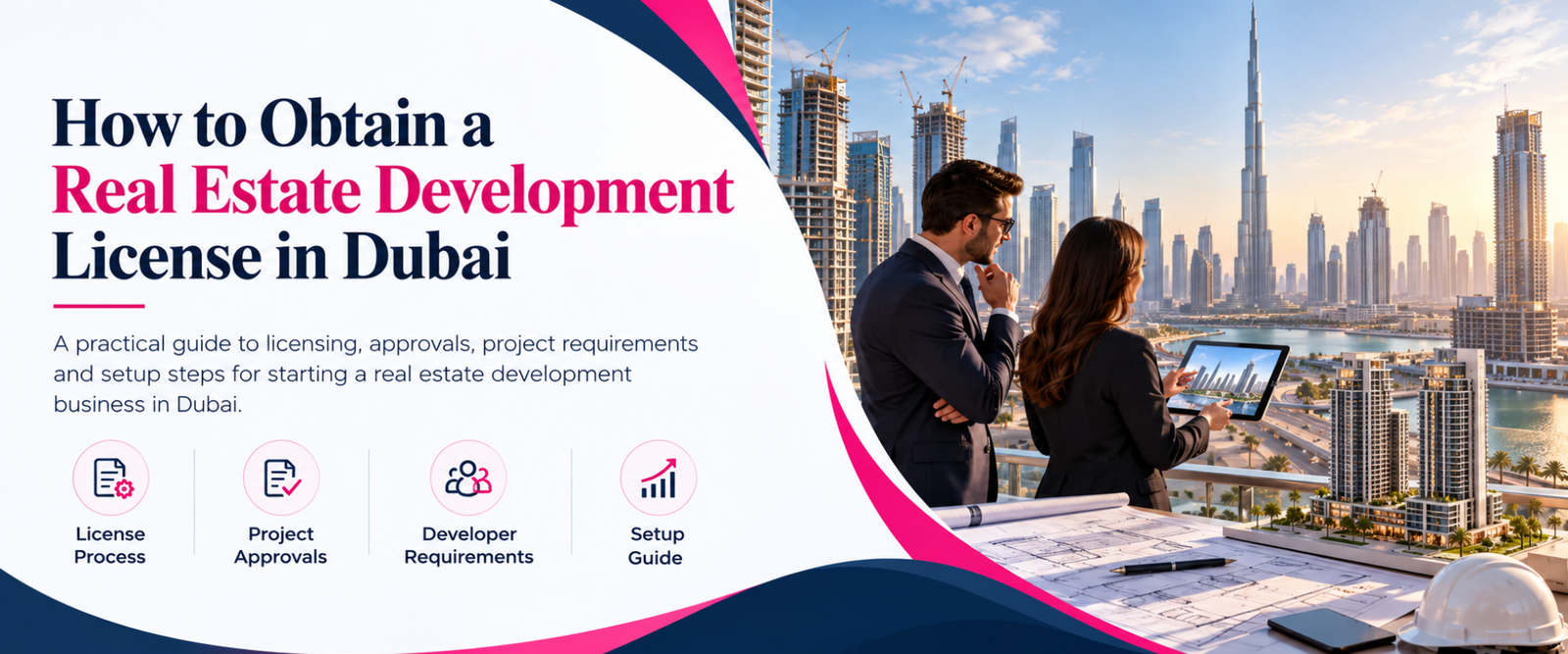
To become a real estate developer in Dubai, you need three approvals: a DET trade licence with a real estate development activity, registration as a developer with RERA, and a separate Dubai Land Department registration for every project. Off-plan sales also need a project escrow account, a financial guarantee, Oqood contract registration and a RERA marketing permit. Budget roughly AED 90,000 to 140,000 before land and construction.
Real Estate Development License in Dubai at a Glance
| Item | What you need |
|---|---|
| Company licence | DET mainland licence with real estate development activity |
| Developer registration | RERA Register of Real Estate Developers, fee around AED 25,000 |
| Each project | DLD project registration, escrow account and Oqood |
| Land | Title deed in the developer’s name, or approved master developer arrangement |
| Financial guarantee | Commonly 20% of construction cost in cash, bank guarantee or site progress |
| Main laws | Law No. 8 of 2007 (escrow), Law No. 13 of 2008 (interim register) |
| Foreign ownership | 100% allowed for a mainland development company |
Developer Licence vs Broker Licence
These two are often confused. A developer licence lets you buy land, build and sell your own units. A brokerage licence lets you sell other people’s property for a commission. They have different approvals, costs and rules. If you want to sell property rather than build it, read our guide to the commercial brokerage licence in Dubai and how to get a RERA certificate.
Who Can Apply: Developer Eligibility Checklist
Before you spend on licences, check that you can meet RERA and DLD expectations:
- A company structure with clear ownership and no negative background on owners or managers
- Access to land, either owned outright or secured with the master developer
- Enough capital to cover the guarantee, fees and early construction costs without relying only on buyer money
- A qualified consultant and contractor ready to sign on the project
- A team or partner who understands escrow, Oqood and marketing rules
If one of these is missing, it is usually better to fix it first than to start licensing and stall at project registration.
The Three-Stage Framework Every Dubai Developer Must Complete
- DET trade licence with the real estate development activity
- RERA developer registration, which adds your company to the official Register of Real Estate Developers
- Project registration with the Dubai Land Department, repeated for every project, with its own escrow account
You cannot skip or reorder these stages. A licence alone does not let you sell a single off-plan unit.
Stage 1: DET Trade License with Real Estate Development Activity
Your company needs a mainland licence from the Department of Economy and Tourism that clearly lists real estate development. A general investment or trading activity is not enough. Most developers choose an LLC, which foreign investors can own 100%.
- Reserve a trade name and get initial approval
- Lease a commercial office and register the Ejari
- Sign and notarise the Memorandum of Association
- Submit shareholder documents and pay the licence fees
Our guide to mainland company formation in Dubai covers this stage step by step.
Stage 2: RERA Developer Registration
The Real Estate Regulatory Agency, part of the Dubai Land Department, keeps the Register of Real Estate Developers. No company can carry out development in Dubai unless it is on this register. The registration fee is around AED 25,000.
RERA typically asks for:
- Your DET trade licence and company documents
- Details of owners and managers, with background checks
- Audited financial statements showing financial strength
- Evidence of land ownership or rights to the project land
- Details of your first planned project
Stage 3: Per-Project Registration and the Oqood System
Every project is registered separately with the Dubai Land Department. Before you sign any sale contract or collect money, the project must be registered and its escrow account open. The main requirements are:
- A title deed for the land in the developer’s name, or an approved arrangement with the master developer
- Approved building permits and consultant appointment
- A no objection certificate from the master developer, where the plot is in a master community
- A feasibility study and audited financials
After registration, every off-plan sale contract is recorded in Oqood, the interim real estate register created under Law No. 13 of 2008. Oqood stops the same unit being sold twice and gives the buyer a registered record, which later converts to a title deed on completion.
The Financial Guarantee: What DLD Requires Before You Can Sell Off-Plan
To protect buyers, the developer must show real financial commitment before off-plan sales begin. This is commonly set at 20% of the estimated construction cost, provided in one of three ways:
- Cash deposit into the project escrow account
- Unconditional bank guarantee from a UAE bank
- Construction progress on site, verified by an approved consultant
The exact amount and form are confirmed by DLD at project registration, so build this into your financing plan early. It is usually the largest upfront cost after the land itself.
Law No. 8 of 2007: The Escrow Rules Every Developer Must Follow
Law No. 8 of 2007 on escrow accounts is the backbone of off-plan development in Dubai. The key rules are:
- Each off-plan project has its own escrow account with an approved bank
- All buyer payments go into that account, never into the developer’s operating account
- Money is used only for that project’s construction and released in stages as work is verified
- Written approval is needed before advertising or selling off-plan units
- After completion, 5% of the account is retained and released one year after units are registered in buyers’ names
- Serious breaches carry a fine of at least AED 100,000, jail, or both
If a buyer stops paying, Law No. 19 of 2017 sets how much of the price a developer can keep, based on how far construction has progressed.
Off-Plan Marketing Rules
Before any advertising, online or offline, you need a RERA marketing permit for the project. Every advert, listing and brochure must show the permit number and match the approved project details. Developers are also responsible for how their appointed brokers market the project, so share approved materials only. Unapproved ads can lead to fines and a stop on sales.
Developer Obligations After Registration
- Escrow reporting: regular progress and escrow reports to DLD and RERA
- Anti-money laundering: real estate developers must register on the UAE FIU’s goAML system, carry out KYC on buyers and report cash transactions of AED 55,000 or more
- Corporate tax: register with the Federal Tax Authority; 0% up to AED 375,000 of taxable income and 9% above
- VAT: sales of new residential units have special VAT treatment, while commercial property is generally taxed at 5%. Our VAT consultants can map this for each project
- Renewals: keep your DET licence, office lease and RERA registration active
Cost and Financial Obligations for Real Estate Developers in Dubai
| Item | Typical cost (AED) |
|---|---|
| DET trade licence (per year) | 15,000 to 30,000 |
| RERA developer registration | Around 25,000 |
| Project registration and escrow setup (per project) | 30,000 to 50,000 |
| Feasibility study and audits | 10,000 to 50,000+ |
| Office lease (per year) | 40,000 to 200,000+ |
| Financial guarantee | Commonly 20% of construction cost |
Government and bank fees change and depend on the project, so treat these as planning ranges. For the licence side, try our business setup cost calculator.
Using the Dubai REST App: How Buyers Verify Developers
Buyers can check a developer’s registration and approved projects on DLD’s Dubai REST app. Keep your registration active and your project details up to date, because an expired status quickly damages buyer trust.
Common Mistakes New Developers Make
- Marketing a project before the RERA permit is issued
- Collecting deposits outside the escrow account
- Buying land before checking master developer approvals
- Underestimating the guarantee and escrow timelines in the financing plan
How Dubai International Advisory Consultants Supports Real Estate Developers
We handle your DET licence, prepare RERA registration documents, coordinate project registration, and set up your corporate bank account. Our PRO services team manages government submissions and visas, and our accounting services team supports audits and tax filings. Protect your project brand with trademark registration, and qualifying investors may also apply for the UAE Golden Visa. If you plan to manage units after handover, see our property management licence guide.
People Also Ask: Real Estate Development License Dubai FAQs
How do I register as a real estate developer in Dubai?
Get a DET licence with the real estate development activity, register with RERA on the Register of Real Estate Developers, then register each project with DLD and open its escrow account.
How much does a real estate development licence cost in Dubai?
Licensing and registration usually cost AED 90,000 to 140,000 before land and construction. The financial guarantee, commonly 20% of construction cost, is the largest extra commitment.
Can a foreigner start a real estate development company in Dubai?
Yes. Foreign investors can own 100% of a mainland development company and register it with RERA.
What is Oqood in Dubai real estate?
Oqood is DLD’s interim register for off-plan sale contracts. It prevents double selling and gives buyers a registered record until the title deed is issued.
Can I sell off-plan without an escrow account?
No. Under Law No. 8 of 2007, every off-plan project needs its own escrow account before any buyer payment is collected.
How long is the 5% escrow retention held?
The 5% is held after completion and released one year after the units are registered in buyers’ names.
Do real estate developers need to register for goAML?
Yes. Developers are covered by UAE anti-money laundering rules and must register on goAML and report qualifying cash transactions.
Do I need to own the land before registering a project?
Yes, in most cases. DLD expects the land to be registered in the developer’s name, or an approved arrangement with the master developer, before the project and its escrow account are registered.
Can a free zone company register as a developer in Dubai?
Most developers selling across Dubai use a DET mainland company. Some zones, such as DIFC, have their own property rules, so check before you choose. Compare structures in our free zone business setup guide.
How long does developer registration take?
The DET licence takes about a week, RERA registration one to two weeks, and project registration a few weeks, depending on documents and approvals.
Conclusion
Real estate development in Dubai is well regulated, which is exactly why buyers trust it. Get the licence, RERA registration and project approvals right, respect escrow rules and plan your guarantee early. Talk to our team about business setup in Dubai or book a free consultation.
About the Author
Adil Ahmad is a senior business setup consultant at DIAC who advises investors on real estate development, brokerage and property management companies in Dubai.