By Adil Ahmad, Senior Tax and Business Setup Consultant, DIAC
Summary
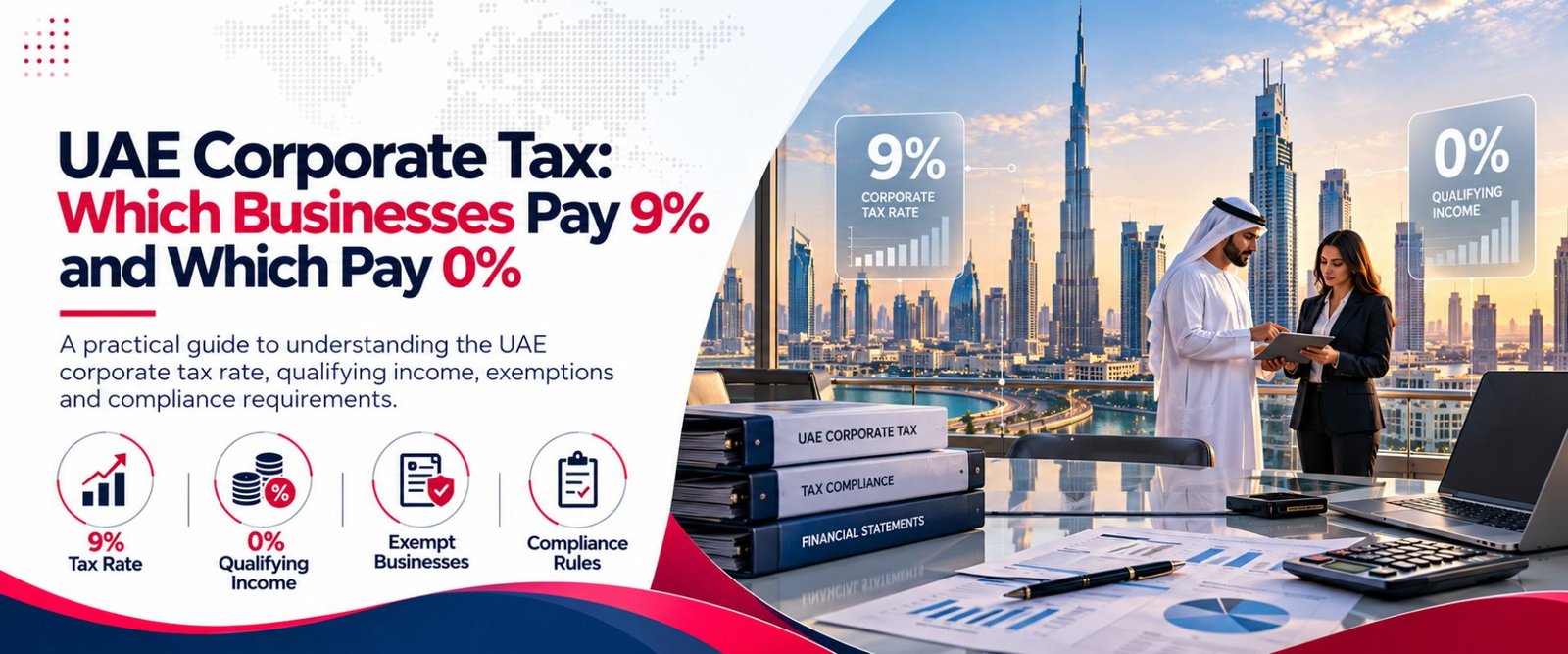
UAE corporate tax is 9% on taxable profit above AED 375,000, with 0% on the first AED 375,000. This guide explains who pays 9%, who pays 0%, free zone QFZP rules, Small Business Relief, exempt entities, withholding tax, the 15% top-up tax for large groups, registration deadlines, penalties, deductions and how your Dubai business setup choice affects your final tax bill.
Corporate tax changed the way every founder in the UAE should think about structure. The country is still one of the most tax-efficient places in the world to run a business, but “tax-free” is no longer the right word. After helping hundreds of companies with business setup in Dubai, registration and their first returns, I see the same misunderstandings again and again. This guide clears them up in plain language.
What Is UAE Corporate Tax?
UAE corporate tax is a federal tax on business profits introduced by Federal Decree-Law No. 47 of 2022. It applies to financial years starting on or after 1 June 2023 and is administered by the Federal Tax Authority through the EmaraTax portal.
UAE corporate tax rates at a glance
| Taxable Profit or Situation | Rate |
| Up to AED 375,000 | 0% |
| Above AED 375,000 | 9% |
| Qualifying income of a Qualifying Free Zone Person | 0% |
| Large multinational groups (revenue EUR 750 million+) | 15% minimum through the top-up tax |
| Withholding tax on payments to non-residents | 0% |
How much is corporate tax in the UAE? For most businesses, nothing on the first AED 375,000 of profit and 9% on the rest. A company with AED 500,000 taxable profit pays 9% on AED 125,000, which is AED 11,250.
Who Pays 9% Corporate Tax in the UAE?
The 9% rate applies to “taxable persons” on taxable income above AED 375,000:
- Mainland companies such as LLCs and public or private joint stock companies
- Free zone companies that are not Qualifying Free Zone Persons, or on their non-qualifying income
- Branches of foreign companies on profits from their UAE permanent establishment. See our branch office in Dubai guide
- Individuals running a business whose business turnover exceeds AED 1 million in a calendar year
- Non-residents with a UAE permanent establishment or UAE-sourced income in scope
The AED 375,000 threshold is based on taxable income, not revenue. Revenue minus allowable expenses gives your taxable profit.
Corporate Tax Examples
- Consultancy with AED 300,000 profit: below AED 375,000, so the tax is AED 0.
- Trading company with AED 1 million profit: 9% on AED 625,000, so the tax is AED 56,250.
- Startup with AED 2.5 million revenue and AED 600,000 profit: if it elects Small Business Relief, the tax is AED 0 for eligible periods.
- QFZP with AED 2 million qualifying profit: 0% on qualifying income, provided all conditions are met.
Who Pays 0% Corporate Tax?
You may pay no corporate tax if you fall into one of these groups:
- Profit up to AED 375,000: every taxable person gets the 0% band
- Small Business Relief: resident businesses with revenue of AED 3 million or less can elect to be treated as having no taxable income, for tax periods ending on or before 31 December 2026
- Qualifying Free Zone Persons on qualifying income
- Individuals earning salary, personal investment income or personal real estate rent
- Individuals with business turnover of AED 1 million or less
- Exempt persons listed below
Small Business Relief is not automatic. You must elect it in your return, and it is not available to Qualifying Free Zone Persons or members of large multinational groups.
Corporate Tax Exemptions in the UAE
| Exempt Person | Notes |
| Government entities | Federal and emirate governments |
| Government-controlled entities | Listed by Cabinet decision |
| Extractive and non-extractive natural resource businesses | Oil and gas and similar businesses taxed at emirate level, if conditions are met |
| Qualifying public benefit entities | Approved charities and non-profits |
| Qualifying investment funds | Subject to FTA conditions |
| Public and private pension and social security funds | Subject to conditions |
Many exempt persons still need to register or apply for exemption with the FTA. Exempt does not always mean “no paperwork”.
Exempt income for taxable companies includes most dividends from UAE companies and, under the participation exemption, dividends and capital gains from holdings of 5% or more kept for at least 12 months.
Free Zone Companies and the QFZP Rules
Free zone companies are not automatically tax-free. A free zone company pays 0% on qualifying income only if it is a Qualifying Free Zone Person (QFZP). In practice it must:
- Maintain adequate substance in the UAE: staff, premises and decision making
- Earn qualifying income, mainly from other free zone persons, overseas clients and qualifying activities
- Keep non-qualifying revenue below 5% of total revenue or AED 5 million, whichever is lower
- Not elect to be taxed at the standard rate
- Follow transfer pricing rules on related-party deals
- Prepare audited financial statements
Fail any one and the company loses QFZP status, paying 9% on taxable income above AED 375,000 for that period and the following four tax periods.
Consultant tip: A one-person flexi-desk company billing mainly UAE mainland clients will rarely qualify as a QFZP. For such businesses, the standard 0% band and Small Business Relief often matter more than free zone status.
Zones such as DMCC and Meydan remain attractive, but plan your substance and client base with QFZP in mind.
UAE Withholding Tax Rate: 0%
The UAE corporate tax law allows withholding tax on certain UAE-sourced payments to non-residents, but the rate is currently 0%. Dividends, interest, royalties and service fees paid abroad are not subject to UAE withholding tax at present.
The 15% Top-Up Tax for Large Groups
From 1 January 2025, the UAE applies a Domestic Minimum Top-up Tax so that multinational groups with consolidated revenue of EUR 750 million or more pay an effective 15% in the UAE. This follows the OECD Pillar Two rules. SMEs are not affected. More detail is on the Ministry of Finance top-up tax page.
Key Deductions and Rules for Taxable Income
- Business expenses incurred wholly for the business are deductible
- Entertainment for clients is only 50% deductible
- Net interest is generally capped at 30% of EBITDA above a de minimis level
- Tax losses can be carried forward and used against up to 75% of taxable income each year
- Tax groups: UAE companies with 95% common ownership can form a tax group and file one return
- Transfer pricing: related-party transactions must be at arm’s length
- Accounting: financial statements must follow IFRS (or IFRS for SMEs for smaller businesses), and audited accounts are required for QFZPs and businesses with revenue above AED 50 million
Corporate Tax Registration and Deadlines
| Situation | Deadline |
| Companies incorporated from 1 March 2024 | Within 3 months of incorporation |
| Companies existing before 1 March 2024 | Staggered deadlines in 2024 by license month |
| Individuals in business | By 31 March of the year after turnover exceeds AED 1 million |
| Tax return and payment | Within 9 months of the end of the tax period |
How to register: log into EmaraTax with UAE Pass, choose “Register for Corporate Tax”, enter your trade license and financial year details, upload documents and receive your corporate tax TRN. It is separate from your VAT TRN.
Our VAT and corporate tax consultants handle registration, elections and returns for mainland and free zone companies.
UAE Corporate Tax Penalties
| Violation | Penalty |
| Late registration | AED 10,000, which may be waived if the first return is filed within seven months of the first tax period ending |
| Late filing of return | AED 500 a month for the first 12 months, then AED 1,000 a month |
| Late payment | 14% a year on unpaid tax, charged monthly |
| Failure to keep records | AED 10,000, rising to AED 20,000 for repeat breaches |
Good bookkeeping is your best protection. Our accounting services keep you ready for filing and audit.
How Corporate Tax Affects Your Business Setup Choice
| Setup | Corporate Tax Position | Best For |
| Mainland company | 0% up to AED 375,000, then 9% | Businesses serving UAE customers |
| Free zone QFZP | 0% on qualifying income | International clients, re-export, free zone trade |
| Free zone non-QFZP | Same as mainland | Small service firms with local clients |
| Offshore company | Generally outside scope without UAE income or presence | Holding and asset protection |
The rate is the same in every emirate, so corporate tax in Sharjah, Abu Dhabi or Dubai works the same way. Choose your structure first for commercial reasons, then check the tax result. Compare mainland company formation in Dubai, mainland company formation in Sharjah, our free zone business setup guide and RAK ICC offshore options.
Corporate Tax vs VAT
| Feature | Corporate Tax | VAT |
| What it taxes | Business profits | Sale of goods and services |
| Rate | 0%, 9% or 15% top-up | 5% (some items 0% or exempt) |
| Registration trigger | Every taxable person | Taxable supplies above AED 375,000 |
| Filing | Annually | Usually quarterly |
Frequently Asked Questions
How much is corporate tax in the UAE?
0% on taxable profit up to AED 375,000 and 9% on profit above that. Large multinational groups pay a 15% minimum through the top-up tax.
Do free zone companies pay corporate tax?
Only Qualifying Free Zone Persons pay 0% on qualifying income. Others pay 9% above AED 375,000, like mainland companies.
Is the AED 375,000 threshold based on revenue or profit?
Profit. It is your taxable income after allowable expenses, not your turnover.
What is Small Business Relief?
Resident businesses with revenue of AED 3 million or less can elect to be treated as having no taxable income for tax periods ending on or before 31 December 2026.
Does UAE corporate tax apply to individuals?
Not to salary or personal investments. Individuals running a business become taxable once business turnover exceeds AED 1 million in a year.
What is the UAE withholding tax rate?
Currently 0% on payments to non-residents.
What is the penalty for late corporate tax registration?
AED 10,000, which may be waived if the first return is filed within seven months of the end of the first tax period.
Do offshore companies pay UAE corporate tax?
Generally not if they have no UAE income or permanent establishment, but each case depends on activity and management.
About the Author
Adil Ahmad is a senior tax and business setup consultant at DIAC. He advises mainland, free zone and offshore companies on corporate tax registration, QFZP planning, Small Business Relief and annual compliance. Book a free consultation to review your tax position.