By Adil Ahmad | Business Setup Consultant, DIAC
| Summary
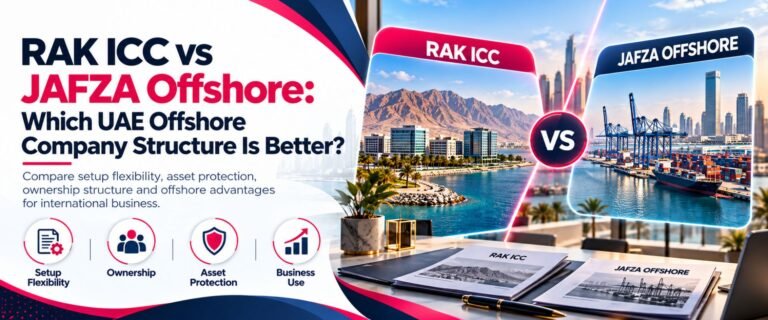
RAK ICC and JAFZA are the two main offshore jurisdictions in the UAE. RAK ICC is the most popular choice for international holding, asset protection, and cost-conscious investors, with no audit requirement and fully remote setup. JAFZA Offshore costs more but is the only UAE offshore structure that can hold Dubai freehold property. This guide covers every key difference to help you choose the right structure. |
When you are considering an offshore company formation in Dubai or anywhere in the UAE, the first practical question you face is which offshore jurisdiction to use. The UAE has three offshore options: RAK ICC, JAFZA Offshore, and Ajman Offshore. For most serious investors, the real decision sits between just two of them: RAK ICC and JAFZA.
Both allow 100% foreign ownership. Neither requires a physical office or a UAE resident director. Both are used for international holding, asset protection, and wealth structuring. But one key difference changes everything for certain investors: only a JAFZA offshore company can hold Dubai freehold real estate in a corporate name.
If property ownership is not part of your plan, the comparison shifts entirely to cost, setup speed, banking access, and structural flexibility. This guide breaks down every factor so you can make a confident decision. If you are still deciding between an offshore and a free zone company altogether, see our guide on UAE Free Zone vs Offshore Company first.
RAK ICC vs JAFZA Offshore: At a Glance
Before going into the detail, here is a side-by-side snapshot of both jurisdictions across the factors that matter most to investors.
RAK ICC vs JAFZA Offshore: Full Comparison
| Factor | RAK ICC Offshore | JAFZA Offshore |
| Established | 2016 (merger of RAK IBC and RAK Offshore) | 2003 (part of Jebel Ali Free Zone Authority) |
| Governing Authority | Ras Al Khaimah International Corporate Centre | Jebel Ali Free Zone Authority (JAFZA) |
| Minimum Directors | 1 (can also act as secretary) | 2 directors required |
| Minimum Shareholders | 1 | 1 |
| UAE Residence Visa | Not standard (available via Premium Product) | Not available |
| Physical Office Required | No | No |
| UAE Address | No (registered agent address only) | No (registered agent address only) |
| Hold Dubai Real Estate | Not permitted directly | Yes (DLD-approved freehold zones) |
| Hold Shares in UAE Companies | Yes | Yes |
| International Trading | Yes (outside UAE) | Yes (outside UAE; no UAE mainland sales) |
| IP / Patent Holding | Yes | Yes |
| Annual Audit | Not required (RAK ICC) | Required for most entity types |
| UAE Corporate Tax Filing | Required (FTA registration mandatory) | Required (FTA registration mandatory) |
| UBO Disclosure | Mandatory | Mandatory |
| Setup Time | 3 to 5 working days | 7 to 10 working days (UAE visit required) |
| Remote Setup | Yes – fully remote | Partial – UAE visit needed for signing |
| Setup Cost (approx.) | AED 8,000 to 15,000 | AED 18,000 to 25,000+ |
| Annual Renewal (approx.) | AED 4,000 to 9,000 | AED 10,000 to 18,000+ |
| Best For | International holding, solo founders, cost-efficiency | Dubai property holding, bank recognition |
Source: DIAC research based on RAK ICC, JAFZA authority guidelines, and published agent fee schedules. Fees are indicative and subject to change. Contact DIAC for a current quote.
The most important takeaway from this table: if you need to hold Dubai real estate, JAFZA is your only offshore option. If you do not, RAK ICC wins on nearly every other metric: lower cost, faster setup, no audit, and fully remote incorporation.
RAK ICC: The Most Popular UAE Offshore Structure
RAK ICC (Ras Al Khaimah International Corporate Centre) was formed in 2016 through the merger of RAK IBC and RAK Offshore. It has grown rapidly to become the most widely used offshore jurisdiction in the UAE, handling a significant share of all UAE offshore incorporations each year. International investors, family offices, and entrepreneurs from over 100 countries use RAK ICC offshore company formation as their preferred UAE holding structure.
Why RAK ICC is the default choice for most investors
- Single director permitted: One person can serve as sole director and secretary. This makes it ideal for solo founders and individual investors who do not want to appoint a nominee director or bring in a second party.
- No annual audit required: RAK ICC does not mandate an annual audit for most offshore company types. You still need to maintain proper financial records, but you are not required to commission an external audit each year, which significantly reduces your annual running costs.
- Fully remote setup: The entire incorporation process can be completed remotely through a registered agent. No UAE travel is required at any stage, including document signing.
- Faster incorporation: RAK ICC typically completes in 3 to 5 working days once your documents are submitted and KYC is cleared. This is faster than JAFZA, which requires an additional UAE visit for signature verification.
- Multiple entity types: RAK ICC offers Company Limited by Shares, Company Limited by Guarantee, Segregated Portfolio Company, Restricted Purpose Company, and Unlimited Company structures, providing flexibility for different investment and holding purposes.
- DIFC Will registration: Shares in a RAK ICC company can be registered under a DIFC Will, making it a strong vehicle for estate planning by non-Muslim expatriates who want to ensure their offshore assets pass to intended heirs under a recognised legal framework.
- Lower cost: Setup fees typically start from AED 8,000 all-in, with annual renewals around AED 4,000 to 9,000. This is substantially lower than JAFZA, particularly when you factor in the absence of a mandatory audit.
What RAK ICC cannot do
- Hold Dubai freehold real estate directly in the corporate name (this is a JAFZA-only privilege for UAE offshore entities)
- Sponsor UAE residence visas under the standard offshore structure (a separate Premium Product with a RAKEZ subsidiary is required for visa access)
- Conduct business with UAE mainland customers (offshore companies of all kinds are restricted to international operations)
RAK ICC is the right choice for the majority of investors who need a clean, cost-effective UAE holding structure for international assets, IP, shares, or consulting income. It is also the preferred jurisdiction for family estate planning structures that use the DIFC Wills Service Centre.
JAFZA Offshore: The Only UAE Offshore That Can Hold Dubai Property
JAFZA Offshore has been operating since 2003, making it the oldest offshore jurisdiction in the UAE. Administered by the Jebel Ali Free Zone Authority, it has built a 20-year track record of working with major UAE banks and international institutions. It is positioned as the premium offshore option in the UAE, and its cost reflects that.
The defining feature of JAFZA Offshore is property. Under Dubai Land Department (DLD) regulations, a JAFZA offshore company is the only offshore entity type in the UAE that can hold Dubai freehold real estate in a corporate name in DLD-approved freehold zones. This includes areas such as Dubai Marina, Downtown Dubai, Palm Jumeirah, Business Bay, and Jumeirah Lakes Towers. For investors who want to buy Dubai property through a corporate structure rather than personally, JAFZA Offshore is the vehicle. For a deeper look at offshore company formation in Jebel Ali, see our dedicated service page.
What JAFZA Offshore offers
- Dubai real estate holding: Hold property in DLD-approved freehold zones. Each property requires a JAFZA NOC and DLD registration. A UAE resident contact person must be appointed for property-owning entities.
- Strong UAE bank recognition: JAFZA has maintained banking relationships with major UAE banks including HSBC UAE and Emirates NBD for over 20 years. Banks that are cautious about newer offshore jurisdictions are generally more comfortable with JAFZA.
- International holding and trading: Hold shares in UAE and international companies, conduct cross-border trading, manage IP assets, and structure family wealth.
- Entity types: Offshore Limited Company, Holding Company, and Trading Company structures are available.
- Multi-currency accounts: JAFZA trading companies can open multi-currency accounts at tier-1 UAE banks, making it well-suited for companies with international revenue in USD, EUR, and GBP.
The trade-offs of JAFZA Offshore
- Two directors required: Unlike RAK ICC, JAFZA requires a minimum of two directors. For solo investors, this means appointing a nominee director, which adds cost and administrative overhead.
- Annual audit mandatory: Most JAFZA offshore entity types require an annual audited financial statement. Audit costs typically run AED 3,000 to 8,000 per year, adding substantially to your annual running costs.
- UAE visit required: JAFZA requires at least one director to attend in person for signature verification during the setup process. You cannot complete a JAFZA offshore incorporation entirely remotely, unlike RAK ICC.
- Higher cost: Setup typically starts from AED 18,000 to 25,000+, with annual renewal costs of AED 10,000 to 18,000+ including the mandatory audit. JAFZA costs roughly twice as much as RAK ICC on an annual basis.
- Slower setup: JAFZA typically takes 7 to 10 working days, compared to 3 to 5 for RAK ICC, partly due to the in-person signing requirement.
Cost: RAK ICC vs JAFZA Offshore Annual Fees
Cost is one of the most decisive factors for investors choosing between the two jurisdictions. The cost gap is significant, particularly once you factor in JAFZA’s mandatory audit requirement.
Cost Breakdown: RAK ICC vs JAFZA Offshore
| Cost Item | RAK ICC Offshore | JAFZA Offshore |
| Name Reservation | AED 500 – 1,000 | AED 1,000 – 2,000 |
| Initial Setup / Govt Fees | AED 6,000 – 10,000 | AED 14,000 – 20,000 |
| Registered Agent (Year 1) | AED 2,000 – 4,000 | AED 3,000 – 6,000 |
| Annual Renewal (Govt) | AED 2,500 – 5,000 | AED 5,000 – 10,000 |
| Annual Audit | Not required | AED 3,000 – 8,000 (required) |
| FTA Registration | AED 500 – 1,000 | AED 500 – 1,000 |
| Dubai Property (DLD) Fee | Not applicable | 4% of property value (DLD transfer fee) |
| Total Year 1 (est.) | AED 8,000 – 15,000 | AED 18,000 – 25,000+ |
| Total Ongoing (per year) | AED 4,000 – 9,000 | AED 10,000 – 18,000+ |
Source: DIAC research based on RAK ICC and JAFZA published fee schedules and registered agent quotes. Costs are indicative; contact DIAC for a current tailored quote.
For most investors who do not need Dubai property holding, the cost difference alone makes RAK ICC the obvious choice. An all-in cost of AED 8,000 to 15,000 in Year 1 and AED 4,000 to 9,000 per year thereafter compares very favourably against JAFZA’s AED 18,000 to 25,000+ in Year 1 and AED 10,000 to 18,000+ annually.
For property investors, the JAFZA premium is often worth paying. Holding a Dubai property worth AED 2 million or more through a proper corporate structure creates significant estate planning, liability, and profit-repatriation benefits that justify the additional annual cost. See also our comparison of the broader UAE Free Zone vs Offshore Company to understand how offshore costs compare to a free zone setup.
Bank Account: Which Is Easier to Open?
Banking is where JAFZA has a clear historical advantage, though the gap is narrowing. JAFZA has operated since 2003 and built established relationships with tier-1 UAE banks including HSBC UAE and Emirates NBD over more than two decades. Relationship managers at these banks are familiar with JAFZA structures, which reduces compliance friction during account opening.
RAK ICC was formed in 2016 and is still building its banking track record, though its acceptance at major UAE banks has improved significantly in recent years. For most standard business activities such as consulting, trading, and investment holding, RAK ICC companies can open accounts with UAE banks. The process is document-intensive for both jurisdictions, and the specific outcome depends heavily on the bank’s current risk appetite and your business profile.
Documents required for offshore bank account opening (both jurisdictions)
- Certificate of Incorporation
- Memorandum and Articles of Association
- Share certificates
- UBO declaration and beneficial ownership register
- Passport copies and proof of address for all directors and shareholders
- Board resolution authorising account opening
- Business plan or description of intended business activities
- Source of funds and source of wealth documentation
- Active business website and professional email address
- Bank reference letter from your existing bank
In practice, at least one signatory will typically need to attend the bank in person for a compliance interview, regardless of jurisdiction. For investors who need UAE corporate banking and prefer the strongest possible track record, JAFZA gives a marginal edge. For most investors, RAK ICC is sufficient and significantly cheaper. For more on the process, see our guide on corporate bank account opening in Dubai.
Alternative banking for UAE offshore companiesIf opening a UAE account proves difficult, both RAK ICC and JAFZA offshore companies are accepted by international banks in Georgia, Mauritius, Singapore, and the UK, as well as by major international payment platforms. Many investors use a combination: an international bank for daily operations and a UAE account for AED transactions and client relationships. |
Compliance: Corporate Tax, UBO, and ESR for Offshore Companies
Both RAK ICC and JAFZA offshore companies are subject to the same UAE federal compliance framework. Understanding these obligations is essential before you incorporate.
UAE Corporate Tax
Since the UAE introduced a 9% corporate tax rate, all UAE entities including offshore companies are required to register with the UAE Federal Tax Authority and file annual tax returns. Offshore companies with purely passive income (dividends from subsidiaries, interest, royalties) may benefit from exemptions, but the registration and filing obligations apply regardless. Income that is UAE-sourced is taxable; income from purely international operations may qualify for exemption subject to conditions.
UBO Disclosure
Both jurisdictions mandate Ultimate Beneficial Owner (UBO) disclosure under Cabinet Resolution No. 58 of 2020. Shareholder and director information must be filed with the relevant offshore authority and maintained in a UBO register. This register is not public, but UAE authorities share it with international counterparts under tax treaty obligations and anti-money laundering frameworks.
Economic Substance Regulations (ESR)
Offshore companies that carry out “relevant activities” such as holding company activities, IP activities, or finance and leasing must file an ESR notification annually and, if applicable, an ESR report demonstrating adequate economic substance in the UAE. For pure holding companies with passive income, the substance requirements are lighter but the filing obligations still apply.
Key compliance calendar for both jurisdictionsFTA registration: within 3 months of incorporation. Annual tax return: within 9 months of financial year end. ESR notification: within 6 months of financial year end. Annual renewal: before licence expiry date. Audit (JAFZA only): typically within 6 months of financial year end. |
Use Cases: When to Choose RAK ICC vs JAFZA
The right jurisdiction depends entirely on what you need the company to do. Here is a structured guide based on the most common investor profiles.
Decision Guide: RAK ICC or JAFZA Offshore?
| Your Goal | Choose | Why |
| Hold international shares or assets | RAK ICC | Lower cost, no audit, fully remote setup |
| Hold Dubai freehold property | JAFZA Offshore | Only JAFZA offshore can hold Dubai real estate |
| Invoice global clients, no UAE presence needed | RAK ICC | Fastest and most affordable option |
| Solo founder or solo investor | RAK ICC | One director permitted; no nominee needed |
| Need two-director structure (family office) | JAFZA Offshore | JAFZA requires 2 directors; suits multi-party estates |
| Priority: UAE bank account with tier-1 banks | JAFZA Offshore | 20+ years of banking relationships; HSBC, ENBD |
| Priority: lowest possible cost | RAK ICC | Setup AED 8,000+; no annual audit required |
| Hold IP / patents internationally | RAK ICC or JAFZA | Both permit IP holding; RAK ICC is cheaper |
| Estate planning + DIFC Will registration | RAK ICC | RAK ICC shares can be registered under a DIFC Will |
Source: DIAC advisory team. This guide is a general reference. Your specific situation may require a different approach; consult a qualified business setup advisor before incorporating.
Choose RAK ICC if you:
- Are a solo investor or founder who does not want to appoint a second director
- Want to hold shares in a UAE free zone company or international subsidiaries under a holding structure
- Are invoicing global clients with income from outside the UAE (consulting, fintech, general trading, digital services)
- Want the fastest and most affordable UAE offshore setup
- Are planning estate transfers and want to register shares under a DIFC Will
- Are setting up a private equity or investment holding vehicle and want to keep running costs minimal
Choose JAFZA Offshore if you:
- Want to hold Dubai freehold property in a corporate name in DLD-approved areas
- Need the strongest possible track record with UAE tier-1 banks for corporate banking
- Are setting up a multi-party structure where a two-director requirement is not a problem
- Are building a family office structure that will hold multiple Dubai assets over the long term
- Are working with a developer or freehold zone that specifically requires a JAFZA entity (check with your business setup consultant before deciding)
What Neither RAK ICC nor JAFZA Can Do
Understanding what offshore companies cannot do is as important as knowing what they can. Both RAK ICC and JAFZA offshore companies share the following limitations.
- No UAE trade licence: Neither offshore entity issues a UAE trade licence. You cannot use either to open a UAE-facing business or sell products and services to UAE customers.
- No UAE residence visa (standard): Standard offshore companies in both jurisdictions cannot sponsor UAE residence visas. If you need UAE residency, you must combine your offshore structure with a free zone company, a mainland company, property investment, or a Golden Visa.
- No physical UAE office: Neither jurisdiction provides a real UAE business address on public documents. If a UAE address matters for your client relationships or contracts, a free zone company is needed.
- No UAE mainland revenue: Neither can be used to earn income from UAE mainland customers directly. An offshore company is for international operations only.
If these limitations are a problem for your business model, you may need a free zone company instead of, or in addition to, an offshore structure. Many investors set up a JAFZA or RAK ICC offshore company as a holding entity and a Dubai free zone company or IFZA free zone company as the operating subsidiary beneath it.
Frequently Asked Questions
Can I switch from RAK ICC to JAFZA offshore later?
Not through a direct conversion process. If you later decide you need JAFZA (for example, because you want to buy Dubai property), you would typically set up a new JAFZA entity separately. Your RAK ICC company can remain as a holding vehicle for other assets while the JAFZA entity holds the property. Get advice from a business setup consultant before restructuring.
Is RAK ICC or JAFZA better for opening a UAE bank account?
JAFZA has a longer track record with UAE tier-1 banks, which can give it a slight edge for account opening with the most conservative institutions. However, RAK ICC is accepted by many UAE banks and the gap has narrowed significantly. The outcome depends more on your business activities, source of funds, and the specific bank than the jurisdiction alone. Our team can advise on the best banking approach for your situation; see our guide on corporate bank account opening in Dubai.
Can a JAFZA offshore company hold property anywhere in Dubai?
Only in DLD-approved freehold zones. These include Dubai Marina, Downtown Dubai, Palm Jumeirah, Business Bay, Jumeirah Lakes Towers, and other designated areas. Each property transaction requires a JAFZA NOC application and DLD registration. A UAE resident contact person must be appointed for property-holding JAFZA entities. Leasehold property and properties outside designated freehold zones are not eligible.
Do offshore companies pay UAE corporate tax?
Both RAK ICC and JAFZA offshore companies are required to register with the UAE Federal Tax Authority and file annual tax returns. Passive income such as dividends from subsidiaries, interest, and royalties may qualify for exemptions, but the registration and filing obligations still apply. UAE-sourced income is taxable at 9%. Always take qualified tax advice before relying on any exemption.
Can I set up a RAK ICC or JAFZA offshore company without visiting the UAE?
RAK ICC can be set up entirely remotely through a registered agent. JAFZA requires at least one director to attend in person for signature verification during the setup process. If travel is not possible, some registered agents can assist with power-of-attorney arrangements for JAFZA, but this adds cost and complexity. For fully remote incorporation, RAK ICC is the simpler option.
Can an offshore company own shares in a UAE free zone company?
Yes. This is one of the most common structures used by international investors. A RAK ICC or JAFZA offshore company holds the shares as the parent entity, while a UAE free zone company operates as the active business below it. This separates operational risk from asset ownership and can simplify future ownership transfers or restructuring.
What is Ajman Offshore and how does it compare?
Ajman Offshore is the third UAE offshore jurisdiction, administered by the Ajman Free Zone Authority. It is the most economical option of the three, with setup costs starting from around AED 6,000 to 8,000. It is suited to very simple SPV or holding structures where cost is the primary concern. It does not offer property holding or the banking track record of JAFZA, and its international recognition is more limited than both RAK ICC and JAFZA. See our Ajman offshore company formation page for more detail.
Not Sure Which UAE Offshore Structure Is Right for You?DIAC’s consultants have set up hundreds of RAK ICC and JAFZA offshore companies for investors from over 100 countries. We help you choose the right jurisdiction, handle all paperwork and registered agent requirements, and support you through UAE bank account opening. Get started with our offshore company formation in Dubai service or contact us for a free consultation. |