| Summary
A UAE free zone company is a licensed operating entity with a UAE address, the ability to sponsor residence visas, and straightforward access to UAE banking. A UAE offshore company is a non-resident holding or investment vehicle with lower running costs but no visa rights and more complex banking. Both are subject to UAE corporate tax registration and UBO disclosure. Choosing between them comes down to whether you need to operate in the UAE or simply hold assets through it. |
UAE Free Zone Company vs Offshore Company: The Core Difference
When international investors and entrepreneurs ask about company formation in the UAE, the comparison between a free zone company and an offshore company almost always comes up. The confusion is understandable: both structures offer 100% foreign ownership, both can be held by a non-UAE resident, and both are commonly associated with tax efficiency. But the structural purpose of each is fundamentally different, and choosing the wrong one creates real operational problems down the line.
The simplest way to frame it: a free zone company is designed for operating a business. A UAE offshore company is designed for holding assets, investments, or group ownership structures. One has a UAE trade licence and a registered address you can put on a business card. The other has no UAE presence by design, and that is precisely its purpose.
The decision affects where you can do business, whether you can sponsor visas, what banking options are open to you, and how much you spend each year. DIAC works with both structures and can compare the right fit for your specific situation. Here is a full breakdown so you can make an informed choice.
Quick overview before we go section by section:
| Factor | Free Zone Company | Offshore Company |
| Type of entity | Licensed operating company | Holding / investment vehicle |
| UAE business address | Yes (zone address on licence) | No (non-resident entity) |
| Can trade in UAE | Yes (within free zone scope) | No (cross-border only) |
| UAE residence visas | Yes (investor + employee visas) | No |
| UAE bank account | Generally accessible | Harder — more scrutiny |
| Office / flexi-desk | Required (varies by zone) | No office required |
| Hold real estate | Not directly (via mainland needed) | Yes (JAFZA offshore can hold Dubai freehold) |
| IP / asset holding | Possible but not primary purpose | Common use case |
| Corporate tax (CT) | 0% qualifying / 9% over AED 375k | 0% qualifying / 9% over AED 375k (CT registration mandatory) |
| UBO registration | Required | Required (same obligation) |
| Economic Substance | Applies to certain activities | Applies to holding and investment income |
| Setup cost (est.) | AED 12,000 — 50,000+ | AED 10,000 — 20,000 |
| Annual renewal cost | AED 8,000 — 30,000+ | AED 5,000 — 12,000 |
| Who Is It For? | Operators, consultants, traders | Investors, HNW individuals, group holding |
Source: UAE free zone authorities, offshore registrars, and Federal Tax Authority guidelines. Costs are estimates; obtain current quotes before committing.
Free Zone Company: Trading, Service, With a UAE Address
A UAE free zone company holds a trade licence issued by a free zone authority. That licence authorises specific business activities — consulting, trading, technology, media, financial services, or any of dozens of other categories — and gives the company a registered address within the free zone. This address is a real UAE business presence: it appears on invoices, bank correspondence, and visa applications.
Free zone companies are the standard choice for:
- Entrepreneurs and startups who want a UAE business entity with the ability to hire staff and operate day-to-day
- Service businesses, consulting firms, digital marketing agencies, and fintech companies that serve clients inside and outside the UAE
- General trading companies and e-commerce businesses that import, export, and distribute goods
- Any business where UAE residence visas for the owner and team are a requirement
- Companies that need a UAE corporate bank account for day-to-day transactions
Free zones vary significantly in cost, location, and the activity scope they permit. Budget zones like IFZA in Dubai Silicon Oasis or RAKEZ in Ras Al Khaimah start below AED 13,000 for a basic licence. Premium zones like DMCC or DIFC can cost AED 30,000 to AED 80,000 or more. The full business setup in Dubai free zones guide covers the major options and how to compare them.
A key limitation of free zone companies: they generally cannot trade directly with UAE mainland customers without a mainland distributor arrangement or a separate mainland entity. This is the trade-off for the free zone’s tax and ownership benefits. For businesses whose primary customer base is within the UAE mainland, a mainland company formation in Dubai is the appropriate structure.
Offshore Company: Holding, Assets, No UAE Address
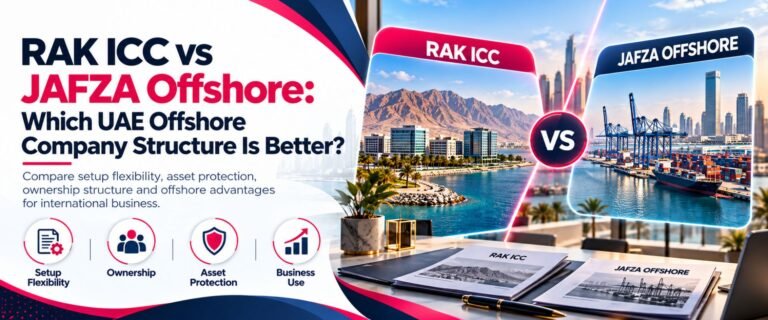
A UAE offshore company is registered with an offshore registrar, the two main ones being RAK ICC (Ras Al Khaimah International Corporate Centre) and JAFZA Offshore (Jebel Ali Free Zone), but it has no physical presence, no trade licence, and no UAE address. It is a non-resident entity incorporated under UAE law, used primarily for international holding and structuring purposes.
The right use cases for an offshore company include:
- Holding company structures: owning shares in other UAE or foreign companies through a single entity, simplifying group ownership and cross-border transactions
- Asset protection: placing real estate, intellectual property, or financial assets in a ring-fenced entity separate from the individual’s personal estate
- Real estate ownership: JAFZA Offshore is the only UAE offshore entity that can directly hold Dubai freehold property — a significant planning tool for high-net-worth property investors
- International trading without UAE operations: a company that contracts internationally but has no employees or office in the UAE, and does not need to invoice local customers
- Succession and estate planning: using a UAE offshore structure to manage the transmission of assets across generations, particularly for families with cross-border wealth
The offshore company formation in Dubai process through DIAC covers both RAK ICC and JAFZA Offshore registrations. The choice between the two registrars typically comes down to whether you need Dubai freehold property ownership (JAFZA) or prefer RAK ICC’s lower costs and flexible corporate structuring options.
What an offshore company cannot do is equally important: it cannot sponsor UAE residence visas, it cannot rent office space or operate from a UAE address, and it cannot hold a UAE trade licence. If any of these are requirements, a free zone company, or a mainland entity, is the correct structure.
Cost: Free Zone vs Offshore Fees
Cost comparison between a free zone company and an offshore company is more nuanced than it first appears. The headline figures suggest offshore is cheaper, and it often is in year one. But the full picture depends on what the company is used for and what services are bundled in.
| Cost Item | Free Zone Company | Offshore Company |
| Formation / licence fee | AED 12,000 — 50,000+ (zone-dependent) | AED 10,000 — 20,000 |
| Annual renewal | AED 8,000 — 30,000+ | AED 5,000 — 12,000 |
| Office / flexi-desk | AED 3,000 — 15,000+ (mandatory) | Not required |
| Registered agent fee | Not applicable | AED 3,000 — 8,000 (mandatory) |
| Visa (per person) | AED 3,500 — 5,500 | Not available |
| Establishment card | AED 450 | Not applicable |
| CT registration | Required (mandatory for all) | Required (mandatory for all) |
| Est. Year 1 (solo) | AED 20,000 — 35,000 | AED 15,000 — 28,000 |
Note: Costs are estimates. Free zone costs vary significantly by zone and package. Offshore costs depend on registrar and registered agent services selected.
The key cost difference is the registered agent fee: offshore companies in the UAE require a registered agent (a licenced UAE firm that handles government filings and maintains the registered address on the company’s behalf). This is a mandatory and recurring cost that free zone companies do not have. Meanwhile, free zone companies must pay for a physical or flexi-desk office address, which offshore companies do not need.
For a solo operator who wants only a holding vehicle, the offshore structure can be AED 5,000 to AED 10,000 cheaper per year than a comparable free zone setup. For a business that needs visas, banking, and an active trade licence, the offshore structure does not serve the need at all regardless of cost. Budget-conscious entrepreneurs can also look at the cheapest free zone options in the UAE to find structures that are comparably priced to offshore while still offering operating capability.
Bank Account: Can Offshore Companies Open UAE Accounts?
This is one of the most important practical differences between the two structures, and one that catches many investors off guard.
Free Zone Company Banking
A UAE free zone company can open a corporate bank account with UAE banks. The process has become more selective in recent years due to anti-money laundering (AML) and know-your-customer (KYC) compliance requirements across the banking sector, but it is a standard and achievable process. Most corporate bank account opening in Dubai takes two to six weeks from initial application, depending on the bank, the nature of the business, and the completeness of the documentation. Banks assess the company’s expected transaction profile, source of funds, business model, and the ultimate beneficial owner’s background.
Free zone companies generally have an easier path to UAE banking because they have a physical registered address, an active trade licence, and a UAE economic presence, all of which satisfy the bank’s primary compliance concerns.
Offshore Company Banking
Offshore companies can open UAE bank accounts, but the experience is more complex and less reliable than for free zone entities. Since an offshore company has no UAE operating presence, no trade licence, and no UAE address, banks must satisfy themselves on source of funds, the purpose of the account, and the beneficial owner’s background through enhanced due diligence (EDD) rather than the standard KYC process.
In practice, this means that some UAE banks decline to open accounts for offshore entities outright, while others will do so under stricter conditions (higher minimum balances, more documentation, longer review periods). Many offshore company owners in the UAE instead bank with international financial institutions, particularly in Singapore, Switzerland, the UK, or EU jurisdictions — where the offshore structure is well-understood and the account-opening process is more predictable.
If regular UAE banking access is a business requirement, a free zone company is almost always the better structural choice.
Visas: Free Zone Has Them; Offshore Does Not
This is the clearest and most absolute difference between the two structures. UAE offshore companies cannot sponsor UAE residence visas — investor visas, employee visas, or dependent family visas. This is a non-negotiable feature of the offshore model: the entity has no UAE presence, so it has no standing to introduce residents into the UAE immigration system.
Free zone companies, by contrast, are a primary route to UAE residency for foreign nationals. A free zone company owner can apply for a UAE investor visa through their free zone, which grants a two-year renewable residence permit. Employees can also be sponsored on standard employment visas. The number of visas a free zone company can issue depends on the zone’s quota rules and the size of the office package, a flexi-desk typically covers one to three visas, while a physical office unlocks more.
For investors who want UAE residency alongside their business structure, the choice is straightforward: a free zone company is required. Offshore-only investors who subsequently need UAE residency often find themselves forming a second entity — a free zone company — specifically to obtain the visa, which means paying for two structures rather than one.
High-net-worth individuals should also consider the UAE Golden Visa route, which provides a ten-year renewable residence visa and can be obtained through property investment, business ownership, or professional achievement without necessarily requiring an active free zone company.
Compliance: What Both Structures Require
A common misconception — particularly among first-time investors, is that offshore companies exist outside the UAE’s regulatory perimeter. This is not the case. Both free zone and offshore companies are subject to a set of UAE-wide compliance obligations that are increasingly stringent and internationally aligned.
Corporate Tax Registration
The UAE Corporate Tax (CT) framework, which came into effect in financial years starting on or after 1 June 2023, applies to all UAE-incorporated entities. This includes offshore companies. CT registration with the Federal Tax Authority (FTA) is mandatory for all entities, regardless of revenue or whether any profit is earned. Failure to register on time carries penalties starting from AED 10,000.
The 9% tax rate applies to taxable profits above AED 375,000. Free zone companies that meet the Qualifying Free Zone Person (QFZP) criteria — including maintaining economic substance, earning qualifying income, and limiting non-qualifying mainland revenue — may be taxed at 0% on qualifying income. Offshore companies follow the same framework: if their income is qualifying (for instance, dividends from subsidiaries or capital gains on qualifying shareholdings), the 0% rate applies; if it is not, the 9% rate applies above the threshold.
Ultimate Beneficial Owner (UBO) Registration
Both free zone and offshore companies in the UAE must file UBO information, identifying the natural persons who ultimately own or control the company — with the relevant authority. For free zone companies, this is typically filed with the free zone authority. For offshore companies under RAK ICC, UBO filings must be made within 60 days of incorporation and updated within 15 days of any ownership change. The obligation applies regardless of whether the company has a UAE address or generates UAE income.
Economic Substance Regulations (ESR)
Entities that carry out “relevant activities”, including holding company income, intellectual property income, banking, insurance, fund management, or headquarters functions, must demonstrate economic substance in the UAE. This means having real decision-making, adequate employees, and qualifying expenditure within the UAE. Offshore holding companies that receive dividends or hold IP frequently fall within ESR scope and must file annually. Non-compliance carries significant penalties.
The compliance burden for an offshore company is not lower than for a free zone company, in many cases it is higher, because the holding income categories that offshore vehicles are used for are precisely those that attract ESR scrutiny.
When to Choose Each Structure
Having covered each dimension individually, here is how the decision resolves in practice:
Choose a Free Zone Company When:
- You need to operate a business actively, deliver services, sell products, or trade, and want a UAE address on your invoices and contracts
- You need UAE residence visas for yourself, your partners, or your employees
- You need a UAE corporate bank account for day-to-day business transactions
- You are a consultant, freelancer, or small business owner who wants a cost-effective Dubai or UAE base, IFZA free zone company formation starts below AED 13,000 all-in for the first year
- Your business involves general trading, e-commerce, technology services, media, or any sector where an active trade licence is needed
- You want to eventually expand into the UAE mainland or hire locally — a free zone entity can add a mainland branch later more easily than converting from offshore
Choose a UAE Offshore Company When:
- Your primary purpose is to hold shares in other companies, own investments, or protect assets, not to trade or deliver services
- You want to hold UAE real estate through a corporate structure, particularly Dubai freehold property, which JAFZA Offshore can hold directly
- You operate internationally and do not need or want a UAE operating presence, no office, no staff, no local customers
- You are structuring a group of companies and need a clean UAE-law holding vehicle at the top of the structure
- You have no requirement for UAE residence visas and your banking can be done outside the UAE
- You want to hold intellectual property or manage royalty income through a UAE entity
Use Both Structures Together
Many sophisticated investors use both structures in combination: an offshore holding company sits at the top of the group, owning shares in one or more free zone operating companies. The free zone companies hold the trade licences, employ staff, and invoice clients. The offshore company collects dividends and manages the investment portfolio. This is a common structure for investors who want both operational UAE presence and a clean holding layer.
If this kind of group structure is what you are building, discussing it early with a formation specialist avoids costly structural mistakes. The offshore company formation in Dubai service page covers both RAK ICC and JAFZA options in detail.
Frequently Asked Questions
Is a UAE offshore company the same as a tax haven company?
No. A UAE offshore company is incorporated under UAE law, is subject to UAE federal tax (corporate tax registration is mandatory), and must comply with UAE UBO disclosure requirements. It is not a secretive or unregulated structure. The UAE has been removed from major international grey and blacklists specifically because it has implemented global transparency standards. An offshore company in the UAE is best understood as a non-resident holding vehicle — not a mechanism to avoid taxation. The official UAE Federal Tax Authority guidance applies to all UAE entities including offshore companies.
Can a UAE offshore company invoice and receive payments?
A UAE offshore company can issue invoices and receive payments for international transactions — contracts where both parties are outside the UAE and the services or goods are not delivered within the UAE. What an offshore company cannot do is hold a UAE trade licence, advertise as a UAE business, or have customers walk into a UAE office. If you need to invoice UAE-based clients directly, a free zone company with an active trade licence is the correct structure.
What is the difference between RAK ICC offshore and JAFZA offshore?
RAK ICC (Ras Al Khaimah International Corporate Centre) and JAFZA Offshore (Jebel Ali Free Zone) are the two main offshore registrars in the UAE. RAK ICC is generally lower in cost and offers more flexible share structures, making it popular for group holding and international structuring. JAFZA Offshore is more expensive but uniquely allows the offshore entity to directly own Dubai freehold real estate — the only offshore vehicle with this capability. For property investors who want a corporate ownership structure for Dubai real estate, JAFZA is the relevant choice.
Can I convert a free zone company into an offshore company or vice versa?
Not directly. The two structures are registered under different authorities and serve different purposes. Converting between them would require dissolving one entity and incorporating the other from scratch. If you find that your free zone company is not being used operationally and you only need it as a holding vehicle, the more practical path is often to maintain the free zone entity for as long as it is economical, then make a planned transition rather than a costly dissolution and re-registration.
Do I need a UAE address to form an offshore company?
No. You do not need a UAE address to form a UAE offshore company. The registered agent handles the official correspondence address on your behalf. You can be based anywhere in the world and still incorporate a UAE offshore company remotely. This is one of the structural features that makes offshore entities attractive to international investors who want a UAE legal entity without needing to be physically present.
Is a UAE offshore company good for holding a UAE free zone company?
Yes, this is a common and legitimate structure. A UAE offshore company (typically RAK ICC) can own shares in one or more UAE free zone operating companies. The offshore vehicle holds the equity, receives dividends, and manages group investment decisions. The free zone companies hold the trade licences, employ staff, and conduct day-to-day operations. This structure is used by investors who want a clean holding layer within UAE law. For group structures involving international operations, comparing this with a company setup in Ras Al Khaimah free zone or an Ajman offshore company may reveal additional planning options.
Can an offshore company be used to hold shares in a mainland UAE company?
This is a more complex area. Historically, UAE mainland companies required a UAE national shareholder, which made offshore holding structures above them complicated. With the 2021 amendments to the UAE Commercial Companies Law, 100% foreign ownership was extended to most mainland sectors. However, the specific shareholding rules for mainland companies and whether an offshore vehicle can sit above them depends on the activity and the relevant licensing authority. Speaking with a specialist before structuring this is advisable. DIAC’s team covers both mainland company formation in Dubai and offshore structures.
Not Sure Which Structure Is Right for You?DIAC’s formation specialists work with free zone companies, offshore structures, and mainland entities across all UAE emirates. They can model the right structure for your sector, tax position, and long-term plans, without pushing a single solution. Get a free consultation at diac.ae or explore UAE offshore company formation options. |
| About the Author
Adil Ahmad is a UAE business formation specialist at DIAC with deep experience in free zone, mainland, and offshore company structures across Dubai, Abu Dhabi, and Ras Al Khaimah. He advises investors and entrepreneurs on the right structural choice for their sector, residency needs, banking requirements, and tax position. |