| Summary
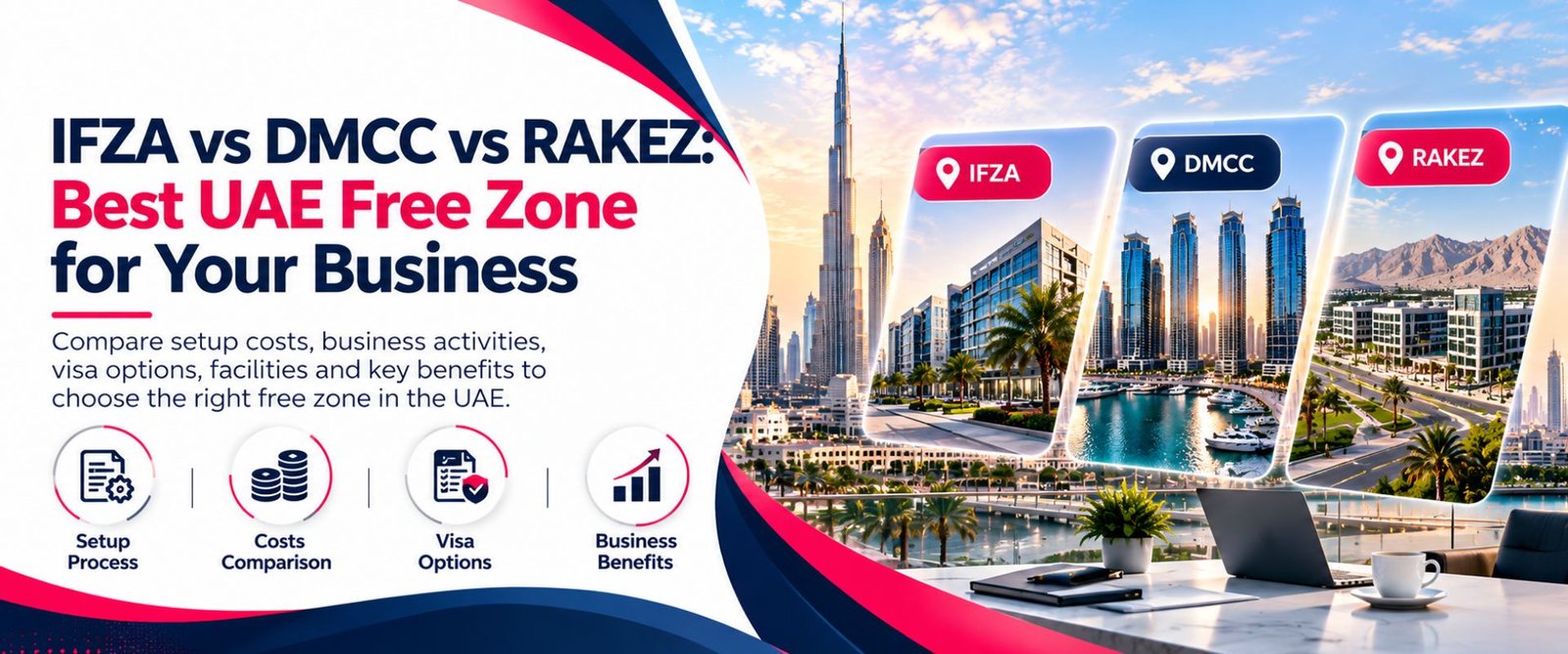
IFZA, DMCC, and RAKEZ are three of the most compared UAE free zones, and they serve very different business profiles. RAKEZ is the most affordable with land and warehouse options. IFZA offers the best value for a Dubai business address. DMCC commands premium pricing but brings unmatched prestige for commodity trading and global commerce. This guide breaks down costs, activities, visa options, and which zone fits each type of business. |
IFZA vs DMCC vs RAKEZ: The Three-Tier Decision
The UAE has over 45 free zones, but three names consistently come up in the same breath when entrepreneurs compare options: IFZA, DMCC, and RAKEZ. They represent three distinct tiers — budget, mid-range, and premium — and they are built for different types of businesses. Picking the wrong one means paying more than you need to, or landing in an ecosystem that does not support your sector or ambitions.
The good news is that the decision framework is straightforward once you understand what each zone is actually designed for. DIAC helps businesses set up across all three zones, which means the comparison here is objective: we are not pushing one zone over another, but showing which choice fits which business.
Here is a quick snapshot before we go deeper:
| Factor | IFZA | DMCC | RAKEZ |
| Location | Dubai (Silicon Oasis) | Dubai (JLT) | Ras Al Khaimah |
| Licence From | AED 12,500 | AED 31,000+ | AED 6,500 |
| Cost Tier | Mid-range | Premium | Budget |
| Prestige / Address | Good Dubai address | World-class brand | RAK address |
| Best Sector | Services, startups, SME | Commodities, trading | Industrial, mfg |
| Activities / Licence | Up to 10+ per licence | 1-3 typically | Sector-specific |
| Office Required? | Flexi-desk option | Registered office req. | Flexi to warehouse |
| Setup Timeline | 3-7 working days | 7-14 working days | 3-7 working days |
| 100% Foreign Ownership | Yes | Yes | Yes |
| Corporate Tax (FZ) | 0% qualifying | 0% qualifying | 0% qualifying |
| UAE Visa Eligibility | Yes | Yes | Yes |
| Who Is It For? | Lean startups, consultants | Commodity traders, HNW cos. | Manufacturers, logistics |
Source: Free zone authority data and company formation costs. All figures are estimates; request current official quotes before committing.
A few key principles to hold before reading further: all three zones offer 100% foreign ownership, 0% personal income tax, and the ability to sponsor UAE residence visas. The differences are in cost structure, location, ecosystem, and the type of business activity each zone supports best. Corporate tax at 9% applies to profits above AED 375,000 under the UAE’s federal tax law, though qualifying free zone income may be taxed at 0% if the company meets the Qualifying Free Zone Person criteria.
Cost: IFZA vs DMCC vs RAKEZ — What You Actually Pay
Cost is usually the starting point for any free zone comparison, but the headline licence fee only tells part of the story. First-year total cost depends on the licence fee, visa count, office requirement, and government fees. Here is a realistic breakdown across all three zones:
| Cost Component | IFZA | DMCC | RAKEZ |
| Licence (1 activity) | AED 12,500 – 15,000 | AED 31,000 – 50,000 | AED 6,500 – 12,000 |
| Flexi-desk / Virtual Office | AED 4,000 – 7,000 | AED 15,000 – 25,000 | AED 3,000 – 5,000 |
| Visa (per person) | AED 3,500 – 4,500 | AED 4,000 – 5,500 | AED 3,000 – 4,000 |
| Establishment Card | AED 450 | AED 450 | AED 450 |
| Estimated Year 1 (1 visa) | AED 20,000 – 27,000 | AED 50,000 – 80,000 | AED 13,000 – 21,000 |
Note: Costs are estimates based on standard packages. Multi-visa packages, specialised activities, and premium office tiers change these figures significantly.
RAKEZ: The Budget Tier
RAKEZ consistently offers the lowest entry price among the three zones. Licence fees for a single-activity freelancer or SME package can start below AED 7,000, and the flexi-desk option is cheaper than comparable offerings in Dubai. For businesses where a Ras Al Khaimah address does not affect client perception or business development — such as e-commerce companies, manufacturers, and logistics operators — RAKEZ delivers maximum value. The RAKEZ free zone formation process is fast and well-suited for operators who want a cost-effective UAE entity without overpaying for a Dubai postcode.
IFZA: The Mid-Range Dubai Option
IFZA sits in a strategically important middle ground: it gives you a Dubai business address at a fraction of what premium Dubai free zones charge. Located in Dubai Silicon Oasis, IFZA packages typically start around AED 12,500 for one activity and one visa, with the all-in first-year cost usually landing between AED 20,000 and AED 27,000. For startups, consultants, and service-based SMEs that want a credible Dubai address and a broad activity scope, IFZA free zone company formation is consistently one of the most popular choices in the market. The modular visa structure also means you can start with one or two visas and scale as the team grows.
DMCC: The Premium Tier
DMCC is in a different league for cost — and for what it delivers. Licence fees start around AED 31,000 and can reach AED 50,000 or more depending on the activity, especially for regulated or commodity-specific licences. First-year all-in cost for a single-person operation at DMCC easily reaches AED 50,000 to AED 80,000 once office requirements, registration fees, and visas are included. But DMCC is not overpriced for its target market: it is the world’s most-awarded free zone and is home to over 26,000 member companies, 3,500 of which are in the energy sector alone. For commodity traders, precious metals dealers, and international trading companies that need the DMCC stamp, the premium pays for itself in deal credibility and ecosystem access.
A practical note: if budget is a constraint and a Dubai address is important, exploring the full range of Dubai free zone options before committing to DMCC is worth doing. There are several zones that offer a Dubai address at IFZA-level pricing, depending on your specific activity.
Location and Address Prestige Compared
Location matters differently depending on your business model. For a company that serves international clients via video calls and email, the address on your letterhead rarely becomes a deal-breaker. For a company that hosts client meetings, participates in industry events, or where address perception affects trust and deal flow, the distinction between JLT (DMCC), Dubai Silicon Oasis (IFZA), and Ras Al Khaimah (RAKEZ) is meaningful.
DMCC — Jumeirah Lake Towers, Dubai
JLT is one of Dubai’s most established commercial addresses, sitting between Sheikh Zayed Road and Dubai Marina. DMCC’s headquarters and the entire JLT cluster are recognised globally as a trading and commodities hub. If your clients are multinational commodity traders, energy companies, or precious metals institutions, being a DMCC member carries weight that no other free zone can replicate. The physical proximity to global banks, trading firms, and legal advisers in JLT also has practical value beyond the address itself.
IFZA — Dubai Silicon Oasis
Dubai Silicon Oasis is a technology park in the east of Dubai, well-connected to the rest of the city but not a prime commercial address in the way JLT or DIFC are. For businesses in technology, digital services, consulting, or e-commerce — where the registered address is an administrative detail rather than a business development asset — IFZA’s Dubai address is more than adequate. Clients and bank compliance teams see a Dubai company, which is usually all that matters. The zone also has excellent motorway access and its own residential and commercial infrastructure.
RAKEZ — Ras Al Khaimah
RAK is a separate emirate, approximately 100 kilometres north of Dubai. For businesses that need physical space — warehousing, light manufacturing, industrial plots — RAK’s lower real estate costs and direct access to port and logistics infrastructure make it commercially superior to Dubai. For service businesses or those where the address appears in client communications, a RAK address is perceived as less prestigious than a Dubai one, though this is rarely a blocking factor for B2B or e-commerce companies. RAKEZ spans six specialist clusters covering more than 50 business sectors, including industry, academics, media, and services.
Bottom line on address: if physical location and client-facing prestige matter to your business, DMCC wins in Dubai and IFZA is the cost-effective Dubai alternative. If you need physical space or your address is not client-facing, RAKEZ delivers the best value per square metre.
Activities, Sectors and Licence Scope
The activities your licence covers define what your business can legally do. This is an area where IFZA, DMCC, and RAKEZ differ significantly in both flexibility and specialisation.
IFZA: Broadest Activity Flexibility
IFZA allows multiple business activities under a single licence, which is one of its major advantages over many other free zones. A single IFZA licence can cover trading, consulting, and services activities simultaneously, reducing the need to hold separate licences for different revenue streams. This flexibility makes IFZA particularly attractive for:
- Startups and solo entrepreneurs who want to test multiple revenue streams
- E-commerce and online business setups that combine trading and services
- Consultants and management consulting companies who provide services across multiple disciplines
- Digital marketing agencies, fintech companies, and technology services businesses
- General trading companies looking for a Dubai-based entity at competitive cost
IFZA does not suit regulated financial activities (you need DIFC or ADGM for that), manufacturing (no warehouse or land), or commodity-specific trading that benefits from the DMCC ecosystem.
DMCC: Specialised Commodity and Trading Ecosystem
DMCC’s activity scope is centred on commodities, trading, and financial services, with deep integration into global commodity markets. The zone has purpose-built infrastructure for:
- Precious metals (gold, silver, platinum) trading and vaulting
- Diamonds and gemstones trading under the DMCC Diamond Exchange
- Energy commodities, including crude oil and LNG — particularly relevant for those setting up a general trading company in Dubai
- Agricultural commodities: coffee, tea, cocoa, spices
- Crypto and Web3 businesses — DMCC has an active crypto centre, though for regulated crypto activity the DIFC crypto licence under VARA is the preferred regulatory route
DMCC’s main limitation is cost and scope. If your business is in services, consulting, or technology without a commodity angle, you are paying DMCC’s premium pricing for a commodity-trading ecosystem that does not add value to your operations.
RAKEZ: Industrial and Multi-Sector Clusters
RAKEZ is structured around six specialised clusters: Academies, Business, Industrial, Media and Entertainment, Services, and Wellness. This cluster model means the zone can accommodate an unusually wide range of activities, from academic institutions to heavy manufacturing. Key sectors include:
- Manufacturing and industrial: Light-to-heavy manufacturing, food processing, chemical production
- Trading and logistics: General trading, import/export, and warehouse-based operations with access to Ras Al Khaimah port connections
- Media and creative: Broadcasting, film production, digital media — an alternative to Dubai Media City for budget-conscious operators
- Education and training: One of the few UAE free zones that issues licences for educational institutions and academic programmes
- E-commerce: RAKEZ has actively courted e-commerce businesses in Dubai and the UAE with dedicated packages and flexible warehouse options
RAKEZ added close to 19,000 new companies in a recent 12-month period, reflecting its appeal to cost-conscious entrepreneurs across many sectors. Its limitations are address prestige (RAK vs Dubai) and the absence of a specialised financial or commodity ecosystem.
Visa Packages and Office Options
UAE residence visas are one of the primary reasons entrepreneurs form a free zone company. All three zones offer investor visas and employment visas, but the packages, quota structures, and physical office requirements differ.
Visa Quota and Cost Comparison
The following summarises how visa access works in each zone:
| Visa Factor | IFZA | DMCC | RAKEZ |
| Investor Visa (2-year) | Included in most packages | Available, application-based | Available, cost-effective |
| Employee Visa Quota | Based on office package | Based on office/registered capital | Based on package tier |
| Visa Cost Per Person | AED 3,500 – 4,500 | AED 4,000 – 5,500 | AED 3,000 – 4,000 |
| Dependent / Family Visa | Yes (after investor visa) | Yes | Yes |
| Freelancer/Self-employed | Yes (IFZA freelance pkg) | No specific freelance package | Yes (freelance zone) |
Office Requirements
Office requirements affect both cost and operational flexibility:
- IFZA: A flexi-desk (shared workspace) is the standard starting option and is included in most packages. This keeps first-year costs low and suits solo operators or small remote teams. Physical office space is available if needed.
- DMCC: DMCC requires a registered office address as a minimum, and most serious operations take a physical office in the JLT towers. Flexi-desk options exist but are generally more expensive than IFZA. DMCC’s workspace requirements are more stringent, reflecting its positioning as a corporate-grade free zone.
- RAKEZ: RAKEZ offers the widest range of physical footprints: from virtual offices and flexi-desks to industrial plots, warehouses, and factory units. This makes it uniquely suited to businesses that need space at a cost that Dubai zones cannot match. Manufacturing businesses and logistics operators particularly benefit from RAKEZ’s land allocation options.
For an entrepreneur setting up a general trading company or a consulting business, the flexi-desk option in IFZA or RAKEZ keeps overhead low in the first year. As the business grows and requires a larger visa quota, a physical office unlocks higher employee counts without requiring a zone transfer.
Which Is Right for You? Decision by Business Profile
Rather than declaring a single winner — which would be misleading — the most useful framework is matching the zone to the business profile. Here is how the decision breaks down across the most common scenarios:
| Business Profile | IFZA | DMCC | RAKEZ |
| Startup / Solo Consultant | Best choice (cost + Dubai address) | Overkill for most | Good if budget is critical |
| E-commerce / Trading SME | Strong fit (wide activity list) | Consider for premium positioning | Viable if RAK suits clients |
| Commodity Trader | Limited ecosystem | Clear winner (DMCC community) | Not ideal |
| Manufacturer / Industrial | No warehouse / land option | Not suited | Clear winner (land + port) |
| Fintech / Digital Finance | Possible (non-regulated) | DIFC better (regulated) | Not suited |
| Media / Creative | Flexible activity scope | Possible via DMCC | RAKEZ media cluster option |
This matrix is a starting point. Specific activity codes, visa requirements, and client expectations can shift the optimal choice.
Profile A: Startup, Consultant, or Service Business
For a solo entrepreneur, freelancer, or small services firm with fewer than five employees, IFZA is usually the best balance of cost, flexibility, and Dubai address credibility. The all-in first-year cost is manageable, the activity scope is broad, and the setup process is among the fastest in the UAE. If budget is the single overriding factor and a Dubai address is not essential, RAKEZ offers even lower costs — but the trade-off on address perception is real for client-facing businesses.
Consultants setting up a consultancy licence in Dubai often find that IFZA provides everything they need at a price that makes sense, especially in the first year when cash flow is tight.
Profile B: E-commerce, Trading, or General Business
E-commerce companies, general trading businesses, and import/export operators benefit from IFZA’s broad activity scope and Dubai address. RAKEZ is a credible alternative — particularly if the business needs warehouse space or if the customer base is not sensitive to the emirate of registration. DMCC is worth considering only if the trading activity specifically involves commodities that benefit from the DMCC exchange and community infrastructure.
For online sellers and dropshipping businesses in Dubai, IFZA and RAKEZ both offer suitable structures. The choice often comes down to whether the business will eventually need Dubai banking relationships that are easier to establish with a Dubai-registered company.
Profile C: Commodity Trader or Specialised Finance
If your business trades in gold, silver, diamonds, energy commodities, or agricultural goods, DMCC is the right choice — not because of the address, but because of the ecosystem. Being a DMCC member gives access to the DMCC commodity exchange, specialist compliance services, recognised counterparty standards, and a community of 26,000+ companies that includes the world’s leading commodity trading houses. Gold trading licence in Dubai applicants, in particular, should default to DMCC unless they have specific reasons to set up elsewhere.
Profile D: Manufacturer, Industrial, or Logistics Company
Manufacturing and industrial businesses should consider RAKEZ first. Dubai free zones — including DMCC and IFZA — either do not offer industrial land and warehouse units or charge significantly more per square metre than RAK. RAKEZ is directly connected to Ras Al Khaimah’s port infrastructure and has established clusters for manufacturing, processing, and logistics. For businesses starting a logistics company in the UAE or a manufacturing operation, RAKEZ’s cost per square metre and port access make it the most commercially logical base.
Banking Access and Corporate Tax: What You Need to Know
Two practical factors, banking and tax, often decide whether a free zone choice is viable for international operations.
Corporate Bank Account Opening
UAE bank account opening has become more selective in recent years. All three zones can support corporate bank account opening in Dubai, but the experience varies. DMCC has the strongest established banking relationships: most major UAE banks and international financial institutions are familiar with DMCC entities and treat them with a higher baseline of credibility. IFZA is well-recognised by UAE banks and is generally straightforward to bank with. RAKEZ companies can open accounts but may face more questions, particularly from banks that are less familiar with the RAK jurisdiction.
The type of activity also matters: commodity traders and financial services businesses face more compliance screening than consulting or services companies, regardless of which free zone they are in.
UAE Corporate Tax and Free Zones
The UAE corporate tax of 9% on profits above AED 375,000 applies across all free zones, including IFZA, DMCC, and RAKEZ. Companies that qualify as Qualifying Free Zone Persons (QFZPs) under the law can benefit from a 0% rate on qualifying income. The key criteria include maintaining adequate economic substance in the UAE, not earning income from UAE mainland sources that exceeds 5% of total revenue or AED 5 million (whichever is lower), and complying with transfer pricing documentation requirements.
This framework is the same regardless of whether your company is in IFZA, DMCC, or RAKEZ. The zone does not affect your tax status — your business structure, income composition, and compliance posture do. For companies with significant mainland UAE clients, consulting a UAE-based accounting and bookkeeping firm to model the tax implications before formation is advisable.
Frequently Asked Questions
Is IFZA better than RAKEZ?
It depends on what you need. IFZA gives you a Dubai address, broader activity flexibility, and strong recognition from UAE banks — at a higher cost than RAKEZ. RAKEZ is better value if a RAK address works for your business, you need industrial space or warehousing, or you want the lowest possible first-year cost. For a service business or consultant that wants Dubai credibility, IFZA is the better choice. For a manufacturer or logistics operator, RAKEZ free zone company formation is usually more practical and cost-efficient.
Can I set up a commodity trading company in IFZA instead of DMCC?
You can set up a general trading company in IFZA, and it can cover a wide range of goods. However, if your business specifically trades regulated commodities — gold, diamonds, energy products — the DMCC ecosystem, exchange infrastructure, and counterparty credibility make DMCC the more suitable choice. Most serious commodity traders operating at volume choose DMCC even with the higher cost, because the ecosystem adds commercial value that IFZA cannot replicate.
Which is the cheapest UAE free zone among IFZA, DMCC and RAKEZ?
RAKEZ is the most affordable of the three, with licence fees starting below AED 7,000 for some activity types. IFZA is the most cost-effective option for a Dubai address, with all-in first-year costs typically between AED 20,000 and AED 27,000 for a single-visa setup. DMCC is the most expensive, with first-year costs commonly reaching AED 50,000 to AED 80,000 or more depending on the office and activity tier.
Does RAKEZ allow 100% foreign ownership?
Yes. RAKEZ, like all UAE free zones, allows 100% foreign ownership with no requirement for a UAE national partner or sponsor. This applies to IFZA and DMCC as well. The 100% foreign ownership rule in UAE free zones has been in place since the zones were established and is a core feature of the free zone model.
Can a RAKEZ or IFZA company do business on the UAE mainland?
Free zone companies, including RAKEZ and IFZA, are generally restricted from trading directly with UAE mainland customers without a mainland distributor or agent arrangement. If you need to sell to local UAE customers without restriction, a mainland company formation in Dubai or a mainland branch of your free zone company is the proper structure. A free zone entity can still service overseas clients and deliver digitally to mainland customers in many cases, but the rules depend on the specific activity.
How long does it take to set up a company in IFZA vs DMCC vs RAKEZ?
IFZA and RAKEZ are among the fastest free zones to set up in, with initial licence approvals often in three to five working days and full company establishment (including visas) in seven to fourteen days. DMCC typically takes longer due to more detailed compliance and due diligence requirements — expect seven to fourteen days for the licence and additional weeks if regulated activities are involved.
Can I get a UAE residence visa through a RAKEZ company?
Yes. A RAKEZ company allows the owner and employees to apply for UAE residence visas (investor visa and employment visas). The UAE investor visa from a free zone company is a standard two-year renewable visa. The number of visas your company can sponsor depends on the office package and the number of registered employees. Visa processing through RAKEZ follows the same federal government procedures as any other UAE free zone.
| Not Sure Which Free Zone to Choose?
DIAC’s formation specialists work with IFZA, DMCC, RAKEZ, and over 20 other UAE free zones. They compare real costs, activity lists, and visa options for your specific business — without pushing one zone over another. Get a free comparison at diac.ae or explore Dubai free zone setup options. |
| About the Author
Adil Ahmad is a UAE business formation specialist at DIAC. He advises entrepreneurs, SMEs, and multinational companies on free zone selection, licence structure, and company registration across Dubai, Abu Dhabi, and Ras Al Khaimah. His approach focuses on matching the right jurisdiction to each client’s sector, budget, and long-term growth plan. |