| Article Summary
Starting an online business in Dubai requires a valid UAE trade license even for fully digital operations. You can choose between a free zone e-commerce license, a mainland DED license, or a freelance permit depending on your model. This guide covers every license type, the best free zones for online businesses, VAT obligations, payment gateway setup, and the full step-by-step process from registration to first sale. |
Dubai is one of the most digitally connected cities in the world, with internet penetration above 99 percent, a population that shops online at rates comparable to Western Europe, and a government that has made digital business infrastructure a national priority. For entrepreneurs looking to build an online business, UAE company formation offers a combination of low tax, fast setup, and access to a genuinely international market that very few other jurisdictions can match.
But starting an online business in Dubai is not the same as simply launching a website. The UAE requires every commercial operation, including fully digital businesses, to hold a valid trade license. Running an online store, a SaaS product, a digital consultancy, or a dropshipping operation without a UAE license exposes you to fines and the inability to open a UAE business bank account or payment gateway. This guide covers the full picture: which license you need, which free zone suits your business model, what it costs, and every step from registration to your first sale.
For a full overview of all UAE company formation options, start at our UAE business setup where our consultants are available for a free initial discussion.
Do You Really Need a License to Run an Online Business in Dubai?
The answer is yes, and it is worth addressing this directly because many online entrepreneurs assume that a digital or borderless business does not require local licensing.
Under UAE commercial law, any business activity generating income from or within the UAE requires a valid trade license. This applies regardless of whether you sell physical products or digital services, whether your customers are in Dubai or overseas, and whether you operate from a physical office or entirely from your laptop. The UAE has no grey zone for unlicensed digital businesses.
The practical consequences of operating without a license:
- UAE banks will not open a corporate current account without a valid trade license
- Payment gateways (Stripe, PayTabs, Telr, Network International) require a UAE trade license for merchant account setup
- You cannot legally issue UAE VAT invoices, which excludes you from B2B sales to UAE corporate clients
- Fines for unlicensed commercial activity range from AED 5,000 upward, plus potential business closure orders
- You cannot sponsor employee or investor residence visas without a licensed entity
| The good news: Getting licensed is faster and cheaper than most online entrepreneurs expect. UAE free zone e-commerce and digital business licenses start from around AED 5,750 per year for certain zones. The process can be completed in under a week with a competent business setup consultant. |
Types of Online Business Licenses in UAE
The UAE does not issue a single universal online business license. Your license type depends on your business model: what you sell, how you sell it, and whether you need physical premises or a virtual setup.
E-Commerce License
An e-commerce license is the most common choice for businesses selling physical products online. It authorises you to operate an online store, sell goods through a website or marketplace (Amazon UAE, Noon), and accept online payments. Both mainland DET and multiple free zones issue e-commerce licenses. The dedicated Dubai CommerCity free zone is purpose-built for cross-border e-commerce and offers warehousing, last-mile delivery integration, and customs facilitation alongside the license.
E-commerce license suits:
- Online retail stores selling physical goods (fashion, electronics, beauty, supplements)
- Dropshipping businesses (goods shipped directly from supplier to customer)
- Amazon FBA and Noon seller businesses with UAE-based entity
- Subscription box and direct-to-consumer product businesses
- Marketplace and platform businesses connecting buyers and sellers
Digital Services License
For businesses that sell purely digital products or services, a digital services or professional consultancy license is more appropriate than an e-commerce license. This covers SaaS products, online education, digital marketing services, software development, and similar activities.
Digital services license suits:
- SaaS and software products
- Online courses and digital education platforms
- Digital marketing agencies (SEO, social media, performance marketing)
- Web development and design studios
- App development and mobile technology companies
- Content creation and influencer businesses
- Online consulting and coaching services
Freelance Permit
For solo digital professionals who are not yet ready to form a full company, several UAE free zones offer a freelance permit: a personal work authorisation that includes a UAE residence visa and the legal right to bill clients without a corporate entity. Zones offering freelance permits include IFZA, DMCC, twofour54 (for creative professionals), and Dubai Media City. Our UAE free zone company formation guide covers the freelance permit option in each major zone.
Freelance permit suits:
- Individual consultants, writers, designers, or marketers billing under their own name
- Professionals wanting UAE residency without the cost of a full company setup
- Transitional setups for entrepreneurs testing the UAE market before committing to a company
| Key limitation: A freelance permit does not create a separate legal entity. You cannot have shareholders, issue company shares, or bring in investors. Once you need to hire staff, take on investors, or structure for scale, a full company license is required. |
Best UAE Free Zones for Online Businesses
Choosing the right free zone is one of the most consequential decisions for an online business setup in Dubai. The right zone affects your license cost, visa allocation, credibility with banks, and operational flexibility. Here is how the most relevant options compare.
| Free Zone | Best For | Starting Cost (AED/yr) | Key Advantage |
| IFZA (IFZA Business Park) | SaaS, consulting, digital services, e-commerce | From 12,900 | Lowest all-in cost; most bank-friendly for SMEs |
| DMCC (Dubai Multi Commodities) | Trading, fintech, commodity-related e-commerce | From 18,000 | Prestigious address; DIFC-adjacent ecosystem |
| Dubai CommerCity | Cross-border e-commerce, online retail | From 15,000 | Purpose-built e-commerce; integrated fulfilment |
| SHAMS (Sharjah) | Freelancers, media, digital content | From 5,750 | Lowest-cost license in UAE; good for solos |
| Dubai Silicon Oasis (DSO) | Tech startups, app developers, SaaS companies | From 14,000 | Tech ecosystem; developer-friendly community |
| Meydan Free Zone | General online business, consulting | From 12,500 | Flexible packages; Dubai address |
| RAKEZ (Ras Al Khaimah) | Budget setups, trading, general business | From 7,500 | Most affordable with UAE bank-friendly structure |
| Honest guidance: The cheapest license is not always the best choice. Banks in the UAE assess free zone prestige when opening corporate accounts. SHAMS and RAKEZ licenses are occasionally declined by tier-1 UAE banks (Emirates NBD, FAB) at higher rates than IFZA or DMCC entities. For online businesses that need a UAE corporate bank account urgently, IFZA or DMCC typically offer the smoothest banking experience for new entities. |
Mainland vs Free Zone: Which Is Better for an Online Business?
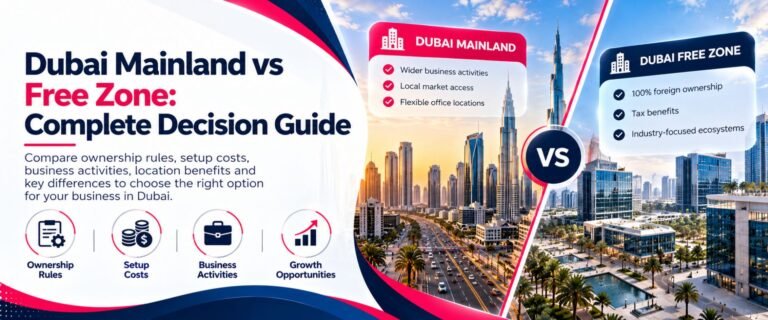
Most online businesses in the UAE set up in a free zone for the lower cost, faster formation, and simpler compliance requirements. But mainland setup through the Department of Economy and Tourism (DET) has real advantages for certain online business models. Our mainland company formation in Dubai guide covers the mainland process in full.
| Factor | Free Zone Online Business | Mainland Online Business (DET) |
| Setup speed | 1 to 5 working days | 5 to 15 working days |
| Cost (entry level) | AED 5,750 to 20,000/yr | AED 10,000 to 20,000/yr (excl. office) |
| UAE market access | Via distributor or marketplace only for physical goods | Direct: sell to any UAE customer or business |
| Government contracts | Not eligible (most tenders) | Eligible for UAE government procurement |
| Office requirement | Flexi-desk or virtual address accepted | Physical office required (Ejari mandatory) |
| VAT registration | Required above AED 375k taxable supplies | Required above AED 375k taxable supplies |
| Banking experience | Slightly harder for some zones; manageable | Generally smooth with most UAE banks |
| Foreign ownership | 100% always | 100% in most activities post-2021 reforms |
The practical rule: if your online business sells exclusively to international customers, content audiences, or B2B clients outside the UAE, a free zone is almost always the right choice. If you are building an online business specifically for UAE consumers, or you want to supply UAE businesses or government entities directly, a mainland DET license gives you unrestricted market access that a free zone cannot.
UAE VAT for Online Businesses
Value Added Tax (VAT) at 5 percent applies to most commercial transactions in the UAE, including online sales. Understanding your VAT obligations before you start operating will save you significant compliance headaches later. The full details are covered in the UAE Federal Tax Authority guidance, but here is what matters most for online businesses.
When VAT Registration Is Mandatory
- Your taxable supplies and imports exceed AED 375,000 in any 12-month period: mandatory VAT registration
- Your taxable supplies exceed AED 187,500 but are below AED 375,000: voluntary VAT registration is possible and often beneficial for B2B businesses
- Below AED 187,500: VAT registration is not required, but you cannot charge or reclaim VAT
VAT and Cross-Border Digital Services
For online businesses selling digital services to UAE customers from a UAE entity, standard 5% VAT applies. For businesses exporting digital services to overseas customers, the supply is typically zero-rated (0% VAT applies, meaning you can still reclaim input VAT on your UAE costs). Physical product exports are also zero-rated.
VAT and E-Commerce Platforms
If you sell through third-party marketplaces (Amazon UAE, Noon), the platform may be responsible for collecting and remitting VAT on your behalf under the UAE’s e-commerce VAT rules. Confirm with your marketplace whether they are acting as a deemed supplier for VAT purposes, as this affects your own VAT reporting obligations.
| VAT tip for new online businesses: Register for VAT voluntarily from day one if you are a B2B service business. UAE corporate clients expect to receive VAT-compliant tax invoices and will often ask for your TRN (Tax Registration Number) before paying you. Being registered also allows you to reclaim the 5% VAT you pay on your own UAE business costs. |
Payment Gateways and Banking for UAE Online Businesses
Two of the most common pain points for online business founders in Dubai are getting a corporate bank account and setting up a payment gateway that accepts international cards. Here is the honest picture.
UAE Corporate Bank Account
All major UAE banks require a valid trade license before opening a corporate current account. The account opening process typically takes four to eight weeks and involves a detailed KYC (Know Your Customer) review. Documents typically required include your trade license, memorandum of association, shareholder passports and Emirates IDs, a business plan or website description, and sometimes evidence of initial business activity or existing client contracts.
The banks most accessible for new online business entities:
- Wio Bank: UAE’s first platform bank, fully digital, specifically designed for SMEs and freelancers. Fastest account opening (often under two weeks). No minimum balance requirement.
- Mashreq NeoBiz: Digital business account from Mashreq. Streamlined KYC for online businesses. Competitive on fees.
- Emirates NBD: Largest UAE bank; preferred by clients wanting the most recognised brand. More rigorous KYC but strong international correspondent banking relationships.
- ADCB and FAB: Good options for free zone entities with clean documentation. Strong for businesses banking in multiple currencies.
Payment Gateways
For accepting online payments from customers worldwide, the most widely used payment gateways for UAE-based online businesses are:
- Stripe UAE: Now available for UAE entities with a UAE trade license and local bank account. Best-in-class developer experience. Accepts cards from 190+ countries.
- PayTabs: UAE-founded gateway with strong local support. Good for Arabic-market businesses, subscription billing, and B2B invoicing.
- Telr: Popular for e-commerce stores. Integrates with Shopify, WooCommerce, and Magento. Supports Apple Pay and Google Pay.
- Network International: UAE’s largest payment processor. Preferred by larger e-commerce operations. Strong acquiring relationships with UAE banks.
- Amazon Payment Services: Formerly Payfort. Best choice for Amazon UAE marketplace sellers and businesses with significant GCC customer bases.
All of the above require a valid UAE trade license and an active UAE corporate bank account to apply. This is the primary reason that getting licensed and banked quickly matters for online businesses: without both, you cannot legally accept card payments from UAE or international customers through these gateways.
Step-by-Step: How to Start an Online Business in Dubai
Here is the complete process from initial decision to fully operational online business with a UAE license, bank account, and payment gateway.
- Choose your business model and confirm which license type applies: e-commerce (physical goods), digital services, or professional consultancy
- Select your jurisdiction: free zone (faster and cheaper) or mainland DET (full UAE market access)
- Choose your free zone if applicable: compare cost, banking reputation, and visa allocation for your team size
- Reserve your company name and submit the initial registration application
- Prepare and submit shareholder documentation: passport copies, address proof, business plan, source of funds
- Receive trade license and company registration certificate (typically 1 to 5 working days for most free zones)
- Apply for UAE residence visa on your new company license (if you are relocating to the UAE)
- Open a UAE corporate bank account: prepare your full documentation pack and apply simultaneously with visa processing to save time
- Register for UAE VAT with the Federal Tax Authority if your projected turnover exceeds AED 187,500
- Apply for your payment gateway merchant account once your bank account is confirmed active
- Launch your online store, website, or digital platform with your UAE TRN number displayed as required by law
| Timeline reality: Steps 1 to 7 (license in hand and visa applied) take approximately two to four weeks. Steps 8 to 10 (bank account and payment gateway live) add another four to eight weeks depending on the bank. Plan your launch timeline around the bank account opening, as this is consistently the longest step in the UAE online business setup journey. |
Online Business Ideas That Work in Dubai
Not every online business model performs equally in the UAE market. Here are the categories with proven traction among Dubai-based online entrepreneurs, based on DIAC’s experience working with hundreds of e-commerce and digital business founders.
High-Performing Online Business Categories in UAE
- E-commerce: fashion and apparel: The UAE has one of the highest online fashion spend rates per capita in the world. Localised sizing, modest fashion, and luxury accessible brands all perform strongly.
- Health and wellness products: Supplements, fitness equipment, skincare, and personal care products have seen consistent double-digit growth in UAE e-commerce.
- Food delivery and meal kits: Dubai’s appetite for convenience and healthy eating has made food e-commerce one of the most competitive and highest-volume online sectors.
- Online education and e-learning: Professional upskilling, language learning, and exam preparation courses attract a large expat audience actively investing in career development.
- Digital marketing services: SMEs across every sector in Dubai need social media management, SEO, content production, and paid advertising. Demand consistently exceeds supply of quality providers.
- SaaS for UAE and GCC businesses: Arabic-language SaaS, HR tech, logistics tech, and fintech for the GCC market are under-served relative to demand.
- Dropshipping through UAE entity: Using a UAE company as the importing entity for international dropshipping operations, particularly for products from China, India, and Turkey, into GCC and MENA markets.
- Content creation and influencer businesses: Dubai’s media ecosystem and the UAE’s high social media engagement rate make it an ideal base for creators monetising through brand partnerships, YouTube, and digital platforms.
Frequently Asked Questions
Can I run an online business in Dubai without a physical office?
Yes. Most UAE free zones allow online businesses to operate from a virtual office or flexi-desk address, which satisfies the physical premises requirement for the license without the cost of dedicated office space. Mainland DET licenses, by contrast, require a physical office with an Ejari-registered tenancy contract. For a purely digital business with no walk-in clients and no physical product inventory, a free zone flexi-desk setup is the most cost-effective and practical approach. Full details on free zone flexi-desk options are in our business setup in Dubai free zone guide.
What is the cheapest way to get a UAE business license for an online business?
The lowest-cost UAE trade license options for online businesses start at around AED 5,750 per year through SHAMS (Sharjah Media City) for a freelance or digital services setup. RAKEZ in Ras Al Khaimah offers packages from approximately AED 7,500. IFZA in Dubai starts at around AED 12,900 and offers a better banking experience than the cheaper northern emirate zones. The true cost comparison should include the annual license fee, visa costs if you are relocating, and workspace rental, not just the headline license price.
Do I need a UAE license if I only sell to customers outside the UAE?
Yes. If you are resident in the UAE and operating a business from the UAE, you need a UAE trade license regardless of where your customers are located. The license requirement is based on where the business activity is conducted, not where the customers are. Many online businesses with entirely international customer bases still hold UAE licenses precisely because they want the UAE’s banking, payment processing, and tax environment. There is no exemption for export-only or international-only digital businesses operated from the UAE.
Can a UAE online business sell on Amazon UAE and Noon?
Yes. Both Amazon UAE (Amazon.ae) and Noon require sellers to hold a valid UAE trade license to register as marketplace sellers. Once licensed, you can list products, use Amazon FBA or Noon fulfilment services, and accept payments through the marketplace’s payment infrastructure without needing your own payment gateway for those channels. For businesses that also want their own website with direct card acceptance, a separate payment gateway (Stripe, PayTabs, or Telr) is needed in addition to the marketplace seller accounts. Dubai CommerCity free zone has a specific Amazon FBA integration and customs facilitation programme worth investigating for e-commerce founders.
Is dropshipping legal in the UAE?
Yes. Dropshipping is a legal business model in the UAE. A UAE dropshipping business typically holds an e-commerce trade license and operates as the importer of record for goods shipped from international suppliers to UAE or GCC customers, or uses the free zone structure to operate as a transit or re-export entity without taking physical possession of goods in the UAE. The UAE’s position as a global logistics hub (Dubai International Airport is the world’s largest air cargo hub) makes it an efficient dropshipping base for MENA-market businesses. For businesses importing and re-exporting physical goods, our import export license UAE guide covers the customs registration requirements.
How much does it cost to start an online business in Dubai?
A realistic first-year budget for a solo online business in Dubai: free zone license AED 5,750 to 15,000, plus visa AED 3,500 to 5,000 if you are relocating, plus workspace (flexi-desk) AED 8,000 to 15,000 if not included in the license package. Total first-year all-in cost typically ranges from AED 17,000 to AED 35,000 for a minimal setup, and AED 35,000 to 70,000 for a more complete setup with a dedicated workspace and multiple visas. These figures exclude website build costs, inventory, marketing, and any product-specific permits. For a personalised cost breakdown, contact a DIAC consultant via diac.ae.
Can I get a UAE residence visa through my online business license?
Yes. A UAE trade license entitles the company to sponsor residence visas for investors (shareholders) and employees. As the founder of a UAE online business holding a company license, you can apply for an investor or partner visa, which gives you a two to three year renewable UAE residence visa. The UAE Green Visa (five-year self-sponsored residency) is also available to founders meeting qualifying criteria. Emirates ID, health insurance, and the full visa package typically costs AED 3,500 to 5,000 per person and takes two to four weeks to process after the license is issued.
What is the difference between an e-commerce license and a consultancy license for an online business?
An e-commerce license specifically authorises the sale of physical or digital products through an online platform, website, or marketplace. A consultancy license authorises the provision of professional advice, services, and expertise. For a business that sells a SaaS product, provides digital marketing services, or delivers online coaching, a professional consultancy or digital services license is the correct category, not an e-commerce license. Using the wrong license category can create problems during bank KYC (the bank checks that your stated business activity matches your license), VAT filings, and any future audits. Our UAE business setup homepage can help you identify the correct license category for your specific business model.
| Ready to Start Your Online Business in Dubai?
DIAC’s business setup consultants work with e-commerce founders, SaaS entrepreneurs, digital agency owners, and online business operators at every stage: from choosing the right license and free zone to completing your registration, processing visas, and introducing you to UAE banking partners. We have helped hundreds of online business founders get licensed and operational in the UAE. Start your UAE online business journey at diac.ae or book a free consultation with our team today. |
About the Author
Adil Ahmad is a senior business setup consultant at DIAC with extensive experience helping e-commerce founders, SaaS entrepreneurs, digital marketers, and online business operators establish UAE companies. He advises on free zone selection, e-commerce licensing, VAT registration, and the payment gateway setup process for digital-first businesses entering the UAE market.