| Article Summary
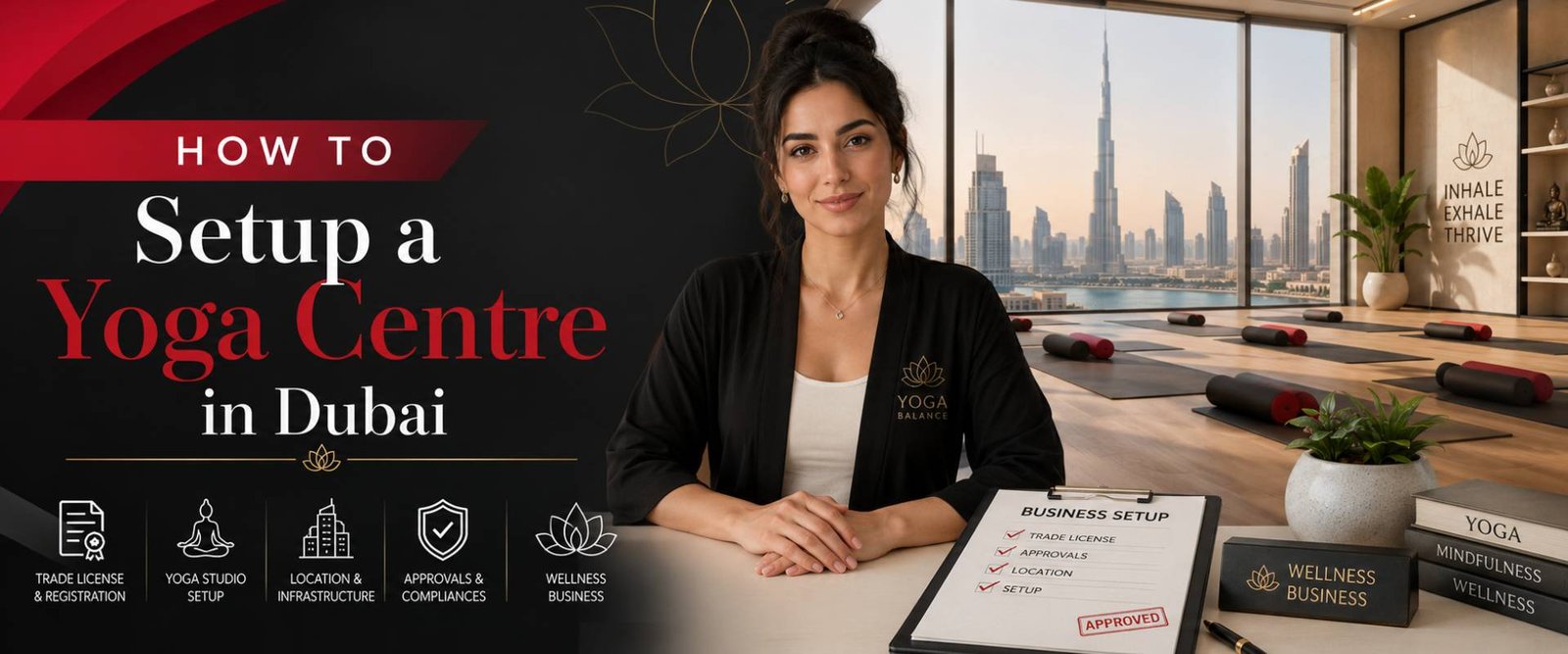
Opening a yoga centre in Dubai requires a DED trade license with the correct wellness activity code and, in most cases, a Dubai Municipality approval for the physical premises. Unlike medical facilities, yoga studios do not need a DHA clinical license unless they offer physiotherapy or medically supervised treatments. This guide covers license type, DM approval, costs from AED 25,000, location considerations, staff visa requirements, and the full registration process. |
Dubai’s wellness industry is booming. With over 3.6 million residents representing more than 200 nationalities, a government-driven health agenda, and a fitness culture that extends well beyond gym memberships, the demand for yoga studios, mindfulness centres, and holistic wellness spaces continues to outpace supply in most of the city’s established residential and commercial districts.
Setting up a yoga centre in Dubai is genuinely achievable for both UAE residents and foreign investors, but the licensing process is more specific than many entrepreneurs expect. A yoga business is classified as a sports and wellness commercial activity, and it sits in a regulatory space that is distinct from standard retail or professional services on one side, and clinical healthcare on the other. Get the activity code and approval route right from the start and the process is straightforward. Get it wrong and you face delays and additional costs.
This guide covers everything: the correct license type, Dubai Municipality approval process, staff visa requirements, location considerations, setup costs, and common mistakes to avoid. For a full overview of UAE business setup options, start at our UAE business setup.
Do You Need a Special License to Open a Yoga Studio in Dubai?
The answer is yes, but it is not a healthcare or clinical license. A yoga centre in Dubai operates under a commercial trade license issued by the Department of Economy and Tourism (DET), with a specific wellness or fitness activity code. This distinguishes it from a gym (different DED code), a physiotherapy clinic (DHA facility license required), or a spa (Dubai Tourism or municipality-specific approvals required).
The key regulatory principle for yoga studios:
- Pure yoga, Pilates, meditation, breathwork, and mindfulness sessions: DED trade license with wellness activity code only (no DHA license needed)
- Yoga centre that also offers physiotherapy, injury rehabilitation, or any manual therapeutic treatment: DHA allied health facility license required in addition to the DED license
- Yoga studio offering nutritional counselling and clinical dietary advice: Dubai Municipality food and nutrition department approval may be needed
- Yoga teacher certification courses and training academies: Knowledge and Human Development Authority (KHDA) approval required if issuing accredited certificates
| The most common mistake: Many yoga centre founders assume they need a DHA healthcare license because yoga has therapeutic benefits. Unless you employ licensed physiotherapists, dietitians, or other allied health professionals providing clinical treatment, your yoga studio does not require a DHA facility license. This distinction saves significant time and cost in the licensing process. |
Choosing Your Business Structure: Mainland vs Free Zone
Yoga studios in Dubai primarily serve walk-in and membership clients from the surrounding residential or commercial community. This means the question of mainland versus free zone has a clearer answer for yoga businesses than for many other service types.
Dubai Mainland (DED): The Standard Route
The vast majority of yoga centres in Dubai are registered on the mainland through the Department of Economy and Tourism. A mainland DED license gives your studio full access to the UAE market, the ability to sign commercial leases at any Dubai location, and the freedom to accept walk-in customers without restriction. Our detailed guide on mainland company formation in Dubai covers the DED registration process end to end.
Mainland advantages for a yoga studio:
- Unrestricted access to Dubai’s entire residential and commercial market
- No requirement to operate within free zone boundaries
- Can sign leases in any Dubai community: JBR, JLT, Downtown, Business Bay, DIFC, Jumeirah, Mirdif
- Access to Dubai municipality support programs for sports and wellness businesses
- Full visa issuance for staff based on studio size
Free Zone Route: When It Makes Sense
A yoga studio inside a free zone such as Dubai Healthcare City (DHCC) or a sports-specific zone can make commercial sense if your target market is the professionals working within that zone. DHCC in particular has a captive wellness market: thousands of healthcare professionals and staff who prefer on-campus wellness services. Outside of niche zone-specific scenarios, most yoga centre investors in Dubai choose the mainland route for maximum location flexibility. For comparison across all free zone options, see our business setup in Dubai free zone guide.
DED Activity Code and License Category for a Yoga Centre
Selecting the correct DED activity code is one of the most important decisions in the yoga studio setup process. The activity code determines your permitted services, your Dubai Municipality approval requirements, and your visa allocation formula.
The most relevant DED activity codes for yoga and wellness businesses:
- Sports and Fitness Centre (Code 7040301): The standard code for yoga studios, fitness centres, and wellness spaces offering physical exercise classes. This is the most commonly used code for pure yoga studios.
- Health and Fitness Clubs (Code 7040302): Used for larger facilities combining yoga with other fitness activities. Requires a minimum floor space and may trigger additional Dubai Municipality requirements for changing room and shower facilities.
- Yoga and Meditation Centre (Code 7040205): A more specific code for dedicated yoga, meditation, and mindfulness studios. Best for businesses that focus exclusively on yoga and related mind-body practices without gym-type equipment.
- Training and Education (Code 7040401): Required if your yoga centre will offer certified teacher training programmes. This code requires KHDA accreditation for courses that award recognised certifications.
| Activity code matters: Many yoga studio owners inadvertently apply for a broader sports club code when a more specific yoga code would have attracted lower licensing fees and simpler DM approval. Confirm the correct code with your setup consultant or DET directly before submitting your initial application, because changing activity codes after license issuance attracts amendment fees and delays. |
Dubai Municipality (DM) Approval for Yoga Studios
Beyond the DED trade license, yoga centres in Dubai require physical premises approval from the Dubai Municipality. This applies to any fitness or wellness facility that accepts paying clients into a physical space. DM approval ensures your studio meets minimum safety, hygiene, and space standards.
What Dubai Municipality Reviews
- Minimum floor area requirements: DM sets minimum studio space requirements for the activity code you hold
- Changing room and shower facilities: required for fitness and yoga centres above certain capacity thresholds
- Ventilation and air conditioning: minimum fresh air exchange rates for enclosed exercise spaces
- Emergency exits and fire safety compliance: coordinate with Dubai Civil Defence for fire safety certificate
- Toilet facilities: minimum ratio of toilets to anticipated maximum occupancy
- Reception and waiting area: required for registered fitness facilities
- Signage compliance: business name, license number, and operating hours must be displayed
DM Inspection Process
- Submit DM fitness facility application after receiving DED initial approval
- DM reviews submitted floor plan and facility specifications
- Complete the fit-out according to DM-approved specifications
- DM inspector visits the premises to verify compliance with submitted plans
- DM issues facility approval certificate upon passing inspection
- Submit DM certificate to DED to complete the final trade license
A failed DM inspection typically results in a remediation list. Common reasons for failure include insufficient changing room space, inadequate ventilation specification, or a studio floor area below the minimum for your declared class capacity. Engaging a fit-out contractor familiar with DM requirements for wellness facilities significantly reduces the risk of a failed inspection and associated delays.
Dubai Yoga Centre Setup Cost: Full AED Breakdown
Yoga studio setup costs in Dubai vary enormously based on your location, premises size, and the quality of the fit-out. Below are realistic estimates for three common setup scenarios.
| Cost Component | Boutique Studio (Small) | Mid-Size Studio | Premium Wellness Centre |
| DED Trade License (annual) | AED 8,000 – 12,000 | AED 10,000 – 18,000 | AED 15,000 – 25,000 |
| DM Approval Fee | AED 1,500 – 3,000 | AED 2,000 – 4,000 | AED 3,000 – 6,000 |
| Studio Fit-Out | AED 40,000 – 100,000 | AED 100,000 – 250,000 | AED 250,000 – 600,000+ |
| Yoga Equipment and Props | AED 10,000 – 25,000 | AED 25,000 – 60,000 | AED 60,000 – 150,000+ |
| Sound System and AV | AED 5,000 – 15,000 | AED 15,000 – 35,000 | AED 35,000 – 80,000+ |
| Annual Rent (varies hugely by area) | AED 60,000 – 120,000 | AED 120,000 – 300,000 | AED 300,000 – 700,000+ |
| Staff Visa (per person) | AED 3,500 – 5,000 | AED 3,500 – 5,000 | AED 3,500 – 5,000 |
| Insurance (annual) | AED 4,000 – 8,000 | AED 6,000 – 12,000 | AED 12,000 – 25,000+ |
| Total First Year Estimate | AED 140,000 – 300,000 | AED 300,000 – 700,000 | AED 700,000 – 1,600,000+ |
| Biggest cost variable: Rent is the single largest cost driver and varies more than any other item. A 150 sqm studio in Jumeirah or Jumeirah Beach Residence (JBR) costs two to three times more than an equivalent space in Mirdif, Al Quoz, or Barsha. Before signing a lease, validate the rental rate against DM minimum space requirements for your declared class capacity to ensure you are not paying for space that exceeds what your licensing requires. |
Best Locations for a Yoga Studio in Dubai
Location is the most important strategic decision for a yoga centre’s commercial success. Dubai’s demographics and geographic spread mean that different areas serve very different customer profiles.
| Location | Target Customer Profile | Average Studio Rent | Key Consideration |
| JBR and Dubai Marina | Expat professionals, fitness-conscious, high spend | AED 180,000 – 400,000/yr | Highest competition; premium positioning essential |
| Jumeirah and Umm Suqeim | Established families, wellness-focused mothers, quality-seeking | AED 120,000 – 250,000/yr | Strong community loyalty if positioned well |
| Business Bay and Downtown | Corporate clients, lunch-hour and post-work sessions | AED 150,000 – 350,000/yr | Corporate packages and B2B memberships key to model |
| DIFC | High-income professionals, financial sector | AED 200,000 – 500,000/yr | Premium pricing required; high spend per head |
| Mirdif and Arabian Ranches | Suburban families, less fitness saturation | AED 80,000 – 160,000/yr | Community studio model; loyalty-based membership |
| Al Quoz and Motor City | Fitness-specific destination seekers, price-conscious | AED 60,000 – 130,000/yr | Lower cost base; good for specialist or hot yoga |
| JLT (Jumeirah Lake Towers) | Mixed professional community, strong lunchtime demand | AED 100,000 – 200,000/yr | Large captive JLT resident and office population |
The most sustainable yoga studio models in Dubai are typically built around a specific community rather than a generic city-wide appeal. A studio that becomes the neighbourhood yoga destination for a particular residential cluster can achieve 70 to 80 percent class capacity within six months. A studio trying to draw customers from across the city needs a significantly stronger brand and marketing investment to justify the footfall cost.
Staff Requirements: Yoga Instructors and Visa Sponsorship
Your instructors are your product. In the UAE, all yoga teachers working at your studio on a regular basis must be legally employed or contracted by your UAE-licensed entity. You cannot pay international yoga teachers cash-in-hand or on tourist visas without risking significant fines for both the studio and the individual.
Instructor Qualifications
Dubai does not require yoga instructors to hold a specific DM or government-recognised yoga certification. However, DM does review instructor qualifications during periodic inspections of fitness facilities as part of its general oversight. The industry standard in Dubai’s competitive wellness market is:
- Minimum 200-hour Yoga Alliance recognised teacher training certification for entry-level instructors
- 300-hour or 500-hour certification preferred for lead instructors and studio directors
- Specialist certifications for specific modalities: prenatal yoga, hot yoga, aerial yoga, children’s yoga
- First aid and CPR certification is strongly recommended and may be required by your liability insurance policy
Visa Options for Yoga Instructors
- Employment visa: Standard route for full-time instructors employed by your studio. Salary must meet the minimum wage requirements for employment visa eligibility. Process takes two to four weeks after license is active.
- Freelance visa: Some yoga instructors in Dubai hold independent freelance permits (via IFZA, DMCC, or other free zones) and work across multiple studios as independent contractors. Your studio can engage these individuals as service providers rather than employees.
- Part-time arrangement: UAE labor law allows part-time employment contracts. For studios using predominantly part-time instructors, this structure reduces your visa and benefits overhead versus full-time contracts.
Your visa quota is determined by your studio premises size. DED allocates employment visas based on the Ejari-registered floor area: typically one visa per nine square metres of office or commercial space. Ensure your lease and fit-out plan support the number of staff you need to operate effectively. For guidance on PRO services and visa processing, see our PRO services Dubai UAE page.
Insurance Requirements for a Dubai Yoga Studio
Running a physical yoga studio without proper insurance in Dubai is a serious risk, both financially and legally. Several insurance types are relevant.
- Public liability insurance: Covers injuries to clients or visitors on your premises. Essential for any physical fitness facility. Most commercial property landlords require proof of public liability cover before handing over keys.
- Professional indemnity insurance: Covers claims arising from instruction that leads to client injury. Particularly important for studios offering hot yoga, aerial yoga, or therapeutic yoga with injury-rehabilitation positioning.
- Property and contents insurance: Covers your studio fit-out, equipment, and contents against fire, water damage, and theft.
- Employee and employer liability: Covers your legal obligations as an employer if a staff member is injured on the job.
- Business interruption insurance: Covers lost revenue if your studio is forced to close temporarily due to fire, flood, or other insured events. More relevant for studios with significant lease commitments and low cash reserves.
Work with a UAE-based commercial insurance broker to build a combined package. Standalone policies from different insurers are typically more expensive than a combined commercial wellness facility policy. Ensure your policy is renewed before the DED license renewal as DM may request insurance certificates during periodic compliance reviews.
Step-by-Step: How to Open a Yoga Centre in Dubai
- Define your studio concept, target market, and financial model: class-based, membership, hybrid, or teacher training academy
- Identify your target location and shortlist two to three possible premises to compare before committing
- Confirm your DED activity code with a business setup consultant: yoga and meditation centre versus sports and fitness centre versus training and education
- Reserve your company trade name and submit DED initial activity approval
- Sign your commercial lease and register Ejari with the Dubai Land Department
- Commission fit-out according to Dubai Municipality space standards for your activity code and capacity
- Submit Dubai Municipality fitness facility approval application with floor plan
- Obtain Dubai Civil Defence fire safety certificate for the fitted-out premises
- DM conducts site inspection: pass and receive DM facility approval certificate
- Submit DM approval certificate to DED and complete the trade license
- Apply for investor visa (for owner) and employment visas for instructors and staff
- Obtain public liability and professional indemnity insurance
- Open UAE corporate bank account
- Set up your booking system, payment processing, and launch
| Timeline: Steps 1 to 11 typically take eight to fourteen weeks for a well-managed setup. The longest stage is usually the fit-out and DM inspection sequence (four to eight weeks). If your initial DM inspection requires remediation, add two to four weeks. Plan your soft opening date around the DM inspection outcome, not the DED license issue date. |
Frequently Asked Questions
Do I need a DHA license to open a yoga centre in Dubai?
No. A yoga studio, Pilates studio, or meditation centre in Dubai does not require a Dubai Health Authority (DHA) facility license, provided it offers only yoga instruction, fitness classes, and wellness programming without any clinical healthcare services. The DHA license is triggered when you employ licensed physiotherapists, dietitians, or other allied health professionals delivering clinical treatment. A yoga centre that stays within non-clinical wellness services needs only a DED trade license and Dubai Municipality facility approval.
Can a foreign national own 100% of a yoga studio in Dubai?
Yes. Fitness and wellness businesses including yoga centres are among the commercial activities permitted for 100% foreign ownership on Dubai mainland following the 2021 UAE FDI reforms. You do not need a UAE national partner or local service agent to open a yoga studio on the mainland. In free zones, 100% foreign ownership has always been permitted. Confirm the current status of your specific activity code with your setup consultant, as the approved activities list is updated periodically. Our mainland company formation guide covers the ownership rules in detail.
What is the minimum size required for a yoga studio in Dubai?
Dubai Municipality sets minimum floor area requirements for fitness facilities, and the specific minimum depends on your declared class capacity. As a general benchmark, a yoga studio should allow a minimum of 4 to 5 square metres per mat for a comfortable practice space, plus additional area for changing rooms, reception, and common areas. For a class of 15 students, a minimum studio floor area of approximately 80 to 100 square metres of practice space is typically required, with additional space for support facilities. DM will review your floor plan against your declared maximum class size during the approval process.
Can I hire international yoga teachers on a tourist visa while setting up?
No. International yoga instructors working at your Dubai studio must be on a valid UAE work or residency visa, not a tourist visa. Working on a tourist visa is a violation of UAE labour law and carries significant penalties for both the studio and the individual. If you need instructors operational before your employment visa process is complete, engage DHA-licensed or free-zone-permitted freelance yoga instructors who already hold valid UAE work authorisation and can legally be engaged as independent contractors.
Do I need KHDA approval for yoga teacher training?
Yes, if your training programme leads to a recognised qualification or certification that students will use professionally. The Knowledge and Human Development Authority (KHDA) regulates educational and training institutions in Dubai. If your yoga centre runs teacher training courses and awards certificates (particularly if you are Yoga Alliance registered or claim alignment with an internationally recognised training body), KHDA registration is required. If you run informal workshops and retreats that do not lead to any professional certification, KHDA registration is generally not required, but confirm with DED at the time of your activity code selection.
What kind of insurance does a yoga studio need in Dubai?
At minimum, a Dubai yoga studio should carry public liability insurance (covering client injuries on your premises), professional indemnity insurance (covering instruction-related injury claims), and property and contents insurance. Many commercial landlords require proof of public liability insurance before lease commencement. For studios offering specialist modalities such as aerial yoga, hot yoga, or prenatal yoga, higher indemnity limits are advisable given the elevated physical risk profile. Work with a UAE commercial insurance broker to build a combined package rather than purchasing individual policies separately.
How much does it cost to open a small yoga studio in Dubai?
A realistic first-year budget for a boutique yoga studio in a non-premium Dubai location (Al Quoz, Mirdif, Motor City, or Barsha) starts at approximately AED 140,000 to AED 300,000 including DED license, Dubai Municipality approval, basic fit-out, yoga equipment, initial rent, and one to two staff visas. Premium locations (JBR, Downtown, DIFC) and larger studios require AED 500,000 and above for the first year. For a personalised cost estimate based on your specific location and concept, contact a DIAC consultant at diac.ae.
Can I run yoga classes from home or outdoors in Dubai without a license?
Running commercial yoga classes from your private residence or outdoors in public spaces in Dubai without a valid trade license is technically a violation of UAE commercial law, regardless of the number of participants or whether fees are charged. However, the enforcement approach differs. For informal community or social gatherings that do not involve commercial fee collection, the practical risk is low. For any business where you regularly charge participants, collect membership fees, or market your services commercially, a trade license is required. The cost and complexity of a proper yoga studio license can make shared-space models such as renting time in an existing licensed studio commercially viable for early-stage yoga instructors.
| Ready to Open Your Yoga Centre in Dubai?
DIAC’s business setup consultants manage the complete yoga studio licensing process in Dubai: DED activity code selection, trade license application, Dubai Municipality approval coordination, fit-out guidance, staff visa processing, and PRO services. We have helped wellness entrepreneurs, fitness professionals, and international yoga brands establish their Dubai presence. Book a free consultation at diac.ae and speak to a consultant who understands the Dubai wellness industry setup process. |
About the Author
Adil Ahmad is a senior business setup consultant at DIAC specialising in wellness and fitness business formation in Dubai, including yoga studios, Pilates centres, wellness clinics, and sports facilities. He advises investors and practitioners on DED activity codes, Dubai Municipality approval processes, location strategy, and the end-to-end setup journey for wellness businesses in the UAE.